

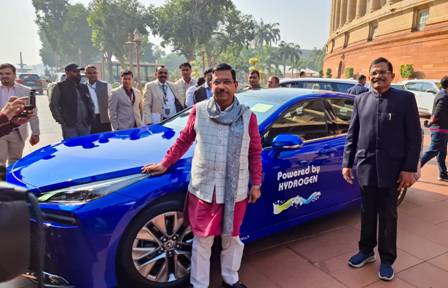
With this, India has begun a two‑year testing programme that is expected to generate critical insights for scaling up hydrogen mobility nationwide.
Union Minister for New and Renewable Energy, Pralhad Venkatesh Joshi, literally took to the driver’s seat while launching field trials for the use of hydrogen in India’s $250‑billion automobile sector. Joshi drove Toyota’s Mirai hydrogen fuel cell electric vehicle (FCEV) from his ministry’s headquarters at Atal Akshay Urja Bhawan to attend the winter session of Parliament, about 11 km away.
Earlier, Toyota Kirloskar Motor handed over the car to the National Institute for Solar Energy (NISE) for an extensive assessment on India’s diverse road conditions, including heat, dust, traffic congestion and varied terrain. Equipped with three tanks, the car has a range of around 500 km.
Calling the introduction of Toyota’s Mirai FCEV a new chapter in sustainable mobility, Joshi said, “The name Mirai translates to ‘future’ in Japanese. It also symbolises India’s aspiration for a clean, green and sustainable mobility ecosystem.”
“Hydrogen fuel cell vehicles are clean, silent and emission‑free, emitting only water, and fuel cell technologies are increasingly powering cars, buses, trucks, trains, ships and stationary power systems worldwide.”
He added that by personally driving the hydrogen vehicle, he wished to send a clear message that hydrogen mobility is ready and well‑suited for Indian conditions. He commended Toyota Kirloskar Motor for its commitment to carbon neutrality and appreciated NISE for its leadership in advancing India’s clean energy ambitions.
“With this vehicle, we are launching not just an MoU but confidence, cooperation and commitment to a clean and sustainable future,” Joshi said.
Yesso Naik, Minister of State for New and Renewable Energy, said the initiative marks a significant step towards India’s clean, green and self‑reliant energy future.
“The pilot project will contribute to the wider adoption of hydrogen‑based clean transportation, improved air quality and sustainable development across the country.”
Vikram Gulati, Country Head and Executive Vice President, Corporate Affairs and Governance, Toyota Kirloskar Motor, stated, “We believe hydrogen fuel‑cell technology, alongside other sustainable technologies, will play a pivotal role in helping India achieve its net‑zero commitments and energy‑independence objectives.”
The two‑year testing period is expected to generate critical insights to scale up hydrogen mobility nationwide. Under the $2.4‑billion National Green Hydrogen Mission, India has targeted the production of 5 million metric tonnes of green hydrogen by 2030.