

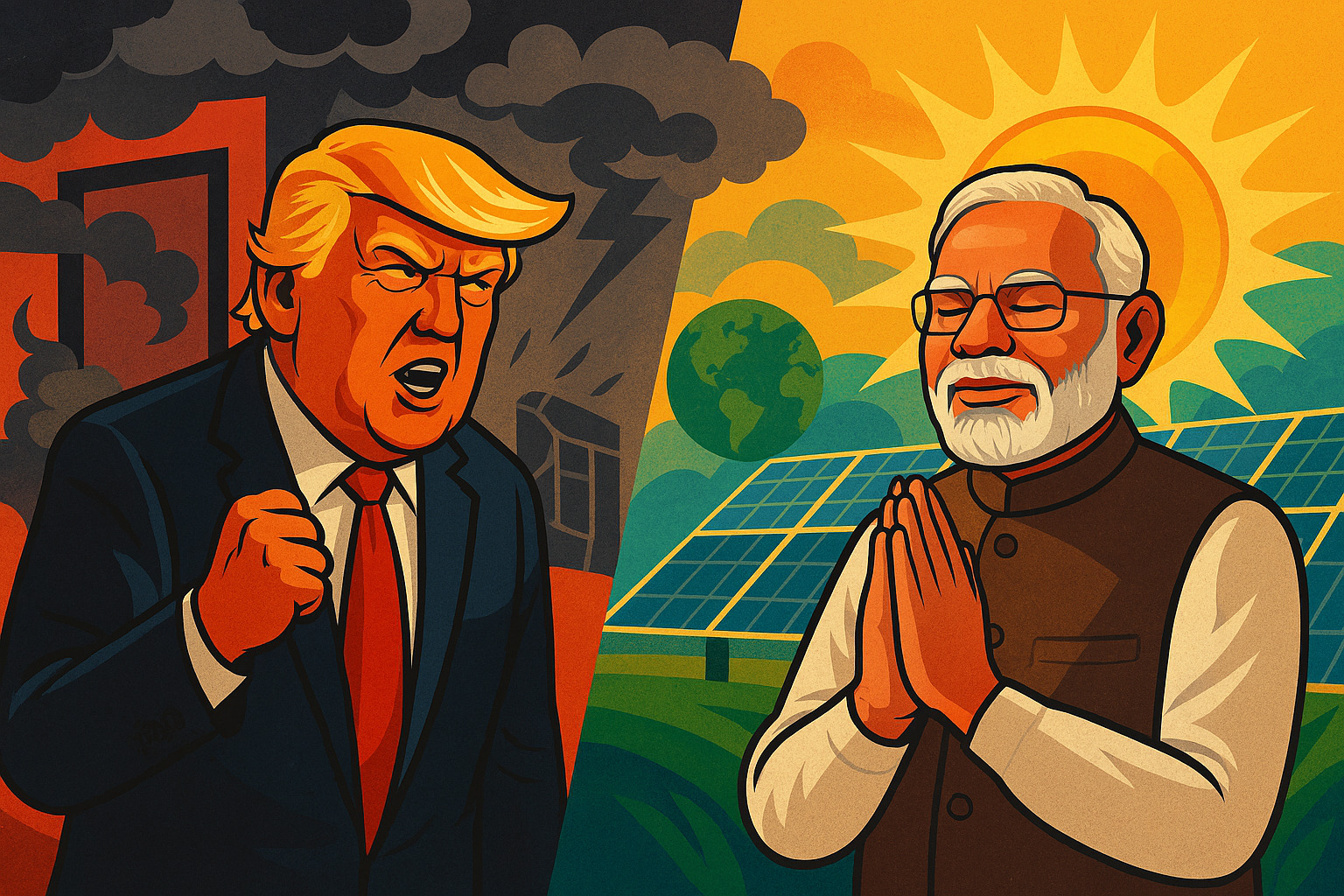
The US, a late entrant to ISA in 2021, remained a symbolic member with a minimal role in funding, projects, policy, and geopolitics.
Following the US withdrawal from the International Solar Alliance (ISA) on Thursday, an unfazed India has said that the body will continue working on its stated objective of scaling up solar energy in 125 member countries for universal energy access.
“ISA will continue to work with member countries, particularly least developed countries and small island developing states, in the development and deployment of solar energy, mobilising finance, building capacity, and reducing risk perceptions,” government sources told Infrastructure Today within hours of the US pullout.
US President Donald Trump announced this as part of a wider withdrawal from 66 international organisations, marking a sharp shift away from multilateral climate and renewable energy cooperation. The Trump administration has termed ISA and other multilateral bodies as “wasteful, ineffective, and harmful.”
Some experts note that the world’s largest energy consumer exit may weaken global solar energy collaboration and reduce momentum for climate partnerships. It must, however, be pointed out that the US was a late joiner (2021) to the ISA, with its presence largely symbolic. Its contribution to funding, projects, policy engagement, and geopolitical positioning was negligible.
“We have seen the memorandum issued by the US Government on January 7, 2026, on its intent to withdraw from several international organisations, including ISA,” the sources added. “We will continue to work with ISA and support solar adoption and energy transition goals.”
Co‑founded by India and France in 2015, ISA’s objective is to promote solar energy adoption worldwide, especially in sun‑rich countries between the Tropics of Cancer and Capricorn. Since its inception, the alliance has made significant progress in advancing its mandate, with solar energy increasingly complemented by energy storage.
ISA programmes are operational in over 95 countries, supporting national pipelines, regulatory frameworks, and market creation. The alliance has successfully showcased the feasibility and effectiveness of solar solutions while promoting their implementation across diverse regions through demonstration projects.
At its 8th Assembly in October in New Delhi, ISA launched the Africa Solar Facility, a $200 million programme to support distributed renewable energy projects.
The US withdrawal is expected to result in India further consolidating linkages with member states in Europe, Africa, and the Asia‑Pacific to keep ISA’s agenda on track.
– Manish Pant