

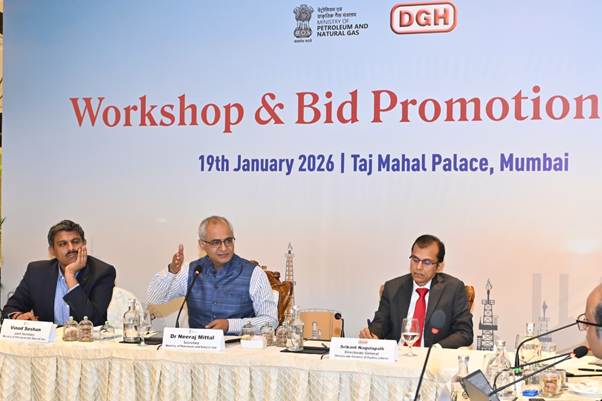
A recent day‑long meeting in Mumbai brought together diverse stakeholders to deliberate on the upstream reform agenda and investment opportunities in India.
The growing interest in the upstream segment of India’s oil and gas industry was evident in the strong participation at a series of engagements organised by the Ministry of Petroleum and Natural Gas (MoPNG) in Mumbai on January 19. The day‑long programme brought together domestic and international upstream operators, exploration and production (E&P) service providers, global consulting firms, leading public and private sector financial institutions, insurers, academia, and industry experts to deliberate on the upstream reform agenda and investment opportunities in the country.
In his virtual address, Union Minister for Petroleum and Natural Gas, Hardeep Singh Puri, highlighted how recent legislative, regulatory and policy reforms mark a landmark transformation of India’s upstream sector. “These reforms, coupled with data‑led exploration initiatives, have unlocked extensive investment opportunities, particularly in India’s offshore and frontier areas,” he said.
He reaffirmed the Government’s commitment to providing a stable, transparent and globally competitive framework to attract sustained domestic and international investment.
The workshop on ‘Financing India’s E&P Growth’ examined the readiness of India’s financing ecosystem to support the scale and continuity of upstream investment envisaged under the Government’s expanded programme, including initiatives such as Samudra Manthan. Global consulting firms, including S&P Global, Deloitte, AT Kearney and EY shared perspectives on international financing models, risk allocation and capital mobilisation. Financial institutions and insurers such as the State Bank of India, New India Assurance and Bajaj Allianz discussed risk assessment frameworks, exposure considerations, bank guarantee structures and emerging instruments like insurance‑backed surety bonds.
It was emphasised that as exploration and development activities expand, capital requirements will rise sharply and become increasingly front‑loaded, necessitating financing structures aligned with upstream risk profiles and investment cycles. Neeraj Mittal, Secretary, MoPNG, underlined that timely and adequate availability of capital will be a critical determinant of execution, calling for sustained engagement between policymakers, operators and financiers to strengthen frameworks in line with India’s upstream ambitions.
Reform Agenda
A dedicated session familiarised operators with the amended Oilfields (Regulation and Development) Act, the revised Petroleum and Natural Gas Rules, and the updated Model Revenue Sharing Contract (MRSC). Officials highlighted that these reforms complete a decade‑long effort to establish a stable, predictable and investor‑aligned regulatory framework, aimed at reducing ambiguities and supporting long‑term planning. The Directorate General of Hydrocarbons (DGH) explained how the updated MRSC operationalises legislative and regulatory changes, ensuring coherence between policy intent and contractual implementation. Mittal noted the constructive response from industry participants and stressed that effective implementation at scale will be key to translating policy certainty into tangible outcomes.
The bid promotion event showcased opportunities emerging from reforms and data‑driven exploration initiatives, encouraging wider domestic and global participation. Srikant Nagulapalli, Director General of Hydrocarbons, presented details of forthcoming bid rounds. These include OALP Bid Round X with 25 exploration blocks covering 182,589 sq. km, 91 per cent of which are offshore; DSF Bid Round IV with nine contract areas comprising 55 discoveries and approximately 200 MMTOE of 2P reserves; and CBM Bid Rounds 2025-26 with 16 blocks, including 74 BCM of prognosticated gas in 2025 and 200 BCM in 2026.
The University of Houston shared insights on the hydrocarbon prospectivity of India’s East Coast basins, while Schlumberger demonstrated how advanced subsurface imaging, data analytics and integrated digital workflows can enhance prospectivity understanding in frontier and underexplored basins. The sessions outlined India’s strategic investment case, including a yet‑to‑find resource potential of 3.9 billion tonnes of oil equivalent, a large and growing domestic market with full marketing and pricing freedom, a relatively low regulatory burden under revenue‑sharing contracts, access to high‑quality E&P data through the National Data Repository, and a strong policy focus on enhancing domestic production and energy security.