

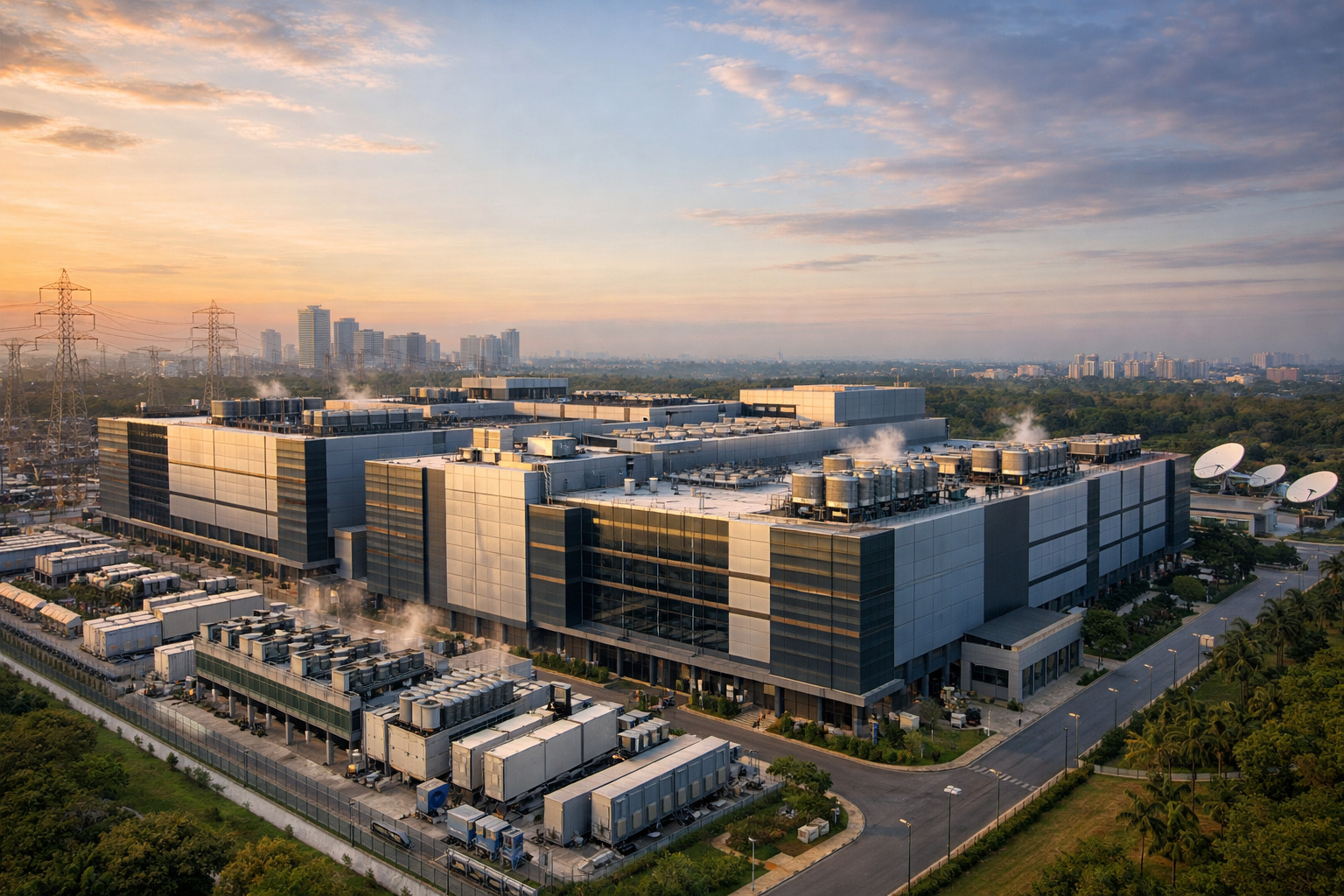
India’s data centre growth is being fuelled by rising internet and telecom subscriptions, expanding enterprise cloud adoption, accelerating AI and high‑performance computing workloads, and shifting consumer preferences.
India’s data centre market, valued at around $10 billion in 2025, is projected to more than double to $22 billion by 2030, according to global real estate advisory Vestian’s latest report.
India’s strong growth trajectory and rising investor confidence stem from its emergence as a strategic hub within the Asia‑Pacific region. The country’s accelerating digital economy, expanding internet user base, and increasing investments from hyperscale operators are positioning it as a key destination for data infrastructure development.
This rapid growth is driven by rising internet and telecom subscribers, increasing enterprise cloud adoption, expanding AI and high‑performance computing workloads, and shifting consumer preferences towards digital payments and over-the-top (OTT) platforms. The rollout of 5G infrastructure has pushed average monthly wireless data consumption beyond 25 GB per user, reinforcing the need for scalable data centre capacity.
Shrinivas Rao, CEO, Vestian, said, “India’s data centre sector is rapidly transforming on the back of strong policy support and rising digital demand. Despite a limited share of global capacity, India has huge upside potential to lead in AI infrastructure. With single‑window clearances, 20‑year tax exemptions, GST benefits, and incentives extending to 2047, India is strategically positioned to emerge as a global data centre and AI hub.”
Globally, the data centre market is expanding rapidly, with 40-50 GW of current installed capacity worldwide and projections exceeding 100 GW by 2030, driven by cloud computing, artificial intelligence, and data‑intensive technologies.
Investment Pipeline Strength
India’s data centre industry has attracted significant investments from global and domestic players. Between 2020-24, the sector drew approximately $13-15 billion, with foreign institutional investors accounting for nearly 80 per cent of inflows. The pipeline remains strong, with announced projects totalling $60-70 billion over the next five years, largely driven by hyperscale platforms and joint ventures.
India also offers a competitive cost advantage, with construction costs of $6-7 million per MW, significantly lower than mature APAC markets such as Singapore and Japan, enhancing its attractiveness for large‑scale investments.
New Hubs Emerging
Data centre infrastructure in India remains concentrated in a few key metropolitan markets. Mumbai is the largest hub, driven by global connectivity and infrastructure advantages, while Chennai serves as a critical global gateway with multiple submarine cable landings. Hyderabad, Bengaluru, and Pune are emerging as secondary hubs, supported by robust IT ecosystems, land availability, and competitive operating costs.
Operators are also exploring Tier‑II cities to support distributed infrastructure. Ahmedabad, Kochi, Jaipur, and Visakhapatnam are gaining traction due to competitive land availability, improving digital infrastructure, supportive state policies, and growing enterprise demand. Operational capacity in Tier‑II markets is currently estimated at 60-80 MW, expected to exceed 100 MW by 2026.
India’s data centre market is set for sustained expansion, with installed capacity projected to reach 1.7-2.0 GW by 2026, backed by nearly $30 billion in investments, and further rising to 4-5 GW by 2030. Rising AI adoption, demand for cloud infrastructure, and rapid growth of digital platforms will drive the next wave of growth.