

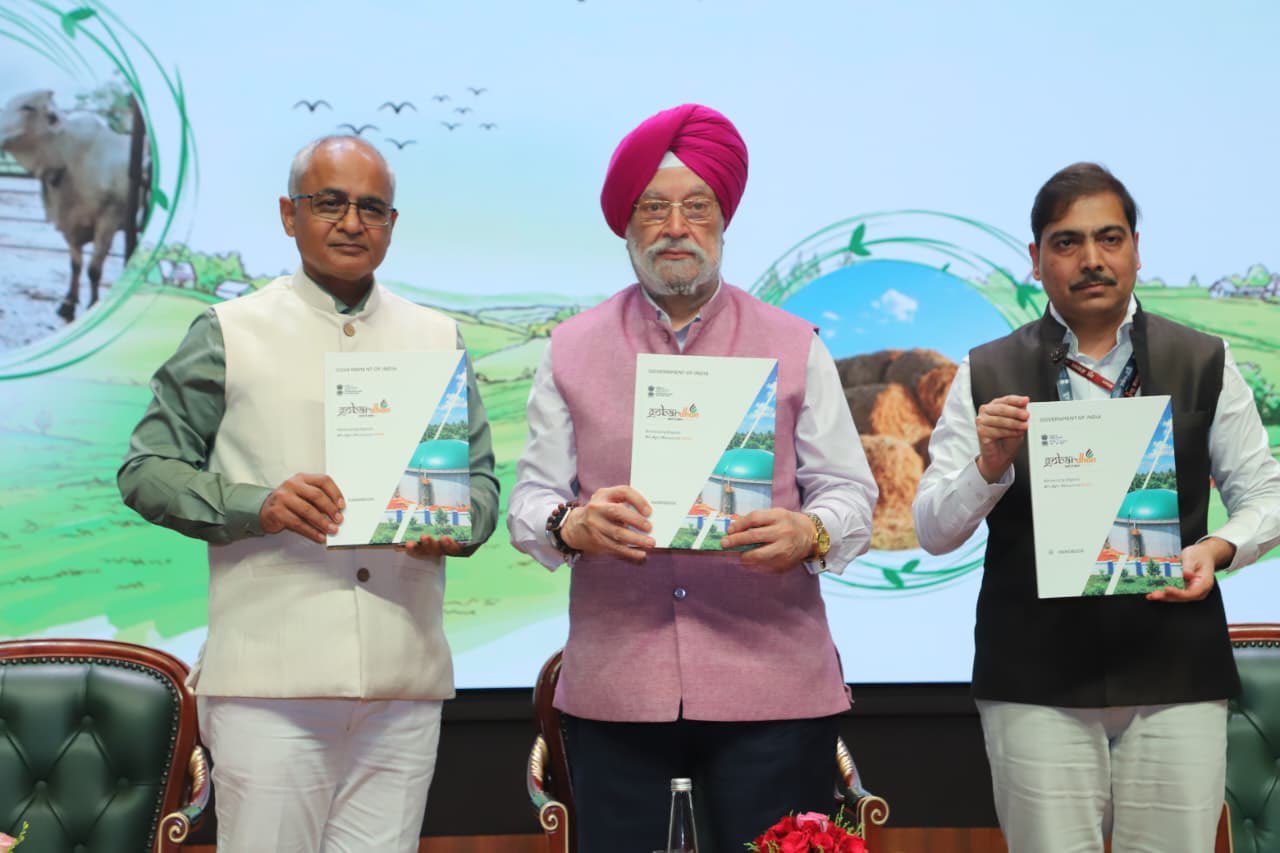
The new integrated central sector scheme offers assured offtake, predictable pricing, capital support, pipeline connectivity, credit guarantees and ecosystem development.
Union Petroleum Minister Hardeep Singh Puri on Thursday launched GOBARdhan, a ₹1.24 trillion ($28 billion) scheme to accelerate compressed biogas (CBG) production, aiming to reduce reliance on imported natural gas and strengthen rural incomes.
“India’s growing energy requirements must be addressed through the combined objectives of availability, affordability and sustainability, with greater development of energy resources available within the country,” Puri said at the launch event organised by the energy policy think‑tank Centre for High Technology (CHT) under the Ministry of Petroleum & Natural Gas.
He added, “CBG has particular relevance for India as it can convert crop residue, cattle dung and other organic resources into clean domestic energy, while generating organic manure and creating new economic opportunities in rural areas.”
India has committed to increasing the share of natural gas in its primary energy mix from about 6-7 per cent today to 15 per cent by 2030, supported by pipeline expansion, growth in city gas distribution (CGD), additions to liquefied natural gas (LNG) terminal capacity, and CBG initiatives.
India’s natural gas import bill for April-November 2025 was about $9.2 billion, down 11.5 per cent from $10.4 billion in the same period of FY2024‑25, according to the Petroleum Planning & Analysis Cell (PPAC). India remains the world’s fourth‑largest LNG importer, accounting for around 7 per cent of global LNG imports.
The GOBARdhan scheme and other biogas initiatives are positioned to reduce this import bill further by substituting fossil LNG with domestic compressed biogas.
Unified Biogas Strategy
Under the GOBARdhan framework, CBG plants will be mapped to CGD areas. Procurement obligations have been set at 3 per cent in FY2026‑27, 4 per cent in FY2027‑28 and 5 per cent from FY2028‑29 onwards for compressed natural gas (CNG) used in transport and piped natural gas (PNG) supplied to households.
Neeraj Mittal, Secretary at the Ministry, said, “India currently meets nearly half of its natural gas requirement through imports. CBG provides an opportunity to convert organic waste into a gas resource.”
Mittal acknowledged constraints such as volatile revenues, fragmented support, limited policy visibility, feedstock assurance, organic manure offtake and access to finance. “GOBARdhan addresses these issues through the Ministry of Petroleum & Natural Gas as the single nodal Ministry, predictable pricing, greater certainty of gas offtake, enhanced capital assistance, consolidated processes and greater use of digital monitoring.”
The scheme introduces an administered CBG price of ₹2,110 per MMBtu, with capital assistance of up to ₹20 million per tonne per day of installed capacity. Pipeline support covers up to 80 per cent of eligible costs for cluster connections and 50 per cent for standalone plants. A credit guarantee mechanism will back SME projects, covering up to 85 per cent of defaults, capped at ₹200 million per project and ₹250 million for women‑led ventures.
India has already commissioned 217 CBG plants with 1,700 tonnes per day capacity. The scheme is expected to save more than ₹400 billion in foreign exchange, add ₹750 billion to GDP, generate 150,000 jobs, replace 10 million tonnes (MT) of fossil fuel and cut 40 MT of carbon dioxide emissions.
– Manish Pant