

As the leading Maharatna non-banking financial company (NBFC), REC Ltd is harnessing the potential of AI and Big Data to unlock a new era of enhanced efficiency and service excellence.
Artificial intelligence (AI) and machine learning (ML)—the imitation by computers and robots of the intelligence inherent in humans for planning, decision-making, improved communication and processing large amounts of data—is significantly changing industries across the world.
The energy landscape itself is no longer a static environment. It’s an ecosystem in constant flux, driven by advancements in technology and evolving societal needs. Standing at the forefront of this dynamic sector, REC Ltd is proactively integrating cutting-edge technologies, such as AI, blockchain, and big data analytics, to enhance internal operations, while also leading the integration of AI/ML across India’s power distribution sector.
Strategic Investments
REC’s strategic investment and growth are driven by its deep commitment to aligning its funding with the nation’s broader development goals. Driven by its Maharatna status, REC is aggressively targeting a massive expansion of its total loan book from the current ₹5.82 trillion to a landmark ₹10 trillion by FY2030. A central component of this future-focused growth is strategic diversification. The government has authorised REC to lend up to one-third of its annual sanctions to vital non-power infrastructure, including metro rail, expressways, airports, and social facilities like hospitals.
REC is also prioritising renewable energy (RE) financing to align with India’s 500 GW RE capacity goal by 2030. REC aims to be a leader in this transition, targeting a loan outstanding of ₹3 trillion (30 per cent of its business) by 2030, a significant increase from the current ₹680.33 billion. This includes financing solar, wind, hydro, pumped storage, and new technologies like green hydrogen and ammonia.
The pace of this comprehensive expansion is further accelerated by the deep integration of cutting-edge technology across all operations.
ESG Leadership
REC has cemented its commitment to sustainability by achieving the top-rank in the latest NSE ESG Ratings. This outstanding performance is a direct result of a comprehensive three-year strategy initiated with the company’s first-ever ESG Policy, guided by the REC board of directors.
Key drivers of this success include strategic planning, benchmarking against global standards like Climate Disclosure Project (CDP), S&P CSA, and developing a clear net-zero pathway. Operationally, REC has demonstrated excellence by achieving 100 per cent green power and zero discharge for its corporate office, which has also earned a GRIHA 5 rating, alongside major electric vehicle (EV) fleet conversions and enhanced human resource policies covering human rights and ethics. The company has also significantly bolstered transparency through enhanced disclosures in its Business Responsibility and Sustainability Report (BRSR) and by publishing the second Global Reporting Initiative (GRI)-referenced ESG report.
Looking ahead, REC is further ensuring its sustained ESG leadership by leveraging data analytics and AI to optimise resource management, enhance risk assessment, and drive smarter, more sustainable decision-making across all operations.
Smart Grid Push
A core component of the power sector’s digital transformation is the deployment of smart meters under the Revamped Distribution Sector Scheme (RDSS). REC and PFC Ltd are the nodal agencies for facilitating the implementation of the scheme.
More than 40 million smart meters have been deployed across India. These devices provide real-time energy usage data to consumers for better budgeting and to distribution utilities for crucial energy accounting and audits. The shift to prepaid smart meters also improves utility cash flow and billing efficiency.
Grid modernisation also includes sanctioning Supervisory Control and Data Acquisition/Distribution Management System (SCADA/DMS) systems under RDSS for remote monitoring and control, significantly reducing outages and improving fault response times. This digitalisation is key to seamlessly integrating renewable energy sources into the distribution network, facilitating India’s clean energy transition.
AI for Distribution
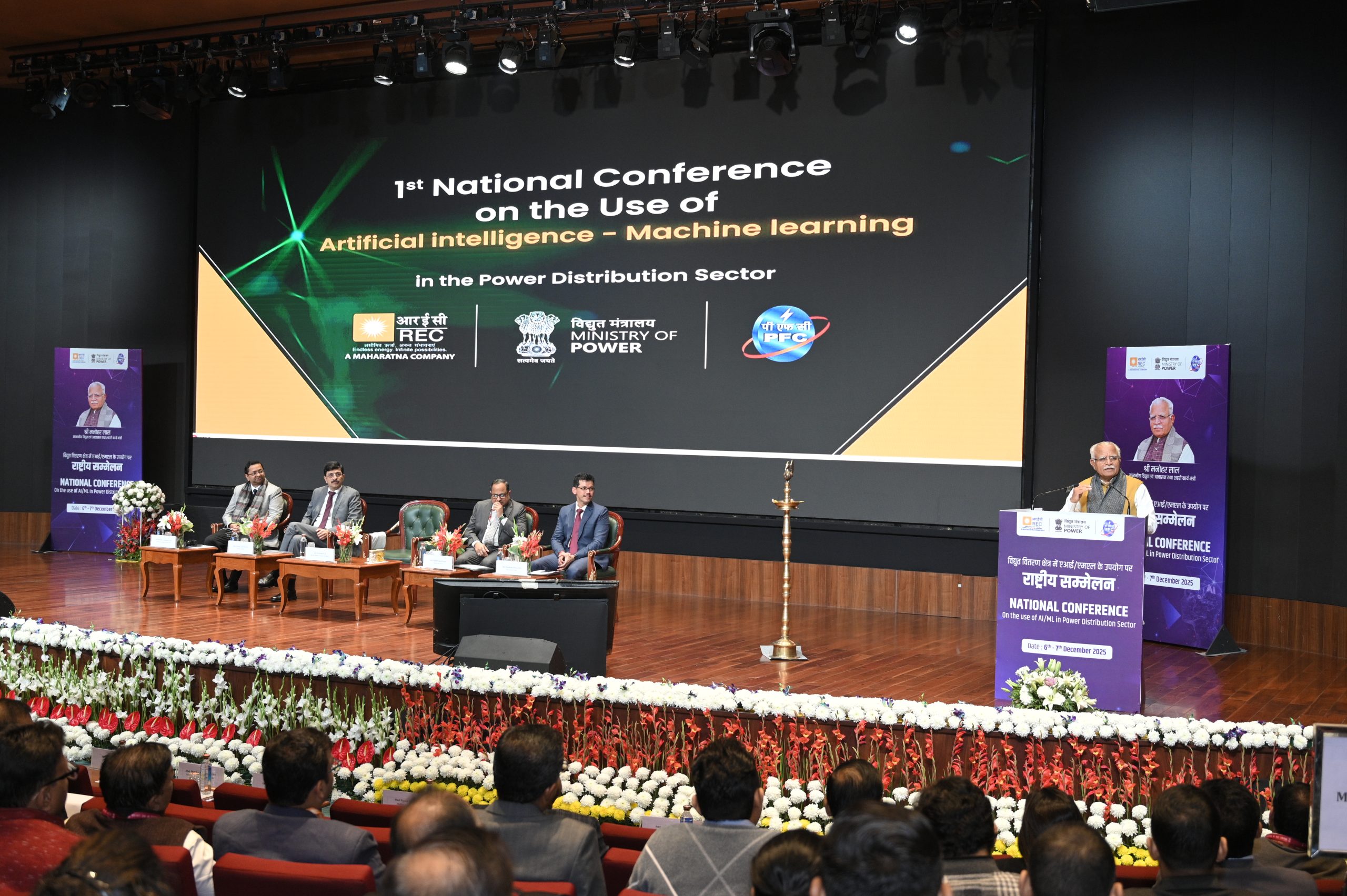
Further advancing the application of data-driven intelligence tools within the power sector, REC, under the aegis of the Ministry of Power and in association with PFC Ltd, conducted a two-day national conference on the use of AI/ML in the power distribution sector under the revamped RDSS on December 6-7, 2025, at Bharat Mandapam, New Delhi.
The conference, themed ‘Harnessing AI/ML for Smart, Efficient and Sustainable Power Distribution’, showcased cutting-edge use cases of smart meter data analytics, integrated information technology/operational technology (IT/OT) systems, and smart home automation solutions that drive innovation, improve operational efficiencies, and enhance consumer satisfaction across distribution companies (DISCOMs) in the country.
During the Conference, AI/ML-driven data analytics and practical use cases leveraging smart meter technology and other integrated IT/OT systems were demonstrated. The two-day event successfully promoted the adoption of advanced technologies such as blockchain, the Internet of Things (IoT), and smart home automation for enhanced power distribution management. It also served as a valuable platform for knowledge sharing and the exchange of best practices aimed at improving operational efficiency, strengthening grid reliability, and advancing sector-wide sustainability goals.
Manohar Lal, Union Minister for Power and Housing & Urban Affairs, graced the event and noted that the AI/ML-based solutions, smart meter analytics, digital twins, predictive maintenance, theft detection intelligence, appliance-level consumer insights, automated outage prediction and GenAI-based decision support can transform both consumer experience and operational efficiency.
Speaking at the National Conference, Pankaj Agarwal, Secretary, Ministry of Power, highlighted the ministry’s commitment to strengthen digitalisation across DISCOMs and promote adoption of AI/ML-based solutions that deliver measurable operational and financial improvements. He stressed the importance of capacity building, secure data-sharing frameworks, and interoperability to ensure that innovations showcased during the conference can be scaled nationwide to facilitate the energy transition across the country.
India Energy Stack
Another major stride towards leveraging AI to transform the power sector has been the initiation of the India Energy Stack (IES) by the Ministry of Power.
The IES initiative, which is envisioned as the unified, secure, and interoperable digital backbone for the entire energy value chain, is being advanced with REC Ltd as the nodal agency and Future Systems Readiness (FSR) Global as the knowledge partner.
The IES, defined as a digital public infrastructure (DPI), aims to identify and connect stakeholders and assets, and facilitate open data exchange through uniform specifications and standards, thereby unlocking transparent, reliable, inclusive, efficient, and affordable energy access. The IES project is scheduled to be completed by July 2026.
From powering India’s Green Revolution by energising agricultural pump sets to championing the rise of green technologies in the energy ecosystem, REC has remained driven by one consistent purpose; meeting the nation’s needs today while preparing it for the demands of tomorrow.
As REC continues to play a pivotal role in advancing the power sector, it recognises the importance of staying ahead of technological change. This commitment to progress is steering REC to actively explore emerging innovations in AI and harness their potential to shape a smarter, more resilient and future-ready energy landscape.