

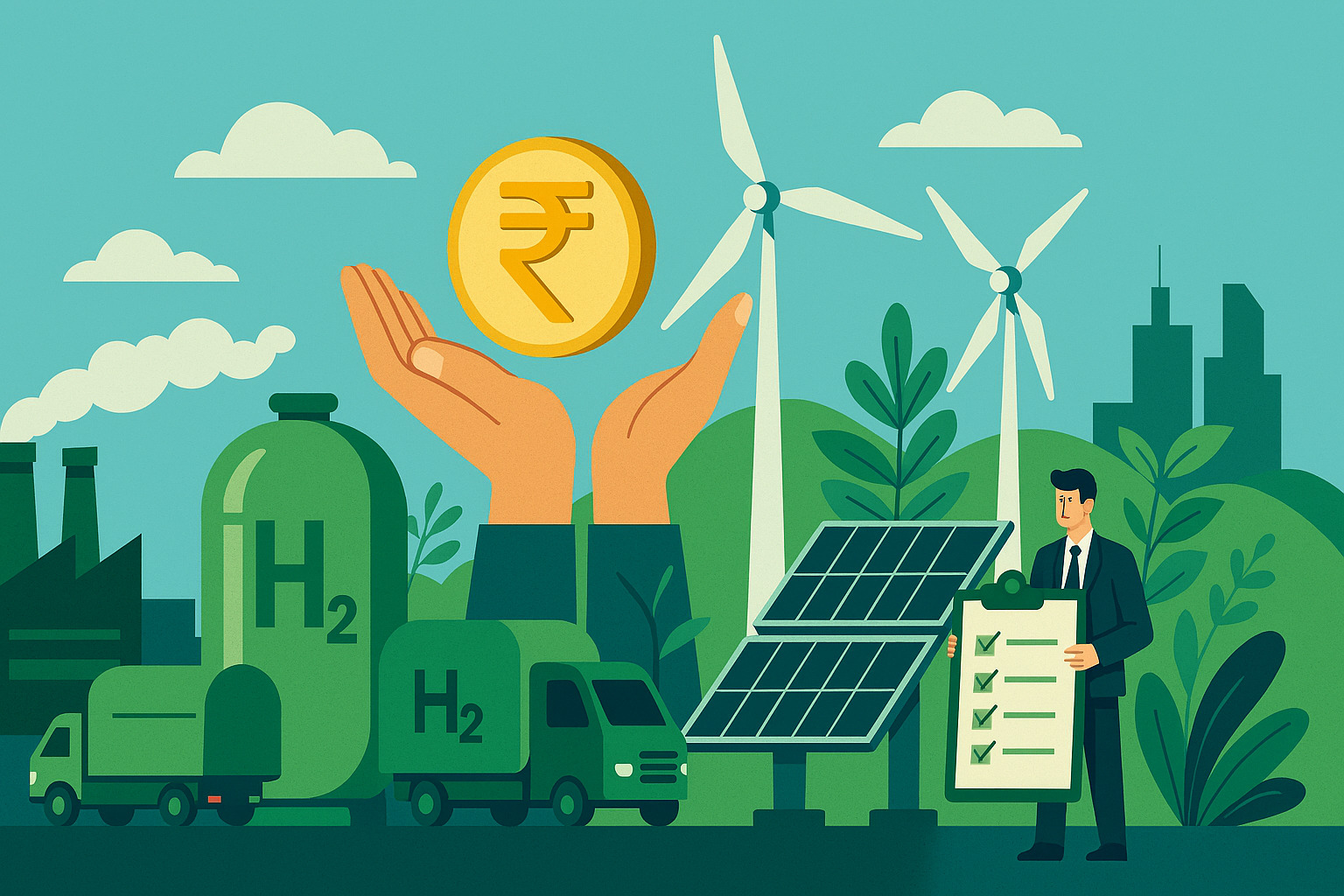
Phased mandates, backed by carbon credits, cross‑subsidies, and viability gap funding, would help reduce the burden on consumers and industry.
Greening mandates, backed by targeted incentives, are emerging as the most critical lever to spur demand for green hydrogen in India. Industry chamber, the Confederation of Indian Industry (CII), has urged the government to introduce blending mandates in sectors such as refining, fertilisers, and natural gas, supported by cost‑offset mechanisms to bridge the gap between green and grey hydrogen.
Sectors that rely heavily on grey hydrogen are best positioned to pioneer large‑scale demand for green hydrogen. Yet the cost differential remains substantial. Mandates, combined with incentives, would provide certainty to producers, accelerate economies of scale, and enable faster cost declines.
The mandates could be phased and accompanied by mechanisms such as carbon credit allocations for emissions saved, cross‑subsidies in fertilisers—e.g., cheaper natural gas if blended with green hydrogen—and viability gap funding to reduce the burden on consumers and industry.
According to Chandrajit Banerjee, Director General, CII, “India should take the next leap in promoting green technologies after marking a record‑breaking year in its clean energy journey in 2025, with non‑fossil fuel installed capacity rising to 266.78 GW. While this represented a 22.6 per cent increase over 2024, the next level of development will come with important technologies like green hydrogen being promoted.”
Public procurement of green hydrogen‑embedded products could also be encouraged. Infrastructure projects such as housing, railways, ports, and bridges represent a significant channel to boost demand. Mandating green procurement would establish predictable demand, lower prices through scale, and de‑risk investments by giving producers bankable offtake commitments. A 10-15 per cent public procurement mandate for materials such as steel, ammonia, and cement could create significant demand if sourced from green hydrogen‑based production units.
Industrial Hydrogen Hubs
Developing industrial green hydrogen clusters with shared infrastructure and demand aggregation would be a key enabler. Such hubs would allow smaller users like MSMEs in ceramics, glass, and chemicals to share infrastructure costs, improve logistics efficiency, and attract anchor industries and investors. This would foster local employment and industrial growth around green hydrogen hubs.
Government support could include land and capital provisioning, common‑use infrastructure such as pipelines, storage, carbon dioxide transport, renewable energy linkages, and cluster‑specific incentives. High‑potential regions such as Gujarat, Maharashtra, Tamil Nadu, and Odisha could be targeted through public‑private partnerships (PPPs).
To enable export demand, bilateral agreements and trade facilitation are essential. India could position itself as a global green hydrogen supplier, capturing 5-7.5 per cent of projected global import demand, translating into 0.8-1.1 million metric tonnes (MMT) annually. Agreements with Germany, the Netherlands, Japan, and South Korea, alongside harmonisation of certification standards and simplified trade documentation, would be critical.
Green hydrogen and its derivatives could be given ‘deemed export’ status, making them eligible for financial benefits under existing export promotion schemes. A rapid shift to green steel and ammonia in export‑oriented sectors is also required to preserve India’s access to premium markets and catalyse domestic demand, especially under the EU’s Carbon Border Adjustment Mechanism (CBAM).
To attract private investment into early‑stage projects, the government should consider developing financial instruments that make India’s green hydrogen ventures globally competitive. Targeted transition support for steel and chemical exporters will be vital to protect competitiveness in carbon‑sensitive markets.