

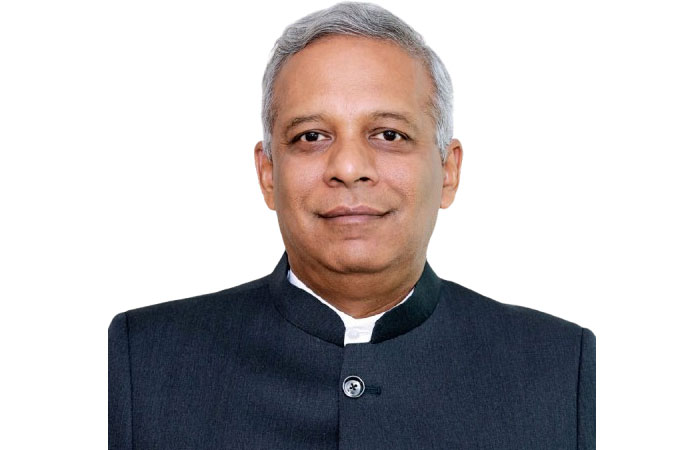
Sanjay Swarup, Chairman & Managing Director of CONCOR, says the rail logistics major is preparing to enter the shipping sector, subject to government clearances. In an exclusive interview with INFRASTRUCTURE TODAY’s Manish Pant, Swarup adds that the company is looking to leverage the expansion of Dedicated Freight Corridors (DFCs) while gradually ramping up electric mobility for first- and last-mile connectivity. Edited excerpts.
You have tied up with Adani Cement and Ultratech Cement to transport bulk cement using specialised tank containers. Are similar partnerships planned with other cement players or industries?
We have tied up with both Adani Cement Industries (which operates through its brands Ambuja Cements and ACC) and UltraTech Cement for bulk cement transportation using our wagons. The companies are procuring their own tank containers, and they can also use ours if required. We are offering them the option to set up silos at our terminals; Ultratech is already ready for that. Hyderabad-based My Home Industries (makers of Maha Cement) has also signed an agreement with us and is setting up a silo at our Domestic Rail Terminal (DRT) in Dronagiri, Navi Mumbai, from where they will transport bulk cement using the silo.
You have announced plans to add 500 terminals by 2028. Are you targeting specific regions?
We see strong demand nationwide, in export-import as well as domestic logistics. To meet this, we are expanding infrastructure. We currently operate at around 200 locations, with 66 of our own terminals, which will rise to 100. We have more than 400 rakes and will scale up to 500 to meet future logistics demand. With new products such as bulk cement transport, we need more rakes and terminals to extend our reach with customers, and the company is planning infrastructure upgrades accordingly.
Given the government’s push to restore rail’s share in freight, what role will Dedicated Freight Corridors (DFCs) play?
DFCs will play a very big role. At present, a feeder route connects ports such as Mundra and Pipavav, and even this has generated significant business, shifting traffic from road to rail. When JNPA (Jawaharlal Nehru Port Authority) is connected to the DFC—expected around January or February 2026—we anticipate a logistics revolution, with substantial freight shifting to rail. It will reduce pollution, expand the use of greener transport, benefit Railways and the country, and make our products more competitive internationally.
How will CONCOR leverage this opportunity?
We will leverage it in a big way. We have high-capacity rakes coming in, and terminals right on the DFCs. We already have four terminals on DFCs, with a fifth under commissioning. Terminals, rakes, and customer reach together will help us significantly increase business.
In the past fiscal, CONCOR reported a 10.54 per cent increase in throughput, driven by export-import and domestic volumes. Which industry segments propelled this growth?
In export-import, we have strong business across solar panels, meat and meat products, raw materials, auto parts, raw cotton and cotton yarn, and rice. Exports and imports are both driving growth. In the domestic sector, cement, gunny bales, and tiles are contributing strongly.
And what about domestic volumes?
Domestic volumes rose by around 13 per cent in the first half of this financial year. Both export-import and domestic segments have increased.
Maritime is another area of interest. How are you planning strategic expansion there?
We already have a tie-up with a Dubai-based company for container movement. Over two hundred containers have been moved, and services to the Far East will commence shortly. We plan a proper entry into shipping: we will have our own ships and work in alliances with major shipping lines. All this is in the pipeline.
Will you lease or buy ships?
Both. We have submitted a proposal to the government. Once approved, we will make a full-fledged entry into shipping.
Any timeline identified?
Subject to government approval, we expect to have our own ships in about three years.
CONCOR’s performance in recent quarters has been impacted by sluggish demand in container logistics and higher operating costs. How are you enhancing efficiencies as you prepare to become a global player?
Demand has been good, and operational efficiency has improved markedly. We have reduced empty container and empty rake movements, directly contributing to the bottom line. Empty running is down by 18 per cent year-on-year in export-import and around 7-8 per cent in domestic. Double-stacking has increased by 7.4 per cent. These measures are making operations more efficient and strengthening the company.
You have also introduced a service rating system for customers…
Yes. The rating system covers the first-mile and last-mile via our app. Transporters bid online through a reverse auction, and the lowest bidder is selected. This facility has been introduced for the first time in India.
CONCOR is a leader in green logistics in the country. Any new initiatives?
Green logistics is a focus area. Around 95 per cent of our volume moves by rail, which is a green mode. For the first and last mile, we are deploying LNG (liquefied natural gas) trailers. More than 200 are already in use, with more being procured. EVs (electric vehicles) are being deployed inside terminals; their current range of about 120 km limits wider use, but when ranges increase to around 500 km, we will use them for first- and last-mile connectivity. We have ordered five ERST (electric reach stackers), with two already at the inland container depot in Whitefield near Bengaluru, and our offices are fully paperless, using e-files. All these measures enhance sustainability.