

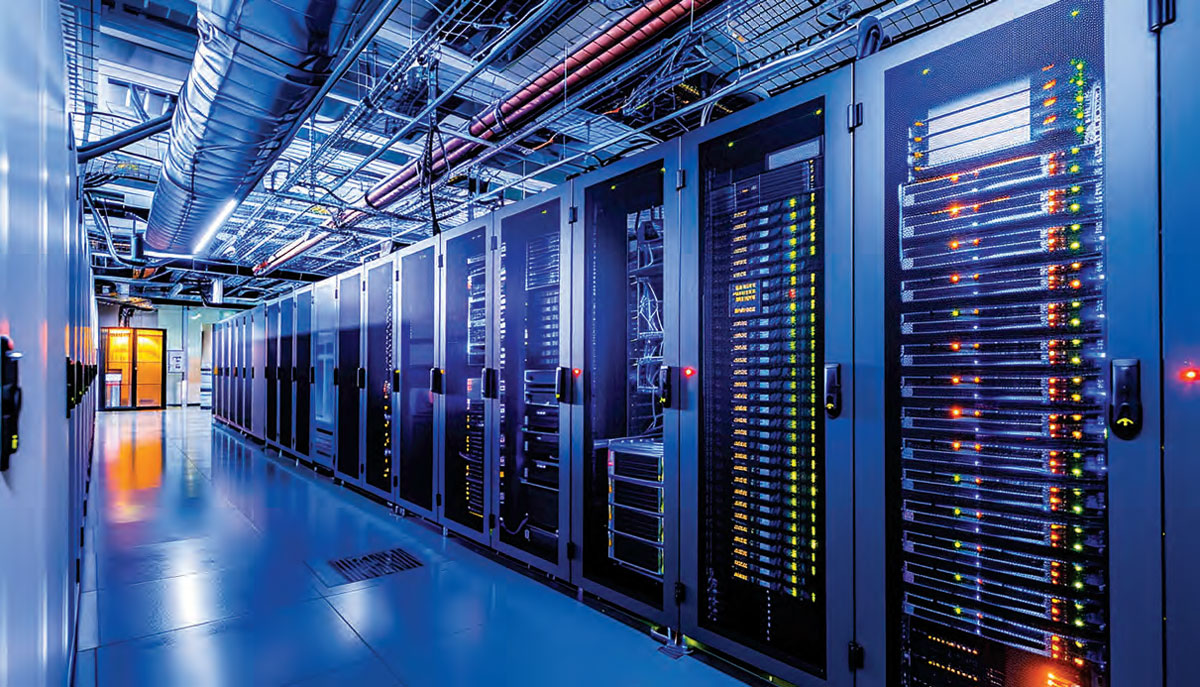
Growing digitisation, digitalisation and an enabling policy environment are expanding India’s data centre footprint, but the next phase of growth will be driven by digital transformation, writes Anand Kulkarni.
The world is rapidly transitioning towards a digitally connected era, powered by high-speed internet services and proliferating generative artificial intelligence (GenAI).
This transformation is fuelling significant growth in the global data centre industry, with India truly plugged in.
The country’s data centre capacity, although relatively small compared to developed economies, has surged nearly threefold, from nearly 0.45 gigawatt (GW) in March 2020 to around 1.25 GW in March 2025. Digitisation and digitalisation by enterprises have been the key drivers of this growth. The COVID-19 pandemic has accelerated digitisation, as businesses converted physical information into digital form, while digitalisation has enabled companies to transform their business processes and unlock new efficiencies.
The demand for data centres has been further amplified by significant data consumption by India’s large population. The accessibility of high-speed internet through mobile data has been transformative for India, and digital applications such as social media, over-the-top (OTT) platforms, and digital payments have catalysed demand.
By March 2028, an additional 1.1-1.3 GW of data centre capacity is expected to come online in the country, bringing the total to 2.3-2.5 GW. The next phase of growth will be led by digital transformation, a significant leap beyond mere digitalisation.
The Union Budget 2026-27 places strong emphasis on positioning India as a global hub for cloud and AI infrastructure, announcing a tax holiday until 2047 for foreign companies providing cloud services globally and operating through local data centres. The government has also expanded support for capacity growth and linked it with semiconductor and AI initiatives, reflecting an integrated approach to building a domestic digital ecosystem. These measures are expected to draw significant foreign investment and accelerate the development of the data centre ecosystem.
Enterprises are rapidly migrating workloads to the public cloud as part of digital transformation initiatives to boost scalability, efficiency and resilience. Additionally, the rapid adoption of GenAI and advanced analytics is driving demand for high-density computing infrastructure, prompting enterprises and hyperscalers to invest in modern large-scale data centres. Hyperscale data centre facilities typically have IT power capacity tie-ups greater than 5 MW. These data centres are generally built to suit the customer’s requirement and tenanted by fewer co-locating enterprises that commit to leasing large operating space.
The expansion of 5G networks and the consequent need for low-latency applications, including video streaming, online gaming and Internet of Things (IoT)-based services, will increase demand for data centres near consumption hubs.
These factors will ensure demand growth remains structural rather than cyclical. Notably, India’s data centre density is relatively low, at around 65 megawatt (MW) per exabyte, as local demand is currently met by global data centres. Data centre density is defined as data centre capacity at the end of a year divided by the average data consumed in exabytes per month for that year. However, with decreasing latency requirements, this ratio is expected to improve, ensuring timely tie-ups of upcoming capacities.
Our analysis of Indian data centre operators, which account for 75-80 per cent of operational capacity, suggests that their combined annual revenue will grow 20-22 per cent per annum to nearly ?200 billion by fiscal 2028. Strong demand is expected to underpin high-capacity utilisation of 90-95 per cent, consistent with the past three fiscals. The reference here is to third-party data centre operators providing co-location services and excludes captive data centre facilities.
The rapid growth of India’s data centre industry will lead to high capital expenditure (capex) of ?550-650 billion over fiscals 2026-2028, primarily towards land acquisition, power infrastructure, cooling systems and advanced equipment.
Despite the substantial capex, securing funding is not expected to be a challenge, due to the healthy availability of equity and a conducive debt funding environment. Incumbents, which account for around 75 per cent of industry capacity, have built capacities with sizeable equity funding. Cash flows from such operational capacities can facilitate funding of future growth.
From a credit perspective, the industry benefits from high customer stickiness because of elevated switching costs and long-term contracts, providing revenue visibility and, hence, enabling competitive debt funding. With a comfortable capital mix, leverage—represented by gross debt-to-Ebitda (earnings before interest, taxes, depreciation and amortisation)—is projected to remain stable at 4.6-4.7 times, supported by cash flows from operational capacities.
While the outlook for the industry remains strong, there are a few monitorables.
A potential risk of pricing pressure could impact contract renewals, given the significant bargaining power of hyperscalers, which now account for over half of total capacity tie-ups. While they offer scale and stability, their increasing requirements, combined with intensifying competition among operators, enable them to secure highly competitive pricing.
Moreover, hyperscalers are expected to set up captive data centres over the medium term, potentially leading to competitive pricing for third-party data centre operators. Although average pricing for new contracts has been largely stable over the past two fiscals, this is a trend to watch.
Technology obsolescence is another long-term challenge, as advancements in computing density, energy efficiency and cooling systems can shorten asset life cycles. However, long-term contracts with hyperscalers mitigate this risk to some extent.
Overall, the data centre sector in India is on the cusp of a significant growth trajectory owing to rapid digital transformation and a surge in demand for data storage and processing. Furthermore, robust capacity additions are expected to drive healthy revenue growth for data centre operators. As the industry evolves, data centre operators must navigate pricing dynamics and funding mix to ensure sustainable growth. With a resilient long-term growth story, the sector is well-positioned to overcome headwinds and capitalise on emerging opportunities.
About the author:
Anand Kulkarni, Director, Crisil Ratings
Capital Shifts Taking Shape
• Digital seen as risk reducer
• Venture equity bridges to project debt
• Policy nudges tie finance to outcomes
• Lenders underwrite tech-enabled infra
• Capital pools converge on reliability
Financing the Next Leap
• Digital treated as core infra asset
• Verified data makes projects bankable
• Blended finance lowers risk exposure
• Policy must recognise digital spend
• Builders with reliability lead growth
Digital Disruption on the Ground
• Bids now embed digital costs
• Supply chains tracked in real time
• Fleet data cuts fuel and downtime
• Greater transparency in online trades
• Projects monitored click-by-click