

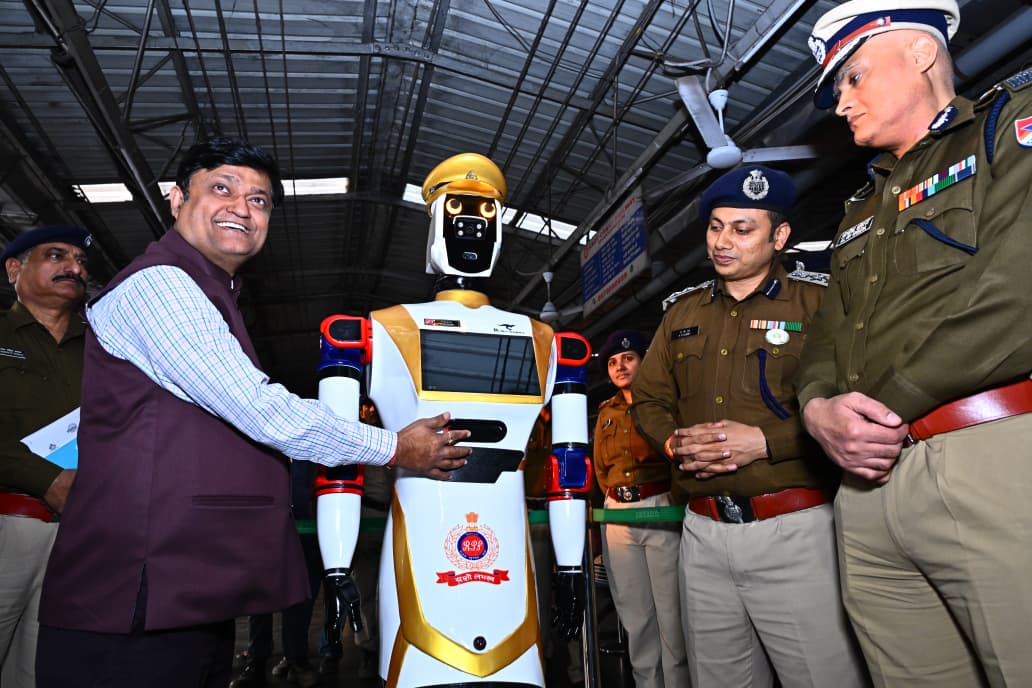
Deployed under the Railway Protection Force’s modernisation push, the humanoid robot strengthens station operations in security, passenger services, crowd management and safety awareness.
In a first for the Indian Railways, a humanoid robot named ASC ARJUN has been deployed at Visakhapatnam Railway Station to enhance passenger safety, security, and service delivery. The robot was launched under the aegis of the Railway Protection Force (RPF) in the East Coast Railway zone by Alok Bohra, Inspector General, RPF, and Lalit Bohra, Divisional Railway Manager, in the presence of AK Dubey, Senior Divisional Security Commandant, RPF, on Thursday.
Introduced as part of the RPF’s modernisation and digital transformation drive, ASC ARJUN is designed to support station operations in areas such as security surveillance, passenger assistance, crowd management, cleanliness monitoring, and safety awareness.
Speaking on the occasion, Alok Bohra, said, “The introduction of ASC ARJUN marks a pioneering initiative in adopting cutting-edge technology to strengthen railway security, improve passenger experience and support frontline staff.”
Entirely designed and developed in Visakhapatnam, the robot integrates state‑of‑the‑art technology through indigenous innovation. It features a face recognition system (FRS) to identify intruders and instantly alert RPF personnel via IoT‑enabled notifications, ensuring rapid response and reduced detection time.
Its AI‑based passenger density analysis helps prevent congestion and enables proactive crowd control during peak hours. The robot autonomously sends alerts to the control room, enabling swift action by security teams.
ASC ARJUN also delivers multilingual safety and information announcements in English, Hindi, and Telugu, improving passenger awareness and compliance. Its semi‑autonomous navigation along predefined paths, with obstacle avoidance, allows continuous patrolling and a 24/7 presence, reducing manpower burden and strengthening security management.