

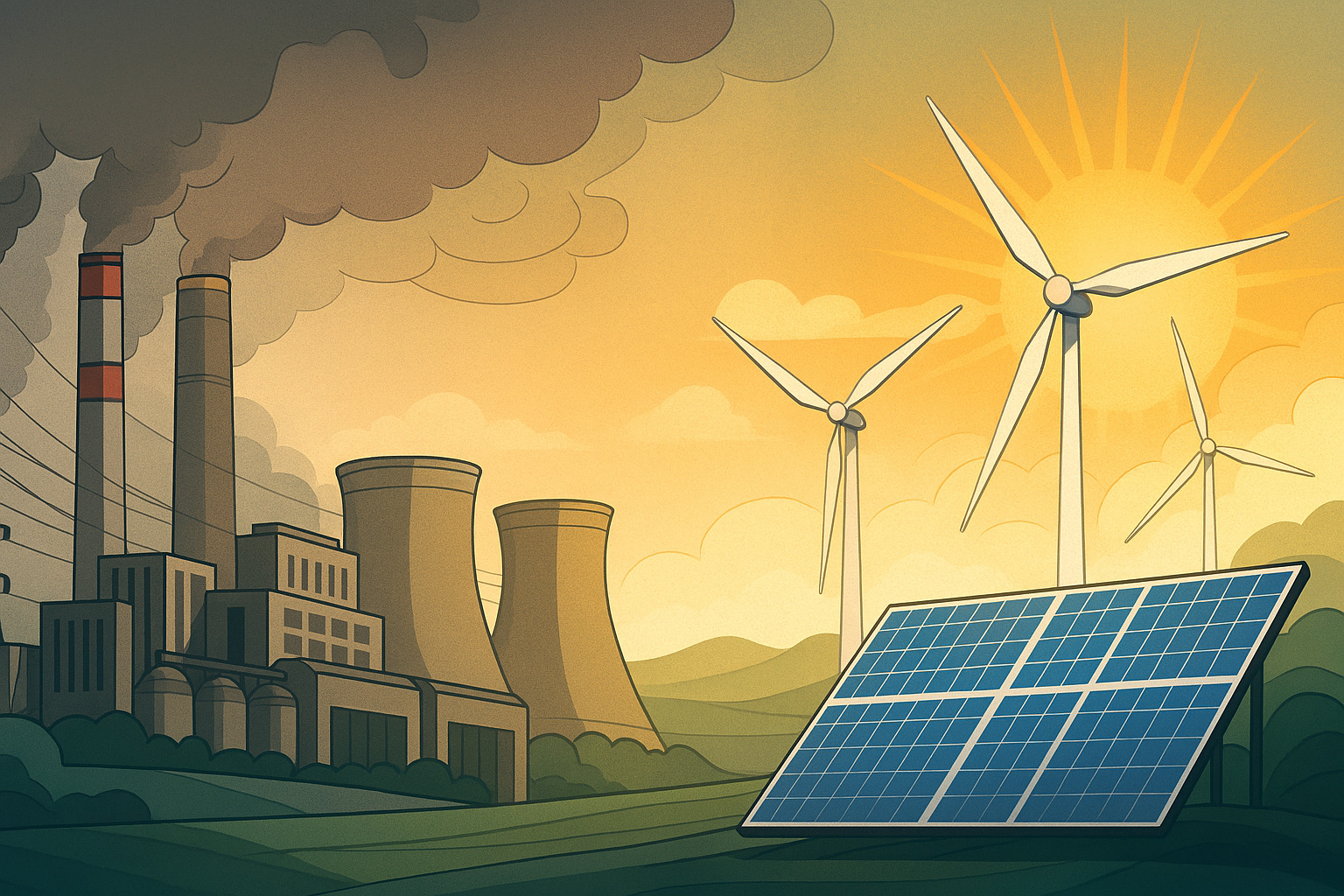
By October 2025, India’s power capacity reached 245,600 MW from fossil fuels and 259,423 MW from non‑fossil sources, with renewables contributing 250,643 MW.
India’s total installed generation capacity has reached 505,023 MW, comprising 245,600 MW from fossil‑fuel sources and 259,423 MW from non‑fossil fuel sources, including 250,643 MW from renewable energy. Minister of State for Power, Shripad Yesso Naik, shared the updated figures till October 2025 in a written reply in the Rajya Sabha, noting that the milestone reflects the country’s rapid progress in transitioning to clean and renewable sources.
The government has committed to achieving 500 GW of non‑fossil energy capacity by 2030. To support this, Inter State Transmission System (ISTS) charges have been waived for solar and wind projects commissioned by June 30, for green hydrogen projects until December 2030, and for offshore wind projects until December 2032. Standard bidding guidelines have been issued for tariff‑based competitive procurement of power from solar, wind, hybrid, and firm renewable projects.
The Ministry of New and Renewable Energy (MNRE) has set a bidding trajectory of 50 GW per annum from FY2023‑24 to FY2027‑28. Foreign direct investment (FDI) up to 100 per cent is permitted under the automatic route. Transmission infrastructure is being expanded under the Green Energy Corridor Scheme, while solar parks and ultra‑mega projects are being implemented to provide land and evacuation facilities for large‑scale renewable installations.
Schemes such as Pradhan Mantri Kisan Urja Suraksha evam Utthaan Mahabhiyan (PM‑KUSUM), PM Surya Ghar Muft Bijli Yojana, and the National Programme on High Efficiency Solar PV Modules have been launched to accelerate renewable adoption. New solar initiatives under Pradhan Mantri Janjati Adivasi Nyaya Maha Abhiyan (PM JANMAN) and Dharti Aabha Janjatiya Gram Utkarsh Abhiyan (DA JGUA), along with the National Green Hydrogen Mission and viability gap funding for offshore wind projects, are also part of the clean energy roadmap.
Driving Renewable Use
To boost renewable consumption, the Renewable Purchase Obligation (RPO) and Renewable Consumption Obligation (RCO) trajectory has been notified until 2029‑30. The RCO applies to all designated consumers under the Energy Conservation Act 2001, with penalties for non‑compliance. It also mandates decentralised renewable energy use.
The Green Term Ahead Market (GTAM) has been launched to facilitate renewable power trading, while the Production Linked Incentive (PLI) scheme for high‑efficiency solar PV modules is driving domestic manufacturing. India reached a landmark in June 2025, achieving 50 per cent of its installed electricity capacity from non‑fossil sources, five years ahead of its Paris Agreement target.
Nuclear Expansion Drive
India is also diversifying its energy portfolio through nuclear power, targeting 100 GW of capacity by 2047. A ₹200 billion Nuclear Energy Mission has been launched to develop at least five indigenously designed small modular reactors (SMRs) by 2033. Amendments to the Atomic Energy Act, 1962, and the Civil Liability for Nuclear Damage Act, 2010, are being pursued to encourage private investment. Bharat Small Reactors of 220 MW capacity based on pressurised heavy water reactor (PHWR) technology are being upgraded for industrial hubs, while BARC is developing SMRs for retiring coal stations and remote areas.
Fuel security is being enhanced through new uranium discoveries, including a significant find that will extend the life of the Jaduguda mine in Jharkhand by over 50 years. Progress in the closed fuel cycle, such as milestones in the prototype fast breeder reactor, will further strengthen the sustainable supply. State-owned power utilities NPCIL and NTPC have formed the Anushakti Vidhyut Nigam Ltd (ASHVINI) joint venture to accelerate nuclear capacity addition.
Clean Energy Incentives
Fiscal support is being extended to energy storage and renewable integration. In September 2023, a viability gap funding (VGF) scheme was approved for 13.22 GWh of battery energy storage systems (BESS), with ₹37.6 billion allocated. In June 2025, another VGF scheme was cleared for 30 GWh of BESS capacity, backed by ₹54 billion from the Power System Development Fund. Ten pumped storage projects totalling 11,870 MW are under construction, supported by new policy measures. Offshore wind energy is being promoted with viability gap funding for an initial 1 GW capacity.
The National Green Hydrogen Mission is central to India’s decarbonisation strategy, targeting at least 5 million tonnes per annum of green hydrogen capacity with 125 GW of associated renewable energy by 2030. This mission is expected to drive industrial transformation, create jobs, and reinforce India’s leadership in clean energy.