

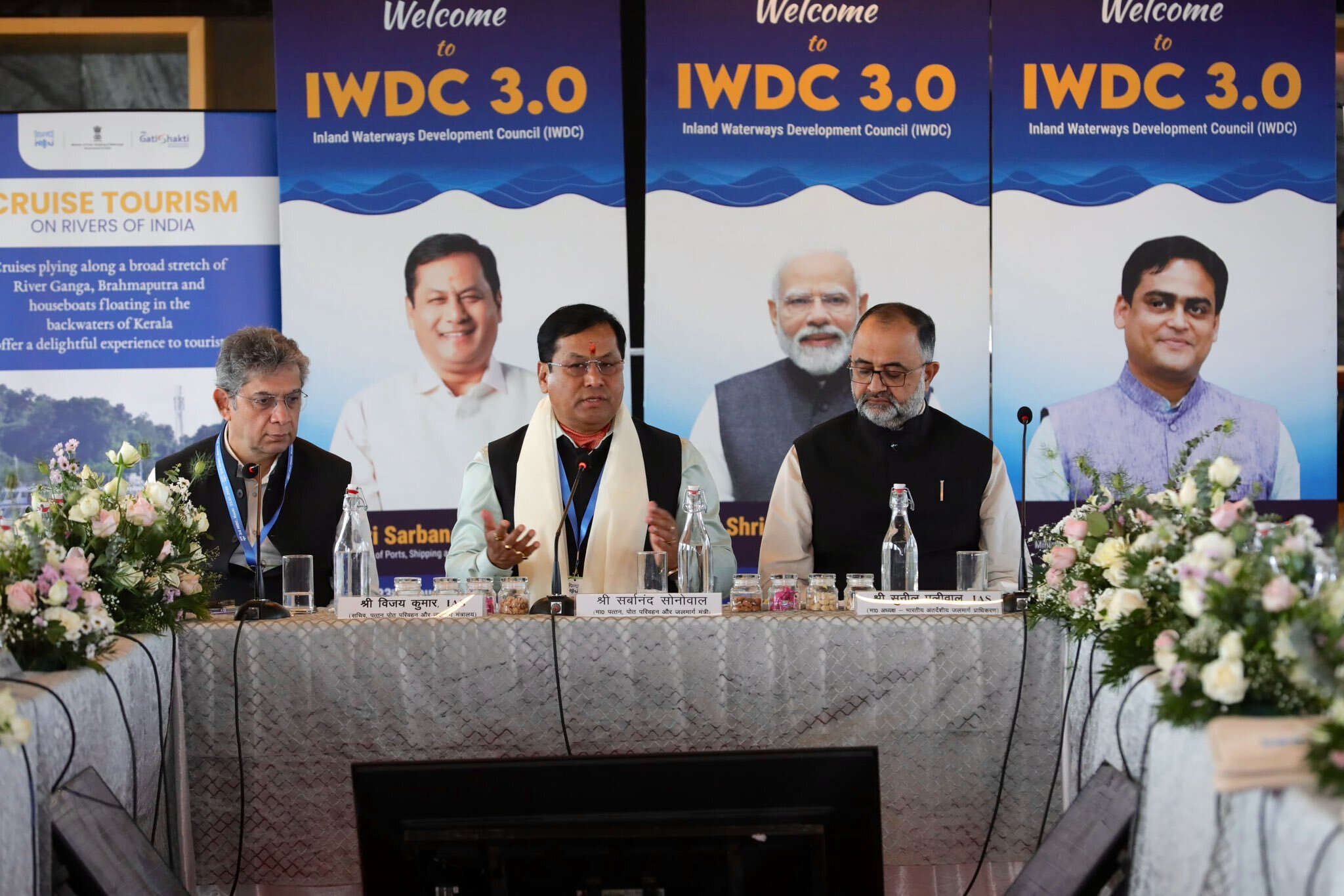
Kerala’s backwater and canal network emerged as a key opportunity for inland water transport at IWDC’s third meeting.
The Inland Waterways Development Council (IWDC), at its third meeting in Kochi, Kerala, approved projects worth over ₹15 billion to accelerate green mobility, strengthen multimodal logistics, and promote river-led economic development. Foundation stones were laid for initiatives exceeding ₹1.5 billion, including river cruise jetties in Kerala, Gujarat, Karnataka, Odisha, and Telangana to expand cruise tourism circuits nationwide.
Chaired by Union Minister of Ports, Shipping and Waterways, Sarbananda Sonowal, the meeting outlined a comprehensive roadmap to scale India’s inland water transport network, unlock major infrastructure investments, and enhance centre-state coordination.
Sonowal remarked, “Inland waterways have become a strategic pillar of India’s multimodal logistics framework. Rivers are no longer viewed merely as natural resources but as economic lifelines driving growth, sustainability and connectivity.”
The council reviewed the development of roll-on/roll-off and cargo terminals at Muktyala and Harishchandrapuram on the Krishna River (National Waterway 4) in Andhra Pradesh, aimed at boosting cargo movement. Onshore facilities on the Jhelum River (NW49) in Jammu and Kashmir were also approved to support passenger movement and tourism infrastructure. Ten hybrid electric vessels will be deployed on NW49 to enhance regional connectivity.
Asset procurement worth ₹4.65 billion was announced to improve navigability, safety, and year-round operations. This includes survey vessels in Kerala, roll-on/roll-off passenger berthing jetties in Bihar, Jharkhand, and West Bengal, floating pontoons and quick-opening mechanisms in Uttar Pradesh, Bihar, and West Bengal, hybrid survey vessels, amphibian and cutter suction dredgers, and tug-barge units.
Major new projects worth ₹9 billion were also cleared, including a slipway facility at Kochi, construction of 110 jetties across Odisha and the Northeast, implementation of the National River Traffic and Navigation System (NRTNS) in Maharashtra, a ₹700 million cruise terminal at Uzan Bazar Ghat in Guwahati, and a ₹1.44 billion approach road connectivity project to the Bogibeel River Port in Dibrugarh on the Brahmaputra (NW-2).
Kerala Focus
Kerala’s extensive backwater and canal network was highlighted as a major opportunity for inland water transport. The Inland Waterways Authority of India (IWAI) is conducting feasibility studies for urban water transport in 18 cities, including Guwahati, Varanasi, Patna, Tezpur, and Dibrugarh.
Kerala emerged as a key focus area with several announcements to strengthen logistics and passenger movement. The Jal Vahak cargo promotion scheme is being considered for expansion to other National Waterways, including Kerala. It offers reimbursement of up to 35 per cent of operating expenditure on cargo movement via inland waterways. The scheme encourages private participation by allowing cargo owners to hire vessels operated by entities other than IWAI or Inland Container Services Ltd (ICSL), making it attractive for shipping companies, freight forwarders, and bulk cargo operators. Valid for three years, the initiative aims to optimise supply chains and improve commercial viability.
Fixed Day Scheduled Sailing Services will be launched on commercially viable stretches to demonstrate the efficiency and sustainability of water-based cargo transport. Kerala’s package also includes new river cruise jetties and the induction of a survey vessel to enhance tourism and navigation.
Northeast Priority
Special emphasis was placed on the Northeast, where waterways projects are expected to boost connectivity, trade, tourism, and livelihoods. The government plans to develop 85 jetties across the region with investments exceeding ₹5 billion, strengthening regional logistics integration.
Sonowal noted, “The Northeast holds a central place in India’s inland waterways vision. With its vast river network, the region can emerge as a major hub for sustainable transport, trade and tourism.”
The meeting reviewed the sector’s rapid growth over the past decade. Cargo movement on national waterways rose from 18 million tonnes (MT) in 2013-14 to 145.84 MT in 2024-25. Operational national waterways increased from three to 32, luxury river cruise vessels from five to 25, terminals from 15 to 25, and floating jetties from 30 to 100.
The council reaffirmed forward-looking priorities including deployment of green and hybrid vessels, expansion of digital navigation and traffic management systems, development of modern inland terminals, strengthening of shipbuilding and repair facilities, and promotion of maritime skill development.