

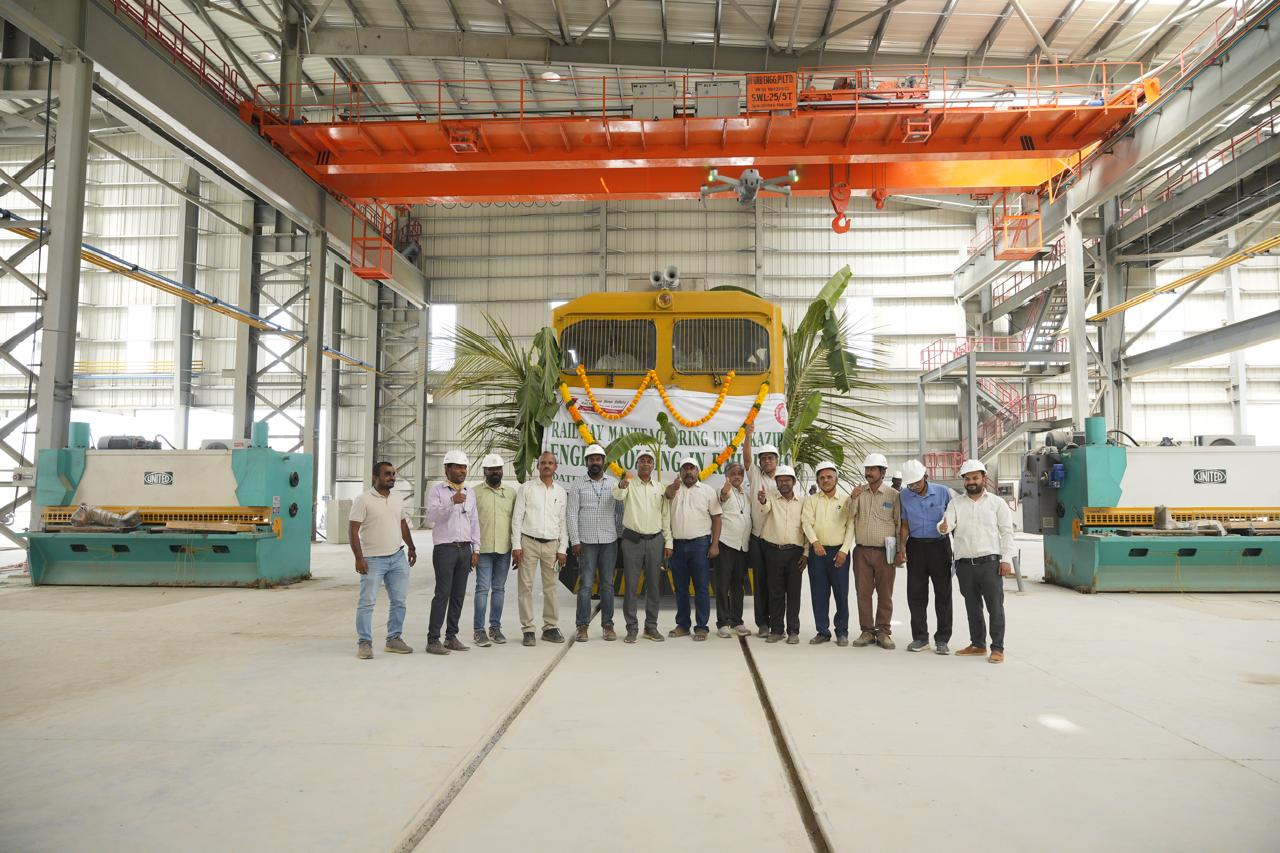
RVNL successfully ran a diesel locomotive with a coach from Kazipet Yard into the RMU premises on February 21, using the newly built connectivity track.
Ministry of Railways-owned Rail Vikas Nigam Limited (RVNL) has completed a significant milestone in the execution of the railway manufacturing unit (RMU) project at Kazipet, Telangana. The railway infrastructure developer successfully conducted the trial run of a diesel locomotive with a coach from Kazipet Yard into the RMU premises on February 21, via the newly constructed railway connectivity track.
This run marks the completion of track connectivity between the RMU complex and the main railway network, formally integrating the facility with the operational system of Indian Railways and signalling the project’s transition from construction to operational readiness ahead of commissioning.
Speaking on the occasion, Saleem Ahmad, Chairman & Managing Director, RVNL, noted, “The successful trial run and integration of the Railway Manufacturing Unit at Kazipet with the main railway network marks a defining milestone in the execution of this project and will strengthen India’s railway manufacturing infrastructure… The RMU will significantly enhance domestic manufacturing capacity, improve logistics efficiency, and support Indian Railways’ long-term modernisation and expansion plans.”
The Kazipet RMU is being developed as a major rolling stock manufacturing and industrial facility to augment the production capacity of the Indian Railways. Spread across 160 acres, the project is being executed by RVNL as the project implementation agency. Strategically located at Kazipet, a major junction under South Central Railway on the vital Balharshah-Secunderabad trunk route forming part of the larger Delhi-Chennai corridor, the RMU offers seamless north-south and east-west connectivity, enabling efficient dispatch of finished rolling stock across the country and strengthening the national rolling stock manufacturing ecosystem.
Kazipet Facility Ready
RVNL has completed the full spectrum of civil and industrial infrastructure required for the RMU, including heavy industrial workshop sheds constructed using advanced pre-engineered building (PEB) technology for manufacturing new-generation passenger coaches. The main shop, measuring 300 m x 110 m, houses four manufacturing bays and is supported by a shower test facility for leak testing, an automated robotic paint shop, a fully equipped test shop for pre-dispatch inspection and an integrated store yard for streamlined material management.
Dedicated assembly and inspection bays fitted with heavy-duty gantry cranes, administrative and utility buildings including staff canteen and parking, stores and logistics facilities, power sub-station, security and surveillance systems, internal roads, drainage networks and boundary infrastructure have also been completed, marking full readiness of civil works across the RMU complex.
The project also includes development of an internal railway track network of 13.15 km, comprising 8.81 km of ballasted track and 4.34 km of ballastless track. Ballastless track has been provided primarily within workshop areas and industrial bays to ensure high stability, precision alignment and low maintenance under heavy operational loads. In addition, RVNL has constructed a dedicated railway link line connecting the RMU to Kazipet Yard, along with yard integration, turnout works and signalling integration with the main railway system, enabling seamless inward movement of materials and outward dispatch of finished rolling stock directly by rail.
Machinery and plant installations in the main shop, paint shop and test shop have been completed and are slated for commissioning by March 2026. The RMU has also been designed as a green-rated industrial complex incorporating a 2 MWp rooftop solar plant with grid export capability, four rainwater harvesting ponds of 2 million litres each, energy-efficient LED lighting and a modern sewage treatment plant. The use of PEB structures supports faster construction, optimal daylight utilisation, lower maintenance and reduced energy consumption.