

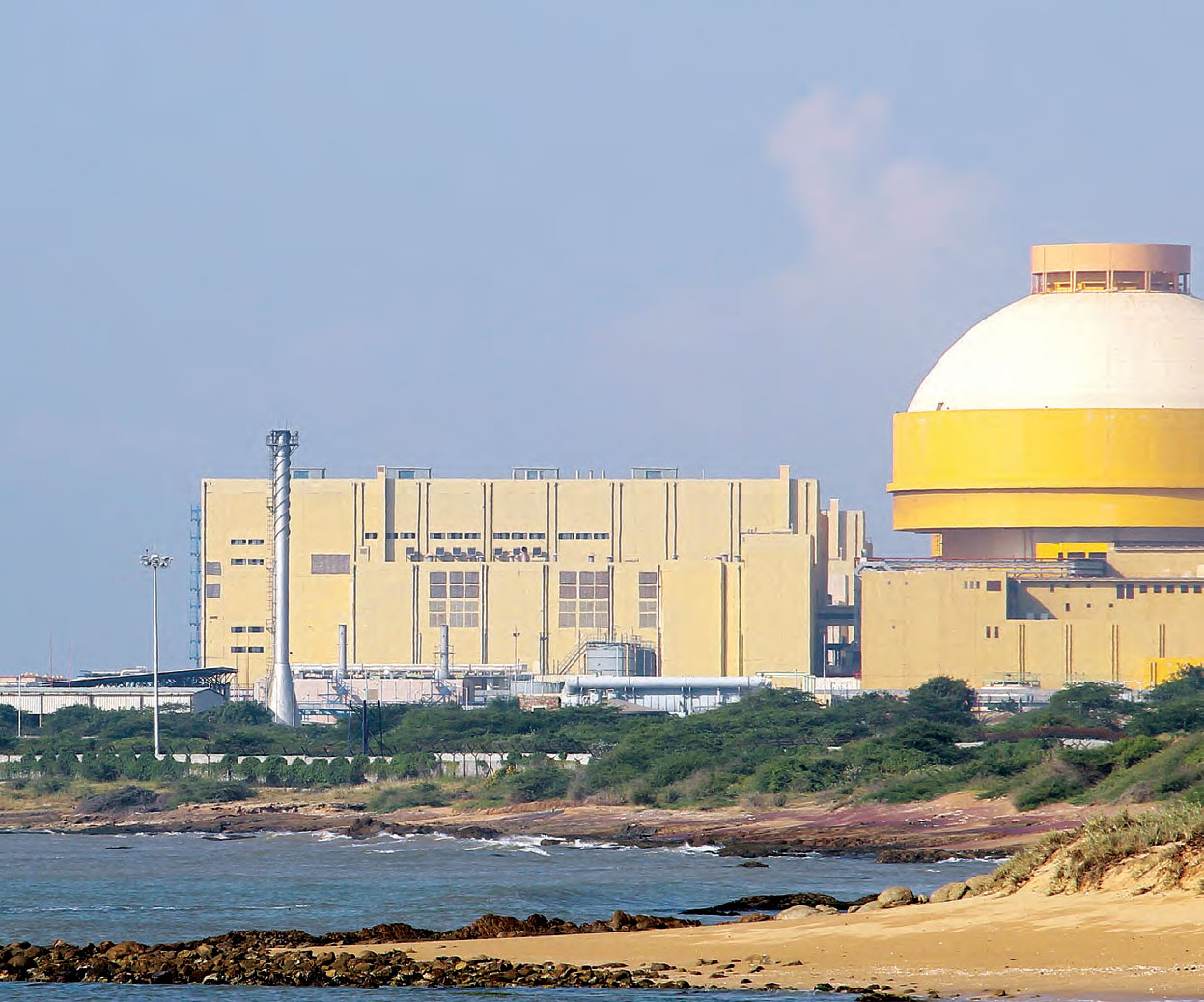
Repositioning nuclear energy under India’s SHANTI Act will require a clear framework of rules, regulations and contracts that define roles, risks and responsibilities, say Amit Kapur and Sugandha Somani Gopal.
The Sustainable Harnessing and Advancement of Nuclear Technology for India (SHANTI) Act, 2025, heralds a transformative shift in India’s nuclear energy governance framework. Seeking to bring greater private participation and advance nuclear technologies aligned with India’s decarbonisation commitments, the Act seeks to reposition nuclear energy as a viable pillar of India’s clean energy transition.
However, a strong push on research and development, accompanied by large-scale patient private capital to fund capital-intensive nuclear power projects, is vital. Much ground needs to be covered before we can hope to actualise the promise it holds out. India needs to establish a clear framework that appropriately allocates roles, risks, and responsibilities through rules, regulations, and standard contracts.
Conduct and performance must be monitored by credible and robust institutions with domain expertise, with suitable processes to get the right balance between energy security, safety, safeguarding the public and the environment, providing for viability while creating pathways for innovation through a sandbox mechanism to test, accredit and stabilise innovations before implementation. A strong effort must be made to build public acceptance. This requires a carefully sequenced set of legal, regulatory, institutional, financial and technological measures.
Subordinate legislation
The most critical step in implementing the Act will be the timely issuance of detailed rules, regulations, notifications and policies envisaged under the Act. The Act recognises that nuclear energy is technically complex, safety-critical and politically sensitive.
With the sector opening cautiously to private players under continued state oversight, it mandates detailed subordinate legislation and notifications to set the rules. These will cover critical aspects such as licensing procedures, safety standards and codes relating to design, siting, construction, fuel storage and transportation, as well as norms governing equipment and material used for nuclear energy production. They will also address qualified personnel, inspection protocols, waste management, decommissioning, emergency response and claims procedures.
Clarity on rules will go a long way in providing certainty to potential investors, technology providers, lenders and the public. Licensing procedures should articulate eligibility conditions for private and joint-venture participation, approval timelines, scope of permissible activities and tariffs for the supply of electricity from nuclear power plants.
Regulatory architecture
Effective implementation will require credible, adequately resourced and capable regulatory bodies. The Atomic Energy Regulatory Board (AERB) has been accorded statutory recognition, which will primarily regulate safety-related aspects. A future involving diverse reactor designs and private operators will require the AERB to build institutional capabilities to oversee a more complex and diversified nuclear ecosystem.
The Atomic Energy Redressal Advisory Council has to be constituted under the Act to review licensing, safety authorisation and tariff-related grievances. It must embody technical competence and institutional credibility. Given the economic and technical complexity involved in tariff matters, the council must possess strong multidisciplinary expertise spanning nuclear energy, power system operations, finance, economics and law, which must balance cost recovery, consumer protection and sector sustainability.
Around such institutions, processes with strong feedback loops and the ability for prompt adjustments if necessary are vital to inspire confidence domestically and internationally. Consistency and predictability in decision-making are critical to provide confidence to investors and utilities. Procedural fairness and stakeholder participation ensure legitimacy. Key steps include enhancing technical capacity, insulating regulatory decision-making from operational entities, and adopting internationally benchmarked safety and compliance standards. Regulatory credibility will be especially critical if India seeks collaboration with global nuclear technology suppliers and access to international finance, including climate-aligned funding pools.
Civil liability
Civil nuclear liability remains among the most sensitive issues affecting nuclear investment in India. The Act seeks to ease the earlier liability regime and rebalance risk allocation, aligned with international norms.
Its effective implementation will require explicit operational guidance on liability caps, recourse mechanisms, indemnity frameworks, waivers, insurance structures and the role of nuclear pools.
Competitive bidding guidelines, standard bidding documents and underlying contracts will define the risk allocation framework amongst operators, suppliers and the state. In this context, it will be important that the risk allocation framework recognises and appreciates the fundamental distinction between the risks associated with the nuclear island vis-à-vis the conventional island and the balance of plants of a nuclear power project. Such calibrated differentiation will be critical to attract credible private participation through the nuclear value chain. In parallel, the government may need to facilitate building deeper and more robust insurance backstopping mechanisms or sovereign guarantees to address residual risks that the private market is unwilling to bear.
Bankable structures
A central determinant of the Act’s success will be its ability to translate policy intent into demonstrably bankable projects. Nuclear projects are characterised by high upfront capital costs, long construction periods, technology risks and extended payback periods. Addressing these challenges requires a deliberate shift from ad-hoc project structuring to standardised, financeable models that appropriately allocate risk and provide long-term revenue certainty.
A robust and standardised contractual framework across the project lifecycle will go a long way. Engineering, procurement and construction (EPC) contracts must clearly allocate construction, performance and delay risks, with well-defined milestone-linked payment mechanisms and remedies. Given the scale and complexity of nuclear construction, sovereign support and completion guarantees will be important to address risks. Similarly, long-term fuel supply arrangements and operations and maintenance (O&M) contracts must ensure predictability in operating costs and availability factors, which are critical inputs for tariff determination and lender due diligence.
Structuring long-term and creditworthy power offtake arrangements is equally important. Nuclear projects require revenue visibility over several decades to support financing. This may necessitate long-term power purchase agreements, tariff stabilisation mechanisms, or regulated asset base (RAB)-type models that allow cost recovery during construction and early operations.
From a financing perspective, implementation of the Act must be accompanied by innovative capital structuring. Traditional project finance alone is unlikely to be sufficient. Viability gap funding and capital grants may be necessary to bridge the gap between economically efficient tariffs and consumer affordability. Blended finance structures—combining public capital, concessional funds and private investment—can help crowd in long-term investors by reducing overall project risk. Attracting suitably patient and long-term capital from insurance, pension and sovereign wealth funds will be critical to credit-enhance the projects. Similarly, availability of long-tenor debt, aligned with the asset life of nuclear plants, is particularly critical, requiring participation from development finance institutions, export credit agencies and multilateral lenders.
Finally, positioning nuclear energy within climate finance and energy transition frameworks could materially enhance project bankability. If nuclear is recognised as a low-carbon or transition technology, projects may gain access to green or transition-linked financing instruments, sustainability-linked loans and climate funds. This will require clear policy signalling, credible emissions accounting and alignment with international taxonomies. Done well, such alignment could lower the cost of capital, broaden the investor base and anchor nuclear projects firmly within India’s long-term decarbonisation strategy under the Act.
Power markets & planning
Implementation cannot occur in isolation from broader electricity market reforms and long-term energy planning processes. Nuclear power’s role in baseload supply, grid stability, complementarity with renewables, and long asset life will need deliberate accommodation within power system planning and market design.
This will require coordination between nuclear authorities, power system operators, regulators and distribution companies to ensure that tariff structures, grid access and dispatch protocols support long-term nuclear investments. Market integration will require alignment of tariff design with the cost structure of nuclear projects. Unlike renewable energy, where costs are largely front-loaded and marginal costs are low, nuclear generation entails substantial capital recovery over long periods. Tariff frameworks must therefore enable predictable and adequate cost recovery. A stabilising role and grid support can be provided by nuclear plants, with an additional revenue stream towards ancillary services to underpin project viability. Without market integration, nuclear capacity additions may struggle to achieve commercial viability.
Technology & capability
The Act emphasises advanced nuclear technologies, including small modular reactors and next-generation designs. Implementation will require meeting an effective regulatory sandbox for R&D and innovation to be tested, stabilised and accredited before deployment. In addition, the regime must provide for technology readiness, localisation strategies and skills development.
This includes facilitating technology transfer arrangements, supporting domestic manufacturing ecosystems, and investing in human capital through specialised training and academic collaboration. A credible roadmap for indigenisation will help address energy security concerns and reduce long-term project costs.
Centre-State coordination
Nuclear projects inevitably intersect with land, water, environmental approvals and local governance, areas where state governments play a critical role. Effective implementation of the Act will therefore depend on robust centre-state coordination mechanisms.
Establishing dedicated facilitation cells, single-window clearance systems and structured stakeholder engagement processes will be essential to minimise delays and build local acceptance. Early and transparent engagement with communities will also
be critical to addressing social and environmental concerns.
Public trust
Finally, implementation of the Act must be accompanied by a deliberate public communication strategy. Nuclear energy remains a subject of public apprehension, and trust deficits can derail even well-designed projects. Transparent disclosure, community participation, emergency preparedness communication and independent oversight mechanisms will be essential to building social legitimacy. Without public trust, regulatory approvals and project execution will face sustained resistance.
The Act represents a strategic opportunity to reposition nuclear energy within India’s clean energy and industrial policy framework. However, its success will hinge on disciplined implementation, anchored in regulatory clarity, institutional credibility, financial innovation and stakeholder trust. If executed thoughtfully, the Act could unlock a new phase of nuclear deployment aligned with India’s decarbonisation goals, energy security imperatives and global climate commitments. If not, it risks becoming another well-intentioned reform constrained by execution gaps.
About the author:
Amit Kapur and Sugandha Somani Gopal, Partners, JSA Advocates & Solicitors.
Unlocking Opportunities
• Private participation opens nuclear projects to new investors and technology providers.
• Climate-aligned finance positions nuclear as part of India’s clean energy transition.
• Advanced reactor designs such as small modular reactors promise safer, flexible deployment.
• Domestic manufacturing ecosystems strengthen energy security and reduce long-term costs.
• Skill development and technology transfer build human capital for sustained growth.
Source: JSA Advocates & Solicitors
Navigating Implementation Challenges
• Capital intensity and long timelines make nuclear projects difficult to finance and deliver.
• Liability and insurance complexities deter private players without clear risk allocation.
• Regulatory capacity gaps risk undermining safety and credibility in a diversified ecosystem.
• Public trust deficits can stall projects despite strong policy intent.
• Centre-state coordination hurdles around land, water, and approvals slow execution.
Source: JSA Advocates & Solicitors
Building an Enabling Framework
• Clear rules and contracts provide certainty on roles, risks, and responsibilities.
• Credible regulatory institutions ensure safety, fairness, and international confidence.
• Bankable project structures with long-term tariffs and revenue visibility attract capital.
• Blended finance and sovereign support reduce risk and crowd in patient investors.
• Transparent communication and community engagement foster legitimacy and public acceptance.
Source: JSA Advocates & Solicitors