India’s skies are expanding faster than anywhere else, yet the trajectory of future growth will hinge on how swiftly structural and systemic challenges are resolved to unlock untapped potential, writes Manish Pant.
India’s aviation sector is experiencing an unprecedented boom, defined by rapid expansion in airport infrastructure, passenger traffic, and airline capacity. Over the past 11 years, the number of operational airports has more than doubled, rising from 74 to 164, with plans to reach nearly 350 over the next two decades. This growth reflects both government policy and industry ambition, positioning aviation as a key driver of economic transformation. According to a study by the consultancy Crisil, every $1 spent on the aviation sector in India delivers a multiplier effect of up to $3 in GDP contribution and employment creation.
Capturing the scale of this momentum, Union Minister for Civil Aviation, Kinjarapu Ram Mohan Naidu, said at Wings India 2026 airshow in Hyderabad in January, “Let it be trade, talent or technology, Indian skies today are brimming with infinite possibilities, reflecting the scale and speed of our growth… In just a span of 15 minutes, India as a country is handling 13 to 15,000 passengers!” His words highlight the sheer volume of passenger and infrastructure growth that has enabled it.
Central to this expansion has been the UDAN Regional Connectivity Scheme. In a country where only about 4-5 per cent of the population travels by air annually, UDAN was launched in 2016 to boost air travel from smaller cities. Since then, 92 airports have been developed and made operational, with 55 previously unserved airstrips revived. Over 15 million passengers have flown
on more than 317,000 UDAN flights, connecting Tier-2 and -3 cities to major hubs. The Government has now announced a modified UDAN scheme to connect
120 new destinations and carry 40 million passengers over the next decade.
Meanwhile, the private sector has matched this policy push with ambitious fleet expansion. Leading Indian scheduled carriers have placed orders for over 1,700 aircraft, with IndiGo (~1,000), Air India (570), and Akasa (226) securing large deals with Airbus and Boeing.
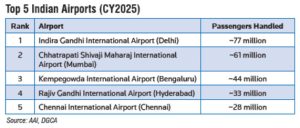
Major airports are already reflecting this surge. Delhi’s Indira Gandhi International Airport (IGIA) handled nearly 79 million passengers in FY2025, its
highest ever throughput, climbing from ninth position to become Asia’s fifth busiest. Videh Kumar Jaipuriar, CEO of the airport’s operator, Delhi International Airport Ltd (DIAL), tells INFRASTRUCTURE TODAY, “IGI Airport recorded a 244 per cent increase in international-to-international transfers
between FY2023-25, underscoring its strengthening role as India’s premier global gateway.” Bengaluru’s Kempegowda International Airport (BLR Airport) has also seen record growth. A senior BLR Airport official, requesting anonymity, observes, “International traffic at BLR grew nearly 29 per cent in 2025, and we are seeing strong demand from both business and leisure travellers. The challenge now is to keep pace with this growth while maintaining service quality.”
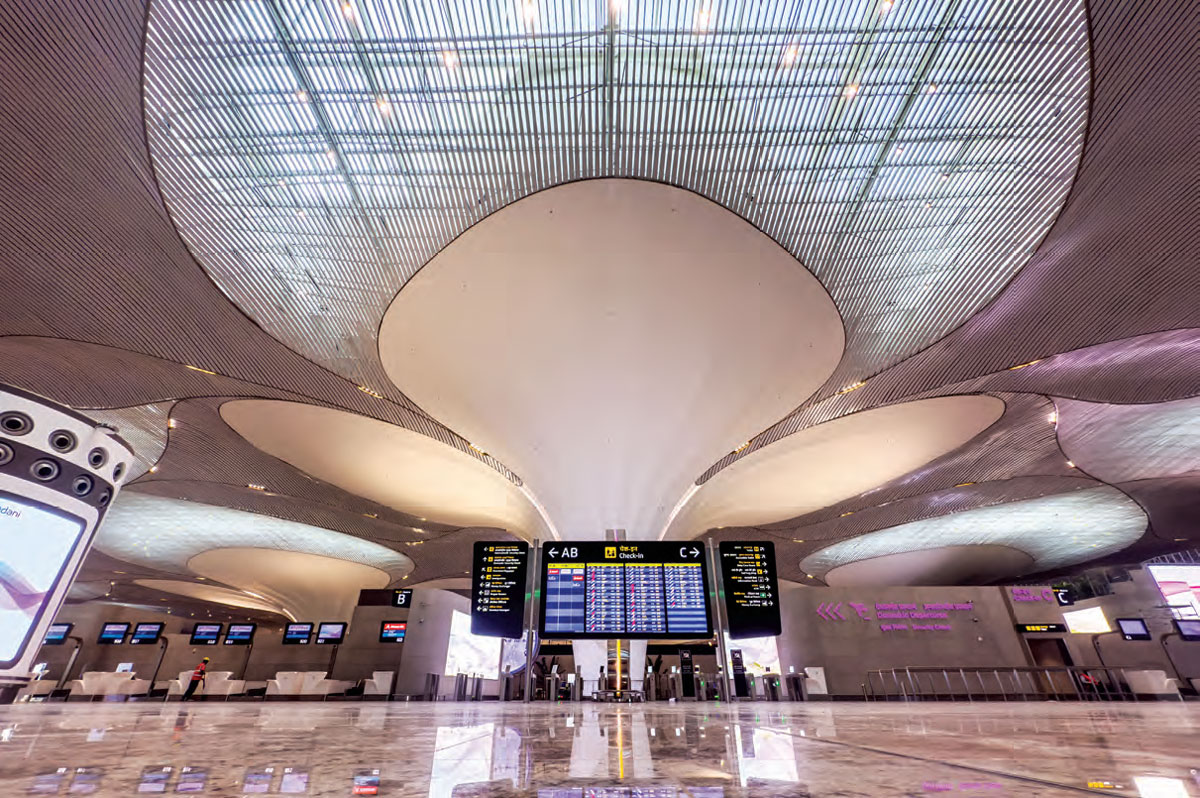
Mega projects such as the Navi Mumbai International Airport and the Noida International Airport (NIA) are designed to absorb future demand. At the October 2026 launch of NMIA, Gautam Adani, Founder & Chairman of the $26?billion Adani Group, described it as “a gateway to exponential possibilities,” adding, “Every flight through these terminals will carry not just passengers, but the pulse of a defining superpower.” Similarly, with a phased plan to handle up to 70 million passengers annually, NIA exemplifies the next generation of airports that combine regional identity with global standards. Christoph Schnellmann, CEO, Noida International Airport, elaborates,
“Our vision is to create an airport that feels rooted in its region while meeting the highest global standards for comfort, convenience, and reliability.”
Stakeholders are also beginning to benefit from this expansion. Poonam Bharadwaj, Executive Director, of the New Delhi-based aviation services company Vandana Aircraft Services, remarks, “The growth in aviation infrastructure is opening opportunities for service providers like us. We are seeing demand for ground handling and allied services rise in tandem with passenger volumes.” Such developments indicate that India’s airports are no longer just gateways; they are becoming engines of transformation.
Navigating Air Pressure
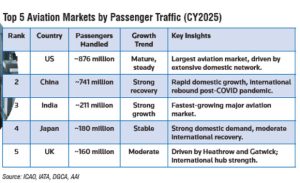
In CY2025, India’s domestic airlines carried about 166.9 million passengers, according to data from the aviation regulator, the Directorate General of Civil Aviation (DGCA). This firmly places India as the world’s third-largest aviation market after the US and China. However, this boom is not without its fair share of challenges that could slow momentum if not addressed strategically. These span infrastructure bottlenecks, regulatory complexities, financial sustainability, and the pressing need for technological and environmental adaptation.
One of the most immediate concerns is capacity. Despite the rapid addition of airports, demand is outpacing supply at major hubs. Delhi Airport’s Jaipuriar acknowledges both sides of the growth. “While 2025 brought temporary external pressures, the underlying fundamentals of demand, hub traffic, and infrastructure readiness remain robust.” BLR Airport faces a similar strain. The senior official notes, “International traffic has surged nearly 29 per cent, and while this is encouraging, it puts immense pressure on our terminals, security, and ground handling systems.”
The UDAN scheme, though transformative, has revealed critical economic challenges. Smaller regional carriers have struggled to remain viable, with several folding under financial stress. Jaipuriar surmises, “The presence of more regional carriers did offer an initial boost to connectivity, though their sustainability varied.” In practice, this has led to the suspension of flight operations at several smaller airports once the three-year viability gap funding ended, highlighting the difficulty of balancing inclusivity with long-term financial health.
Airlines themselves face mounting pressures. Given the large aircraft orders, carriers must manage financing, leasing, and operational costs in a volatile global environment. Fuel taxation remains a persistent challenge, and industry leaders have repeatedly called for aviation turbine fuel (ATF) to be brought under GST to reduce costs. Such policy reforms, already long overdue, are essential to ensure Indian carriers remain competitive against their global peers.
Regulatory clarity is another hurdle. Analysts caution that fragmented processes across security, immigration, and bilateral agreements risk slowing expansion. Jagannarayan Padmanabhan, Senior Director & Global Head, Consulting, at the advisory Crisil Intelligence, notes, “The Indian aviation industry is expected to witness sustained growth in demand in the medium term, despite the supply chain crunch.” His observation highlights the need for harmonised regulations.
Cargo and maintenance infrastructure also present challenges. India’s leading metro airports, despite being the country’s largest cargo gateways, must contend with fragmented logistics and limited multimodal integration. Then there is the absence of a robust maintenance, repair and overhaul (MRO) ecosystem. Jaipuriar explains, “In the absence of adequate on-airport MRO infrastructure, airlines are often compelled to ferry aircraft to off-station maintenance bases, leading to higher costs, longer aircraft downtime, and operational scheduling inefficiencies.” The scale of the gap is stark. Indian carriers spend nearly 90 per cent of their MRO budgets, or around $1.5-$1.8 billion annually, overseas. Currently, only 14 per cent of work is handled domestically, according to government think tank NITI Aayog. As a result, a significant share of India-registered aircraft continues to fly to overseas hubs such as Singapore, Dubai, and Colombo for maintenance.
Technology adoption, while promising, is uneven. Initiatives like DigiYatra and AI-enabled operations are transforming passenger experience, but their spread across airports remains patchy. Smaller airports often lack the resources to deploy advanced systems, leading to inconsistencies in service quality.
With global carbon-reduction norms under the UN aviation agency ICAO’s Carbon Offsetting and Reduction Scheme for International Aviation (CORSIA) framework to kick in from 2027, environmental sustainability is perhaps the most pressing long-term challenge. India is targeting carbon-neutral airports and a 5 per cent blending of sustainable aviation fuel (SAF) by 2030 to reconcile growth with climate responsibility. Summing up the sector’s trajectory, Jaipuriar says, “India’s aviation future hinges on scaling faster, regulating smarter, and innovating bolder.” Yet, electrifying ground fleets, reducing emissions, and adopting SAF at scale require significant investment and policy support.
Stakeholders also highlight workforce pressures. Khushbeg Jattana, General Manager India at pilot training provider Simaero, remarks, “Pilot training capacity is stretched, and unless we expand quickly,
the shortage of skilled professionals will become a bottleneck for growth.” Others point to rising demand for ground handling and allied services, but stress the need for training and regulatory support to keep pace.
Thus, India’s airport boom has challenges that are as structural as they are systemic. Capacity constraints, financial sustainability, regulatory fragmentation, technological gaps, environmental imperatives, and workforce shortages all converge to test the sector’s resilience.
Unlocking Sector Potential
Yet, leveraging these vast opportunities can reshape India’s economic and social fabric, catalysing trade, tourism, connectivity, and employment at an unprecedented scale. Global OEMs increasingly view India as a long-term growth market. Salil Gupte, President, Boeing India, tells INFRASTRUCTURE TODAY, “India’s civil aviation sector is poised for an exciting decade of rapid expansion and rising global significance… India benefits from strong demographics, growing incomes, supportive connectivity policies, and an expanding route network, factors that underpin durable, multi-decade demand.”
Echoing this optimism, Raul Villaron, Head of Asia-Pacific at Brazilian aircraft maker Embraer Commercial Aviation, comments, “Embraer is looking to tap the huge opportunities in the Indian aviation market as our aircraft can provide competitive seat
cost for the operators.” Their outlook highlights how India’s fleet expansion and regional connectivity will open opportunities for both global OEMs and domestic carriers. In January this year, Adani Defence & Aerospace and Embraer signed an MoU to develop an integrated regional transport aircraft ecosystem in India. This collaboration aims to establish design, manufacturing, and sustainment capabilities for regional aircraft, positioning India as a hub for next-generation aviation manufacturing and support.
The UDAN scheme—perhaps the largest such initiative globally—remains a cornerstone of opportunity for solutions providers. Pushkar Gokhale, Business Head, Godrej Security Solutions, states, “With the rapid expansion of airports under UDAN, the demand for advanced security infrastructure has grown significantly. From passenger screening to cargo handling, robust and technology-driven solutions are essential to ensure safety and efficiency across this expanding network.”
Beyond mega-projects such as NIA and NMIA, which have horizons spanning decades, the immediate priority for existing metro airports is capacity addition. Cargo and MRO facilities represent untapped potential. Delhi Airport already handles over 30 per cent of India’s air cargo, and its planned Cargo City and future Cargo Special Economic Zone (SEZ) aim to benchmark against global hubs like Dubai and Singapore. Jaipuriar reveals, “Cargo City significantly reduces airside-landside transfer times and enhances multimodal efficiency. Looking ahead, Tier-3 development will focus on establishing a first-of-its-kind Cargo SEZ in India.” IGIA’s cargo handling capacity is being expanded beyond 2.3?million tonnes, while Air India is establishing a dedicated hangar-cum-MRO facility on site to ensure efficient maintenance of wide-body aircraft.
NIA has awarded the concession for its state-of-the-art multimodal cargo hub (MMCH) to Air India SATS (AISATS), a joint venture between Air India and Singapore Airport Terminal Services (SATS). Designed to serve the airport’s catchment area as it develops over four phases, the MMCH will become a key facilitator of trade in northern India. “In the first phase of the airport, the annual capacity of the cargo hub will be around 200,000 tonnes, which will further expand to 1.8 million tonnes over time,” says Schnellmann. He emphasises that NIA’s cargo infrastructure will be bolstered by its multimodal connectivity, proximity to manufacturing hubs, and the region’s growing consumption base, making it an attractive option for airlines, freight forwarders, exporters, and importers alike.
Technology adoption is another frontier. Global air transport IT specialist SITA has reaffirmed its commitment to smart airports in India. Sumesh Patel, President Asia-Pacific, says, “Leveraging emerging technologies, including biometric-focused projects like the Digi Yatra initiative, across 145 existing
and 70 new airports by 2025, India has shown commitment to using smart technologies to increase efficiencies for airports and airlines and to streamline the passenger journey.” Extending these innovations to Tier-2 and -3 airports will ensure consistency in passenger experience nationwide.
Security is another area where airports are embracing digitalisation. Godrej Security Solutions’ Gokhale informs that airports are increasingly deploying intelligent solutions such as automated vehicle screening, AI-enabled surveillance, advanced scanning systems, automated number plate recognition, and next-generation access control. “These technologies enable faster anomaly detection, real-time monitoring of high-traffic zones, and tighter management of critical access points, including entry gates, service corridors, and restricted airport zones.”
Beyond short- and medium-term technology trends, stakeholders like SITA’s Patel foresee a shift towards a full digital identity for travel over the next decade. “AI will take on a bigger role in planning capacity, predicting disruptions, and optimising for sustainability. We will also begin to see genuine integration across different modes of travel—air, rail, and road—enabled by a single digital ticket and identity.” With India simultaneously making significant additions to its road and rail infrastructure, the scale of opportunity will only broaden.
Other stakeholders are equally cognisant of the emerging opportunities. Vandana Aircraft Services’ Bharadwaj mentions, “As India’s aviation infrastructure expands, we see opportunities to diversify into advanced aircraft support and allied services. The next phase will be about scaling capabilities to match global standards, not just meeting immediate demand.” Simaero’s Jattana remarks, “Pilot training demand is rising sharply, and this expansion allows us to scale capacity and support the industry’s workforce needs.”
Finally, sustainability offers both
challenge and opportunity. India’s commitments on SAF blending and carbon-neutral airports create scope for innovation in green aviation. By embracing green practices, the country can position itself not just as the fastest-growing market but also as a leader in sustainable aviation.
Charting Future Growth
Sustaining the upward trajectory of India’s aviation boom requires a strategy that blends ambition with resilience. Global aircraft manufacturers have already projected a long runway for growth. Boeing India’s Gupte observes, “India will need more than 2,400 new aircraft over the next 20 years, and the country’s aviation ecosystem must prepare for this scale of growth with investments in infrastructure, sustainability, and workforce.” Embraer’s Villaron remarks, “Regional connectivity will be critical to sustaining India’s aviation growth, and smaller jets can play a key role in linking emerging cities to the
national and global network.” These projections set the tone for solutions that ensure India’s airports and airlines can meet global standards while remaining financially and environmentally sustainable.
Financial sustainability is especially pressing. Airlines face mounting costs from fuel taxation and leasing structures. While calls for ATF to be brought under GST have grown louder, the aircraft and leasing framework at the International Financial Services Centre (IFSC) in Gujarat International Finance Tec-City (GIFT City) offers a way to reduce forex outflows. So far, major carriers including IndiGo, Air India, and Akasa have established offices at the location, alongside specialist lessors such as ModAir Aviation IFSC and Adani’s Udanvat Leasing. The roster continues to expand.
Similarly, policy clarity across security, immigration, and bilateral agreements
will allow airports to deliver on their potential, helping Indian carriers expand globally. Reflecting on the changes, S Vasudevan, Head Aviation, Travel & Tourism, India, at the consultancy, ICF Consulting, recalls the sector’s transformation since the first Operation, Management and Development Agreement (OMDA) for Delhi’s IGIA was inked in 2006. “With India now the world’s third-largest aviation market, its airports have emerged as national identities and global gateways. We also now have the largest aircraft order in the world.”
Cargo and maintenance infrastructure, such as IGIA’s proposed Cargo SEZ and Noida’s MMCH, are designed to benchmark
against global leaders. Vasudevan emphasises, “In the medium to long term, India’s aviation ecosystem will undergo a structural
expansion and network deepening phase, with the number of metro cities developing a second or even third airport. Hence, we may increasingly witness the establishment of large aero-cities and airport-led development zones near major metros, on lines of development being planned around Noida airport by the Uttar Pradesh Government.”
Undoubtedly, the future of India’s aviation industry holds immense potential. Its course, however, will depend on how effectively these priorities are pursued in tandem.