

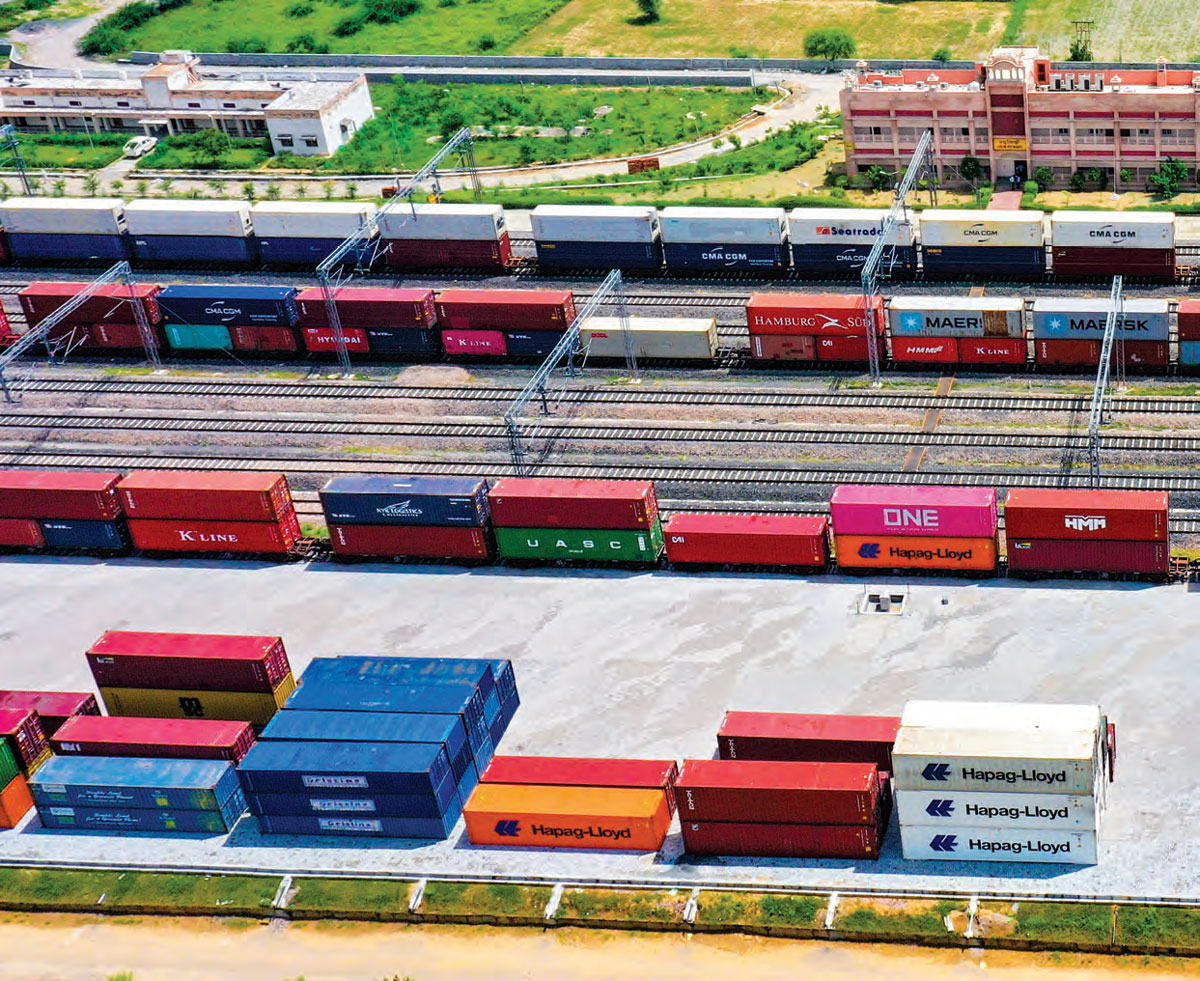
The Western Dedicated Freight Corridor (WDFC) is more than infrastructure; it is a strategic inflexion point for India’s manufacturing, exports, and the long-awaited shift from road to rail, writes Lalit Chandra Trivedi.
India’s freight logistics story is being rewritten, not on a highway, not at a seaport terminal, but on a dedicated railway corridor that stretches nearly 1,500 km from Dadri in Uttar Pradesh to Jawaharlal Nehru Port Authority (JNPA) in Mumbai. The Western Dedicated Freight Corridor (WDFC) is more than just an infrastructure project. It is a strategic inflexion point for India’s manufacturing competitiveness, export ambitions, and its long-overdue shift from road to rail for bulk and containerised freight. The WDFC is not just a freight corridor. Decades of planning, political will, engineering resolve, and financial patience have converged to create an asset that has the potential to transform India’s logistics GDP.
Port connectivity push
India’s western coastline is home to its most consequential port cluster.
JNPA, Mundra, Kandla, Pipavav, and Hazira collectively handle a dominant share of the country’s container and dry bulk trade. For decades, the freight movement from these ports to the industrial heartland of North India—Punjab, Haryana, Rajasthan, the Delhi NCR—has depended on a rail network that simultaneously served the densest passenger traffic in the world.
The result was predictable: freight
trains were delayed, slow, and unreliable. Average freight train speeds on the congested Western Railway mainline hovered in the
20-25 km per hour range, commercially unviable for time-sensitive cargo. Shippers migrated to road transport despite higher costs, congestion, and emissions.
The WDFC changes this equation fundamentally. With a dedicated double-stack container train corridor capable of sustaining speeds of 100 km per hour for freight,
transit times from Mundra to Dadri can drop from over 60 hours to under 16 hours. That is not an incremental improvement; it is a supply chain revolution.
Manufacturing belt spine
The WDFC traverses one of India’s most industrially significant geographies. Gujarat alone accounts for over 16 per cent of India’s industrial output, with major manufacturing clusters in automotive, chemicals, pharmaceuticals, textiles, and petroleum products. Rajasthan is emerging as a significant player in cement, minerals, and renewable energy equipment manufacturing. The Delhi-NCR belt anchors India’s consumer goods and FMCG distribution networks.
The corridor’s alignment through these states is not coincidental; it reflects a deliberate attempt to create a logistics spine that serves existing industry while inducing investment into new industrial clusters along its route. The operator, Dedicated Freight Corridor Corporation of India (DFCCIL), has planned multimodal logistics parks and freight terminals (MMLPs) at strategic points along the alignment. These are not simple railway yards. They are designed as integrated freight villages with customs-bonded warehousing, container freight station (CFS) facilities, cold chain storage, and last-mile road connectivity.
When this infrastructure matures, the WDFC corridor will not merely move goods; it will anchor the next wave of industrial investment in India’s interior, reducing the tyranny of coastal geography that has historically constrained manufacturing location decisions.
Double-stack advantage
One of the WDFC’s most underappreciated technical features is its design for double-stack container operations. The corridor has been built with a high overhead electrification clearance of 7.45 metres, specifically to permit the stacking of two standard ISO containers vertically on a single flatcar. This doubles the container payload per train without doubling the number of train slots.
For a country where rail capacity is perpetually constrained, this is a profound efficiency gain. A single double-stack freight train on the WDFC can carry the equivalent
of over 150 truckloads. The implications for decongesting national highways, reducing logistics costs, and cutting carbon emissions are enormous. India’s logistics cost as a percentage of GDP is estimated at 13-14 per cent, compared to 7-8 per cent in developed economies. Double-stack operations on the WDFC are one of the most credible tools to close that gap.
Port integration edge
The WDFC’s value proposition is critically dependent on seamless port integration. For Mundra— India’s largest commercial port by container volumes—the freight corridor connectivity via the Sanand-Sachin link and the Palanpur junction brings direct rail access to the national freight network for the first time at scale. JNPA—historically the dominant container gateway—connects through the Jawaharlal Nehru Port Railway terminal that feeds into the WDFC alignment.
What matters most is not just the physical connectivity but the systems integration. Electronic data interchange (EDI) between port terminal operating systems, DFCCIL’s Freight Operations Information System (FOIS), and customs must operate seamlessly. The goal is a world where an importer in Ludhiana can track their container from vessel discharge at Mundra to the MMLP at Ludhiana in real time, with predictable transit windows. We are not entirely there yet, but the WDFC provides the physical backbone on which this digital freight ecosystem must now be built.
Private freight framework
Indian Railways has opened freight train operations to private container train operators (CTOs) for over 15 years. Names such as the Container Corp. of India (CONCOR), APM Terminals, Hind Terminals, and several others have been operating container trains on the Indian network. The WDFC represents a transformative upgrade to the track infrastructure available to these operators.
However, the real opportunity lies in expanding the freight train operator ecosystem. The forthcoming private freight train frameworks, including Automobile Freight Train Operators (AFTOs) and Special Freight Train Operators (SFTOs), will bring new players into rail freight for time-sensitive, high-value cargo.
The WDFC’s speed and reliability credentials make it a natural platform for this next generation of private freight services. If Indian Railways manages slot allocation, haulage pricing, and terminal access fairly and transparently on the WDFC, it could attract exactly the kind of shipper migration from road to rail that has eluded the system for decades.
Pending priorities
The WDFC is near completion, but near completion is not the same as full operational readiness. Several critical enablers remain works-in-progress. Terminal development at key MMLP nodes needs to be accelerated.
The DFCCIL’s commercial and operational management capabilities—distinct from the engineering competencies that built the corridor—need institutional strengthening. Pricing must be calibrated to compete with road transport on the total logistics cost equation, not merely on track haulage.
Most importantly, the corridor’s success will be judged not by trains run but by cargo shifted from road to rail. That shift requires active shipper engagement, service reliability demonstration, and a willingness by the operating entity to be commercially accountable in ways that Indian Railways has not always embraced.
National asset moment
The WDFC is, in every meaningful sense, a national asset at a threshold moment.
The infrastructure has been built at considerable cost and effort. The Japanese Official Development Assistance (ODA) financing that underpinned the project reflects international confidence in India’s long-term freight growth story. The question now is whether India’s logistics ecosystem—shippers, port operators, warehouse developers, private train operators, and technology providers—will rise to meet the corridor with the commercial energy it deserves.
India’s logistics competitiveness is not just a cost issue; it is a strategic issue. In a world where global supply chains are being restructured and India is positioning itself as an alternative manufacturing hub to China, the ability to move goods reliably, swiftly, and cheaply from port to factory and factory to port is a sovereign competitive advantage. The WDFC is India’s most powerful infrastructure response to that challenge.
The bridge has been built. It is now time to move the freight across it. India cannot afford to let this one gather dust.
About the author:
Lalit Chandra Trivedi, CEO, LCT Engineers, and former General Manager of Indian Railways, brings over 38 years of expertise across rolling stock, signalling, freight infrastructure, and urban rail.
Dedicated Freight Corridors: Powering India’s Logistics Transformation
India’s logistics transformation is being accelerated by the Dedicated Freight Corridor (DFC) programme, implemented by DFCCIL. Building on the success of the Eastern and Western corridors, the East-West DFC has been announced in the Union Budget 2026, further strengthening connectivity between industrial clusters and logistics hubs nationwide.
- Fully operational Eastern and Western corridors now carry 13% of India’s rail freight.
- Over 135,000 freight trains operated in FY 2025-26, with more than 400 trains daily.
- Rudrastra’, India’s longest freight train, ran 209 km with 354 wagons.
- 110.5-metre rail flyover girder launched at Kalamboli, Western DFC.
- AI-powered Machine Vision Inspection Systems enable predictive maintenance.
- Logistics ecosystem: Gati Shakti terminals and hubs aim to cut logistics costs to ~8% of GDP.
- DFCCIL has collaborations with Monash University for railway research, IRFC for refinancing, and Esri India for geospatial integration.