A smart city is not only about cutting-edge technology, gadgets guiding your lifestyle or using ICT (Information and Communications Technology) but also to string together a man-machine interaction that will drive our socio-economic engagement in the society.


Tag: GDP
Post

Post
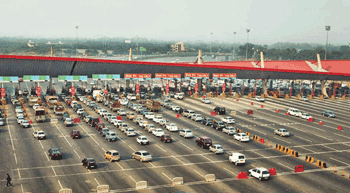
Embarking on Seamless Mobility
It is a well-known and widely accepted datum that infrastructure is the backbone of a sound and growing economy. Amongst all infrastructure, the transport sector facilitates trade and migration, thereby raising productivity in other parts of the economy and directly contributing to the economic growth.
Post

We aim to be the first digital tanker company in India
With its new office establishment in Mumbai, Maersk Tankers India is well-positioned to contribute to India's growing energy demand and strengthen its service offerings to its customers and partners.
Post
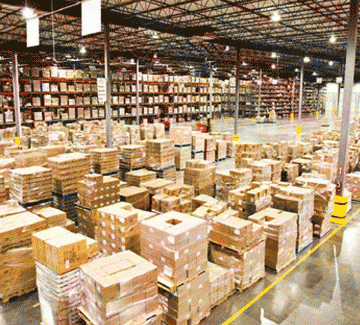
Need an Integrated Logistic Policy
The logistics industry has always been an underdog and has not received the much-deserved attention yet. Though the sector is full of potential, it is yet to achieve optimal utilisation of resources.
Post
Investment close to Rs.250 billion is expected for ultra-solar park
With Vibrant Gujarat scheduled next year, the government is going all guns blazing to make this summit one of the mega events of the country.
Post

Public Spending: Can the Government keep up the Tempo?
Resumption and broad-basing of private investments has become critical to sustain the share of infrastructure investments.
Post

Housing for All to attract USD 1.3 trillion into residential by 2025
In order to fulfill the various schemes by the government, India needs investments up to USD 4 trillion over the next 5-6 years.
Post

SC bans construction activities for states and UTs; but respite for Maharashtra and Uttarakhand
The Supreme Court has stayed all construction activities in states and Union Territories which do not have a solid waste management (SWM) policy under the Solid Waste Management Rules, 2016.
Post

Dholera: A New Era
Greenfield Dholera industrial city is targeting industries such as defence and aero, heavy engineering, auto and auto ancillaries, general manufacturing, pharma and biotechnology, electronics industries, IT and ITES, and agro and food processing. These industries are expected to create around one million job opportunities.
Post

The Order Book Chase
Total order backlog of the engineering and construction firms was Rs.8.1 trillion at the end of FY18. Of the whole order backlog, almost 62 per cent was contributed by the construction companies, followed by 24 per cent of capital goods companies catering to the energy industry.