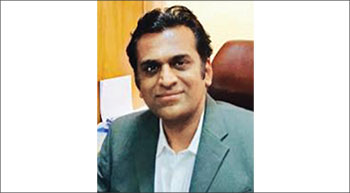
<span style="font-weight: bold;">Nandan Yalgi, Managing Director, Boxco Logistics India Pvt Ltd,</span> lauds the efforts of the Ministry of Shipping in launching port-led development projects that will eventually bring down logistics costs across the country. <br />
<br />
<span style="font-weight: bold;">Of all the governmental schemes like Sagarmala which ones have benefited the industry the most?</span><br />
The Indian shipping and logistics industry has been gaining traction, with e-commerce penetration, economy revival, proposed GST implementation and government initiatives like the ‘Make in India’ campaign, National Integrated Logistics Policy, 100 per cent FDI in warehouses and food storage facilities, Dedicated Freight Corridor, Delhi-Mumbai Industrial Corridor, and the ‘Blue Revolution’ called Sagarmala.<br />
<br />
All the above initiatives are enablers which are giving a thrust to the shipping and logistics sector. This year’s Budget has seen a record allocation for infrastructure development, which stands at Rs 3 lakh crore. <br />
<br />
For the transportation sector itself – including railways, road and ports ù the budget allocated is around Rs 2 lakh crore. Such investments will accelerate economic development and create employment. <br />
<br />
<span style="font-weight: bold;">Compared to the norms in advanced countries, around 18 per cent of a product’s landed cost is made up by logistics. Will this scenario ever change?</span><br />
Scenarios are dynamic and will keep on changing. Currently, logistics cost in India is at 18 per cent as compared to China which is at 8 per cent. It is imperative to bring this down to a single-digit level, so that our exporters have a competitive edge globally. I would like to congratulate our dynamic Minister Nitin Gadkari whose prime focus is port-led development through the Sagarmala initiative, which will revolutionise logistics in India. <br />
<br />
The government has also readied a multimodal transport plan which includes setting up of 35 multimodal logistics parks at an investment of Rs 50,000 crore. This strategy will involve a resetting of India’s logistics sector from a ‘point-to-point’ model to a ‘hub-and-spoke’ model involving railways, highways, inland waterways and airports, which will put in place an effective transportation grid. <br />
Such integrated and cohesive initiatives by our government will change the scenario. <br />
<br />
<span style="font-weight: bold;">Do you feel the Indian Railways is doing enough to enable seamless connectivity of shipments, or will the roads sector continue to account for the maximum movement of freight across the country? </span><br />
Port connectivity is extremely crucial for seamless movement of goods. Currently, movement of goods in our country is dominated by roads, but a need for modal shift of cargo movement is crucial from only roads or rail to (the) road-rail-waterways (mode), which will not only reduce logistics costs, but will also be environment friendly.<br />
<br />
The Indian Railways has undertaken several initiatives to boost seamless connectivity of shipments. Indian Port Rail Corporation Ltd (IPRCL) – a JVC between Major Ports under the Ministry of Shipping and Rail Vikas Nigam Ltd – was envisioned to improve the rail connectivity network for speedier, congestion-free and non-polluting movement of cargoes across the country.<br />
<br />
Execution of the Eastern and Western Dedicated Freight Corridors has been fast tracked. The Railways is also creating a robust logistics network which will boost freight traffic movement. It has proposed logistics parks and warehouses along railway lines on PPP mode.<br />
<br />
<span style="font-weight: bold;">Safety on Indian roads continues to be a major issue. Has the government done enough to address the situation?</span><br />
Almost 1.5 lakh citizens give their lives and close to 5 lakh get injured on our roads. The Ministry of Road Transport & Highways has set a target to reduce this figure by half over the next three years. Recently, Gadkari urged all major automobile manufacturers to adopt stretches of highways for fixing ‘black spots’, setting up trauma centres and providing lifesaving ambulances. <br />
<br />
Several initiatives have been taken by the government like the National Highway Accident Relief Service Scheme, National Road Safety Policy and the setting aside of Rs 11,000 crore for eliminating ‘black spots’ on National Highways.<br />
<br />
<span style="font-weight: bold;">Lack of adequate depth and absence of port-side connectivity have been the two major factors curbing the developments of the port-led trade. Can these obstacles be overcome?</span><br />
India is planning investments of around Rs 1 lakh crore in port modernisation and new port development. Investments worth Rs 2 lakh crore have also been planned to improve rail and road connectivity. Total investments to the tune of $30 billion are being planned in order to improve connectivity across the country. The Ministry of Shipping has chalked out a roadmap over the next five years, where significant investments would be made in the sector to boost trade and development. <br />
Major Ports are already being targeted for expansion, modernisation and upgradation of infrastructural facilities under the Sagarmala project.<br />
<br />
Private players like Adani, JSW and the JM Baxi Group have been participating in developing private terminals with modern mechanised material handling systems,benchmarked to international standards.<br />
<br />
Ports like Kandla and Mundra have surpassed the 100 MMT cargo handling mark. Recently, we have seen the largest dry bulk vessel of 200,000 DWT berthing at JSW Jaigarh Port. We are observing that our ports – both major and non-major – are gearing up for handling of Next Generation Vessels along with faster and more efficient ways of evacuation. Hence, I don’t see any factors curbing developments of the trade in this sector, going forward.<br />
<br />
<span style="font-weight: bold;">- Rahul Kamat</span><br />


Multimodal transport plan will reset India’s logistics sector
Leave a Reply
You must be logged in to post a comment.