

India’s energy future isn’t just about getting more megawatts; it’s a journey where wind power helps the country become independent, boosts industry, and supports its goal of becoming net-zero, writes Amit Kansal.
India’s renewable energy story has garnered global attention, but one chapter of that story comes with special promise: wind energy. India, once a global leader in onshore wind, now stands at a crossroads. As of Aug-2025, India remains the world’s fourth-largest wind energy market, with a cumulative installed capacity exceeding 52 GW, according to data from the Ministry of New and Renewable Energy (MNRE).
With the nation committed to 500 GW of renewables by 2030, the time has come for wind to take its place at the centre of the energy mix again.
While wind and solar have grown rapidly in tandem, wind offers distinct advantages: higher capacity utilisation, nighttime generation, and grid stability. The latest GST 2.0 reforms support this transition, as they are expected to improve the viability of the projects and will also deliver a better levelised cost of energy (LCOE). Furthermore, the GST revision will help increase the share of domestic manufacturing in new installations each year. The rationalisation also makes the manufacturing ecosystem more supportive and easier to grow. Increasingly, as India’s energy demand continues to grow and dependability becomes a requirement for its grid, wind is a necessity.
Why wind matters
The next ten years will not be only about scaling renewables. It will be about constructing an energy ecosystem that is reliable, affordable, and sustainable. Wind has inherent properties that support the diversification of generation profiles, supply smoothing, and 24×7 renewable energy. Hybrid wind-solar projects, which are increasingly complemented by battery storage, are already demonstrating how India can deliver firm renewable energy at scale. The hybrid wind-solar installations in Karnataka, for example, have shown how variability can be reduced and curtailed, and that it can provide a predictable supply to consumers.
In addition to electricity generation, there are also economic and resiliency benefits associated with wind. Wind is one of the most localised renewables, with a substantial part of its value chain being constructed in India. Each gigawatt generated by wind energy creates thousands of jobs along the entire value chain, in manufacturing, logistics, construction, and operation. For India, which is actively seeking to be a global manufacturing player, wind is a suitable answer for energy security, industrial growth, and jobs. The dual value of both clean power and economic development makes wind a national strategic priority.
Navigating the past
The path has not always been easy, with land acquisition bottlenecks, permitting process delays, and transmission infrastructure constraints curtailing the rate of new capacity growth. In many instances, developers found disruptive gaps between project timelines and grid readiness, while investors were uncertain about tariffs and long-term offtake reliability.
While these barriers may have felt reflective of stagnation, they were not structural barriers. Rather, they represented the necessary growing pains of a sector evolving from its early-phase turn with early growth, into a more mature, competitive, and technology-enabled sector. We are witnessing a necessary transformation, where once peripheral delivery issues are now central to the experience. We are beginning to confront these challenges directly and establish a new foothold.
Winds of change
Alongside regulatory reforms, fiscal measures are also reinforcing confidence. Recent GST revisions have lowered the rate on solar and wind equipment, including modules and nacelles, from 12 per cent to 5 per cent. In contrast, coal and lignite now attract an increased rate of 18 per cent, up from 5 per cent. By reducing input costs for renewable developers while simultaneously raising the cost of fossil fuels, these revisions provide a clear market signal: India is prioritising clean energy as the backbone of its growth story.
We are now coupling these rational outcomes with substantial infrastructure programmes like the Green Energy Corridor. This initiative is building transmission capacity and addressing evacuation constraints. Under the PM Gati Shakti masterplan, we are integrating energy infrastructure with logistics, land use, and industrial zones. This ensures that energy projects are built within broader economic frameworks.
Innovation to the fore
Completing the path to maturity in the policy landscape and the industry is responding quickly in tandem. Domestic manufacturers have now reached a level of maturity where they are building large rotor turbines. These turbines can harness energy even in low wind speeds. This is a shift from the earlier greenfield stage, which focused on enhancing energy harnessing across India’s diverse wind regimes. Meanwhile, predictive analytics, digital twins, and systems which utilise AI to optimise maintenance are driving down downtime and costs, whilst simultaneously increasing generation.
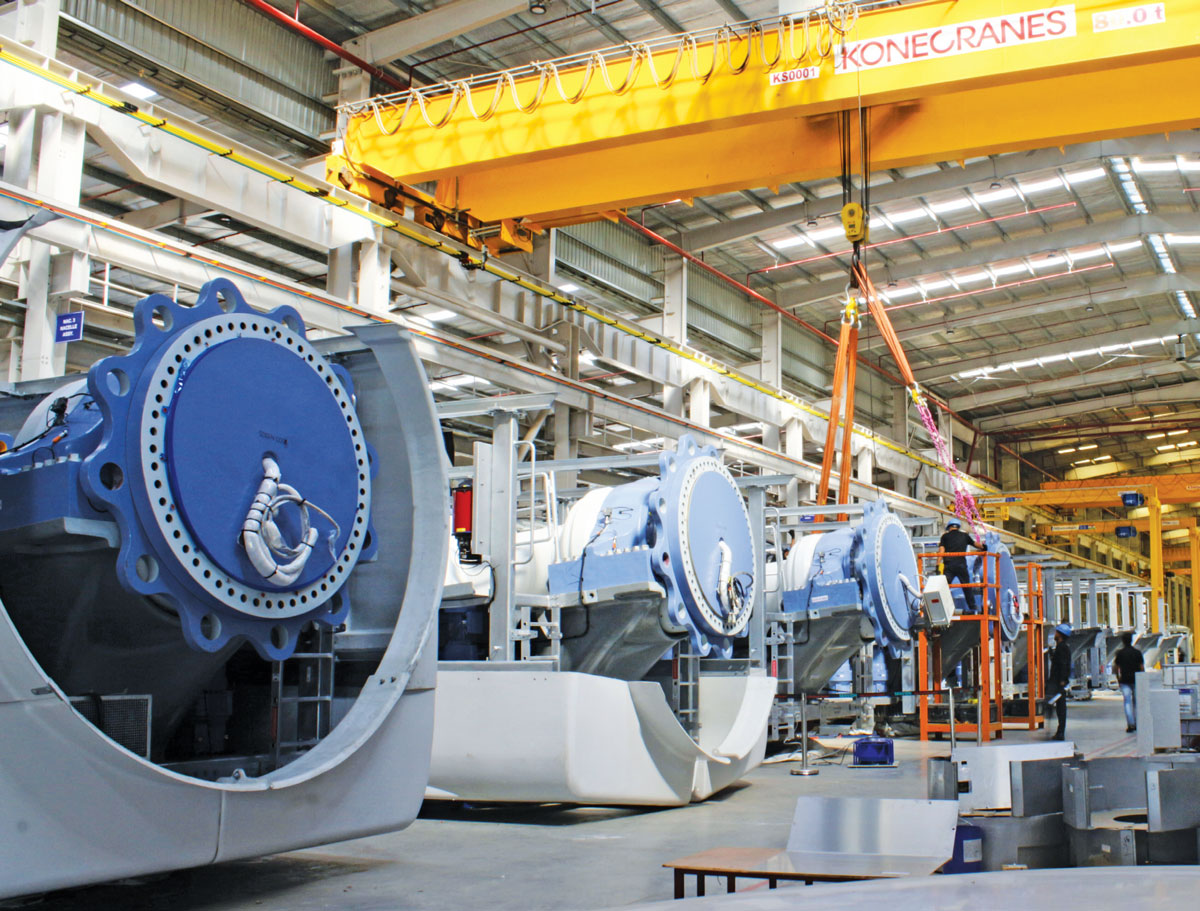
The wind industry is also ready to play a critical role in fuelling India’s manufacturing story. Already over 70-80 per cent of the
wind value chain is localised, from blades and towers to nacelles and gearboxes. With GST efficiency and policy tailwinds, India has moved from a country of deficit to a country of surplus and is a potential exporter of cleantech equipment across the world. Supported by engineering partnerships, technology transfers, and supply chains that do not snap, India is slowly emerging as a real hub for renewable manufacturing.
In the field, the scale of projects is accelerating. In Gujarat, the Khavda Renewable Park is envisaged as a 30 GW complex, which will include significant wind, alongside solar and storage in large-scale renewables. Such megaprojects also suggest that relying on wind systems alone is an older way of managing interdependent architecture. These projects serve the common purpose of consistent energy growth at regional or national scales. In such systems, projects are geographically collocated, and broad energy demand requirements can be met using many different technologies.
Path to sustainable growth
Moving forward, three priorities will define the growth trajectory for wind in India.
First, speed and scale. Multi-GW wind parks should be the new normal. Getting there involves expedited approvals, prioritisation of land, and grid readiness at the time of project rollout. If executed well, India could easily add 8-10 GW of wind capacity every year, and realistically pursue the wind target of 100 GW.
Second, a seamless government-industry representational construct. Policy intent and private sector readiness need to meet at a common point. Whether it involves synchronising land acquisition with grid expansion, or ensuring that tariff structures are grounded in actual grid and market conditions, consistent alignment will be critical to execution. The government has demonstrated and expressed willingness to dialogue,
and the industry is robust with capital and technology. Industry-government partnership will, therefore, be a defining factor behind
future growth.
Third, leading-edge technologies. Higher hub-height turbines, AI predictive maintenance, and improved energy storage will position wind as an around-the-clock, dispatchable option. Alternating wind deliveries with pumped hydro and battery systems can create dispatchable firm capacity, and transition to a disaggregated energy system that a scale-enabling industrial economy requires.
Wind’s second innings
India’s wind sector is entering its second innings. It will be larger, stronger, and better than the first innings. Building blocks are already there: supportive policy environment, domestically manufactured competitive base with global standards, maturing grid, recent fiscal reforms like GST rationalisation, and growing monetisable investor interest in hybrid and storage-backed projects.
The coming decade is not just about megawatts; it’s about having wind at the heart of India’s energy independence,
driving industrial competitiveness, and playing a key role in the net-zero goals. If the last decade was about solar’s meteoric rise, the next decade must be about wind returning to its rightful position in the country’s renewable energy journey.
The commitment is clear. The sector is ready. The momentum is back. With our collective ambition, India has a real opportunity to ride the returning tailwinds to not only meet but exceed our renewable energy targets and set the benchmark for the world.
About the author:
Amit Kansal, CEO & Managing Director, Senvion India
Wind Power: India’s Strategic Advantage
24×7 Renewable Backbone
Wind complements solar with night time generation and grid stability.
Hybrid Synergy
Wind-solar-battery hybrids reduce variability and ensure predictable supply.
Localised Value Chain
Over 70-80% of wind components are manufactured in India.
Job Creation Engine
Each GW of wind capacity supports thousands of jobs across sectors.
Energy + Economic Security
Wind delivers clean power while fuelling industrial growth and self-reliance.
Enabling Policy Environment
Policy Tailwinds Powering Wind
GST 2.0 Boost
Wind equipment GST cut from 12% to 5%; fossil fuels raised to 18%.
Green Energy Corridor
Transmission upgrades reduce evacuation bottlenecks.
PM Gati Shakti Integration
Energy infra now aligned with logistics and industrial zones.
Land & Grid Synchronisation
Faster approvals and grid readiness are now policy priorities.
Industry-Government Dialogue
Collaborative frameworks are shaping execution and tariff reforms.
Wind’s Second Innings: Scale, Tech, Trade
Multi-GW Wind Parks
Projects like Khavda, Gujarat, signal a new scale of ambition.
Advanced Turbine Tech
Larger rotors and higher hub heights enable low-wind harnessing.
AI & Predictive Analytics
Digital twins and smart maintenance cut costs and boost output.
Export-Ready Manufacturing
India now produces surplus cleantech equipment for global markets.
Firm Capacity Models
Wind + storage systems offer dispatchable, industrial-grade energy.