

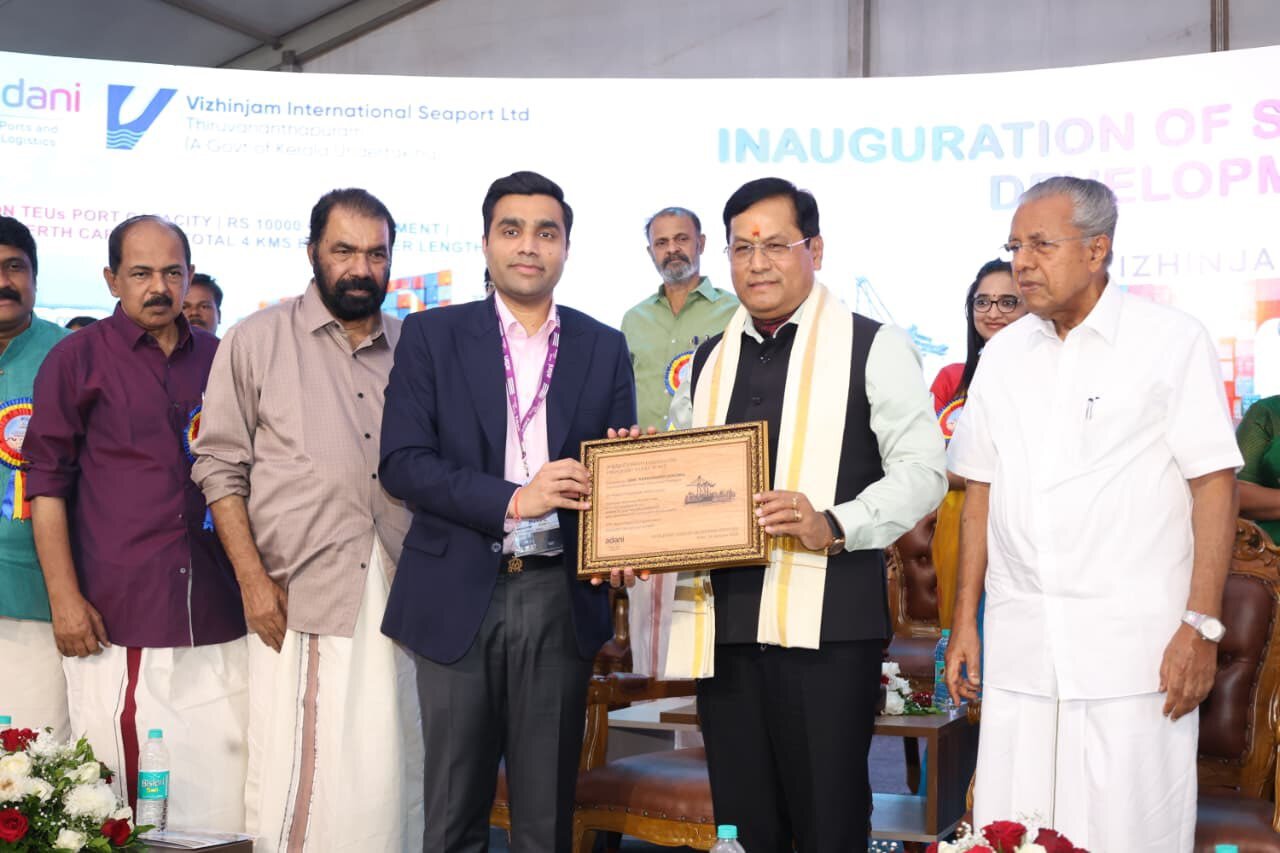
The expansion marks the commencement of construction works for Phases II, III and IV of Vizhinjam International Seaport, under a fast‑tracked integrated programme.
Union Minister for Ports, Shipping and Waterways Sarbananda Sonowal has said that capacity expansion at Vizhinjam Port will substantially reduce India’s dependence on foreign hubs for transhipment of merchant cargo.
Inaugurating the expansion at India’s deepest natural seaport near Thiruvananthapuram, Sonowal remarked, “The rapid operationalisation and expansion of Vizhinjam International Seaport reflects India’s focused approach towards building world‑class port infrastructure. The capacity augmentation will play a critical role in reducing India’s dependence on foreign transhipment hubs, improving logistics efficiency, and supporting the growth of India’s external trade.”
The inauguration marked the commencement of construction works for Phases II, III and IV of Vizhinjam International Seaport, under a fast‑tracked integrated programme. The expansion aims to substantially augment India’s container transhipment capacity and strengthen the country’s maritime infrastructure ecosystem.
Sonowal further noted that Vizhinjam’s development is aligned with national objectives under Maritime Vision 2030 and Amrit Kaal Vision 2047, contributing to a resilient, efficient and globally competitive maritime sector.
A transhipment port enables large container vessels to offload cargo, which is then redistributed to smaller feeder ships for onward destinations. Presently, the Government of Kerala and Adani Vizhinjam Port Private Ltd joint venture (JV) operates India’s only transhipment hub. Another two hubs are planned at Galathea Bay in Great Nicobar and at Vallarpadam in Kochi.
Expanding Throughput
Vizhinjam International Seaport commenced commercial operations of Phase I in December 2024, with a designed capacity of 1 million TEUs. Within a short period, the port has handled over 1.43 million TEUs, operating at more than 130 per cent capacity utilisation. It has established direct connectivity with major global shipping routes across Europe, the Americas, Africa and the Far East, reinforcing its role as a key national transhipment terminal.
Kerala Chief Minister Pinarayi Vijayan said, “Vizhinjam is currently serving mainly Indian container ports as a transhipment port. With the completion of Phase 2 development, Vizhinjam will become the transhipment hub of the whole world including Asia, Europe, America and Africa.”
Under the augmentation programme, the existing container berth will be extended to create a continuous 2‑km berth, the longest in India. The breakwater will be extended to 3.88 km, and additional container yards will be developed through sea reclamation. The port’s cargo handling capacity will be strengthened with new ship‑to‑shore and yard cranes, enabling handling of next‑generation container vessels of up to 28,000 TEUs. On completion, Vizhinjam will be capable of handling up to five mother vessels simultaneously, with throughput capacity of 5.7 million TEUs per annum.
The expansion works are being undertaken pursuant to a supplementary concession agreement signed in November 2024 between the JV partners, advancing the project timeline by nearly 17 years, with completion targeted by December 2028. The total investment envisaged for Vizhinjam International Seaport is approximately ₹160 billion, including about ₹74 billion for the expansion phases.