

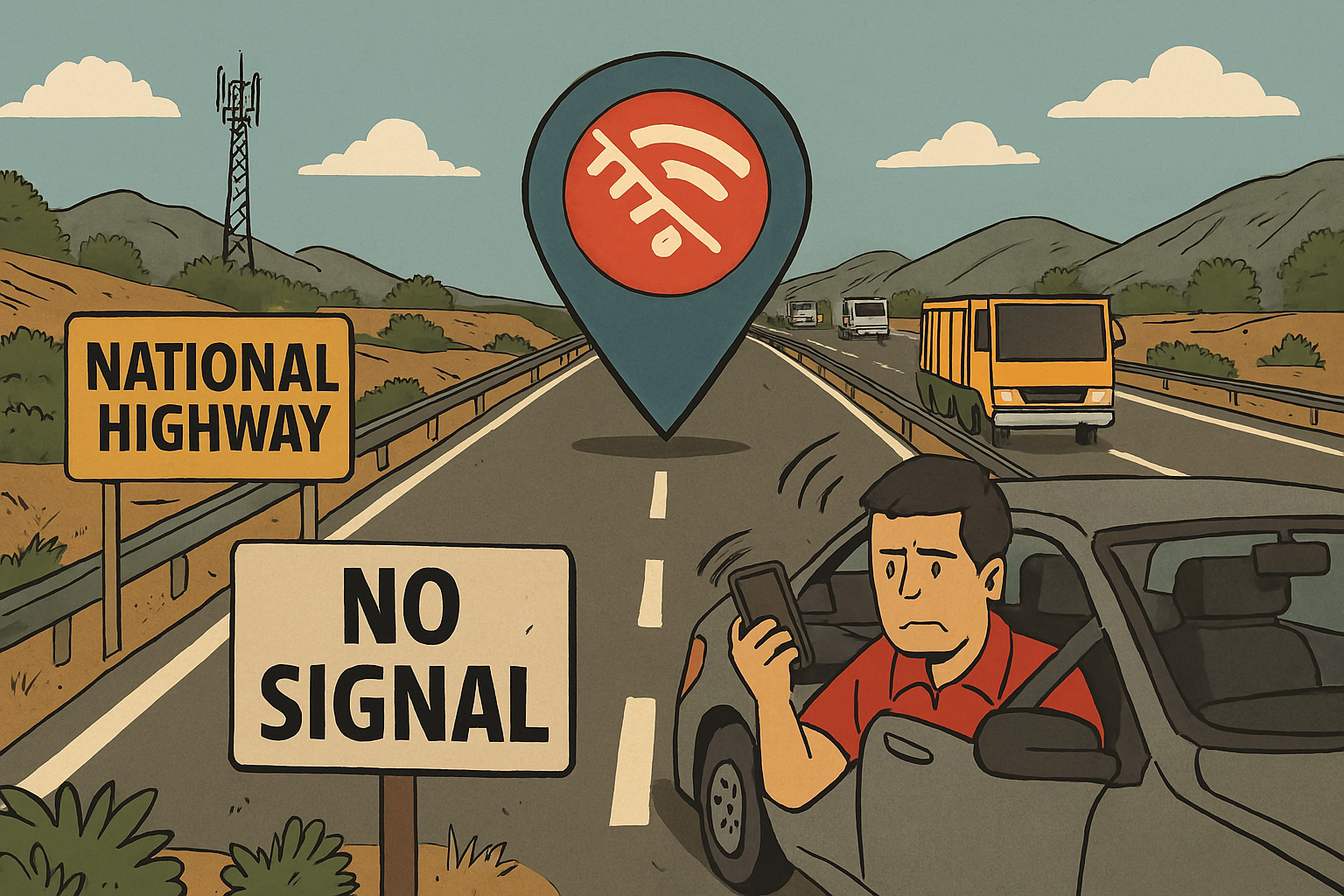
Citing safety concerns and the strategic role of highways, NHAI has pressed for urgent, coordinated measures to deliver seamless connectivity nationwide.
The National Highways Authority of India (NHAI), India’s apex highway development agency, has flagged critical mobile network connectivity issues across several stretches of the national highway network and sought urgent intervention from the concerned regulators.
NHAI has urged the Department of Telecommunications (DoT) and the Telecom Regulatory Authority of India (TRAI) to direct telecom service providers (TSPs) to address the non‑availability of mobile coverage, particularly on greenfield corridors and remote sections.
Highlighting the public safety implications and the strategic importance of the highway network, NHAI has called for an expeditious and coordinated approach to ensure seamless connectivity across the country’s road corridors.
As part of a comprehensive assessment, NHAI identified 424 locations spanning nearly 1,750 km of highways as critically affected due to poor or absent mobile coverage. Detailed information on these stretches has been shared with DoT and TRAI for immediate action.
“By seeking intervention to address mobile network connectivity gaps and enhancing safety along National Highways, NHAI reaffirms its commitment to working in close coordination with all concerned stakeholders to ensure that the National Highway network is not only physically well‑connected but also digitally enabled,” the authority said in a statement on Tuesday.
The absence of dependable mobile coverage on remote and rural highway sections adversely impacts operations, emergency response mechanisms, and delivery of technology‑enabled public services.
In addition, NHAI has requested TRAI to instruct telecom operators to disseminate proactive SMS or Flash SMS alerts at geo‑mapped accident‑prone locations, including stretches affected by stray cattle movement and other hazards. These alerts are intended to reach road users before they arrive at such locations, enabling timely caution and safer driving behaviour. A list of accident‑prone stretches has already been shared with TRAI.