

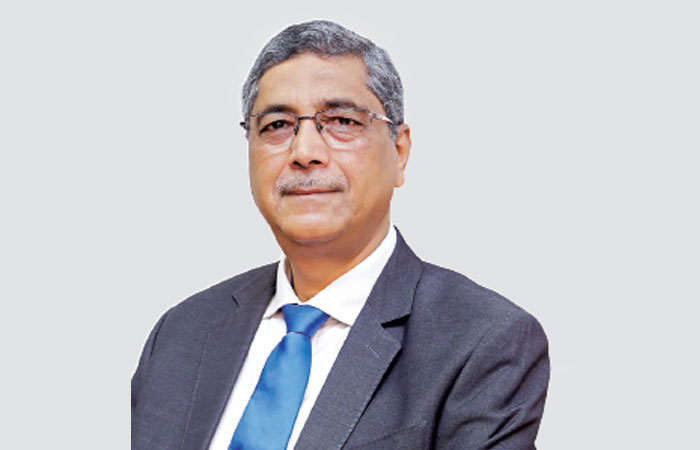
Following the extensive overhaul of its Pipavav shipyard since the January 2024 acquisition and renaming, Rear Admiral (Retd) Vipin Kumar Saxena, CEO, Swan Defence and Heavy Industries (SDHI), told INFRASTRUCTURE TODAY’s Manish Pant that the facility is now ready to receive shipbuilding orders, including MRO projects. A Navy veteran, Saxena previously headed Garden Reach Shipbuilders & Engineers, where he drove operational and performance enhancements. His next mission: embedding design, engineering, supply chain, and project management competencies at SDHI. This directly aligns with India’s ambition to become a global maritime manufacturing hub. Edited excerpts.
How do you see the passage of five critical maritime bills and the Union Cabinet’s Rs.697 billion package impacting the sector?
These reforms are a long-overdue correction. For decades, commercial shipbuilding in India lacked government support, despite our vast coastline and port infrastructure. Countries like China, Korea, and Japan succeeded because their governments actively nurtured the ecosystem. That kind of intervention was missing here. The recent policy decisions finally acknowledge that shipbuilding is strategic, not just industrial. They send a strong signal to the maritime community and lay the groundwork for a robust, self-reliant ecosystem.
In June, Indian shipbuilding firms secured a record number of deals at Nor-Shipping in Oslo. Do you see this as a global endorsement for Make in India and a leap into emerging trends?
Absolutely. I was at Nor-Shipping, and the experience was telling. The Ministry of Ports, Shipping and Waterways took the lead in bringing together public and private players under a unified India Pavilion. That presence—backed by government intent—sent a clear message: India is serious about shipbuilding. We engaged with clients, agents, and designers from across Europe, and the response was encouraging. And it’s not just Oslo; delegations are now regularly participating in events in Korea, Germany, and the UK. When the government sits at the table, it lends credibility and confidence. These interactions, coupled with recent policy reforms, show that India is not just aspiring but actively positioning itself as a global player. The visibility we are gaining abroad is unprecedented. For decades, we lacked this kind of sustained focus. Now, there’s momentum, and it’s helping us stand shoulder to shoulder with established shipbuilding nations like Japan and Korea. It’s a shift from aspiration to assertion.
Maintenance, repair and overhaul (MRO) is another important aspect.
NITI Aayog projects India’s this to grow from $1.7 billion in 2021 to $4 billion by 2031. Could actual growth surpass these estimates?
It’s possible, provided we address foundational gaps. For decades, refits and major upgrades weren’t taken seriously. Beyond CSL (Cochin Shipyard Ltd) and a few smaller players, there wasn’t much capacity. MRO requires strong vendor ecosystems, clusters with domestic and foreign OEMs (original equipment makers), and rapid turnaround capabilities. That’s where maritime clusters become critical. The government’s push through the Shipbuilding Development Scheme is timely. At SDHI, we are developing a maritime cluster within our 200-acre facility, with a dedicated MRO vertical. But policy enablement is key. Places like Dubai and Singapore have succeeded because they streamlined processes, including customs, spares, and specialist access. We still face regulatory hurdles in bringing in foreign experts or importing critical components. These issues have been flagged to the government, and I believe they will be resolved in time.
Geographically, we are well placed. India’s peninsular location and proximity to trade routes give us a natural advantage. SDHI, CSL, and L&T (Larsen & Toubro) are all strategically located to tap into regional MRO demand. The roadmap is clear: if we want to be a global shipbuilding player, we must build a complementary MRO ecosystem. It’s not just about building ships; it’s also about sustaining them. With the right policy support, I am confident we will not only meet but possibly exceed the projections laid out by NITI Aayog.
Would you be servicing MRO as a subsidiary business?
Not as a subsidiary; MRO is one of SDHI’s three core verticals. We have laid out a clear roadmap across short-, medium-, and long-term horizons. The first vertical is MRO, which will handle refits, upgrades, and conversions for both domestic and foreign vessels. The second is new shipbuilding, covering defence and commercial platforms. The third is offshore and heavy engineering, where we will work on topsides, jackets, and fabrication for ONGC and other clients, including international players. Each vertical is being developed within our dedicated facility. MRO, in particular, is a strategic focus. It’s early days for SDHI in its new avatar, and credibility in this space takes time. But we have committed to a three-year plan to build capacity and capability across all three divisions. MRO is a different ball game; it demands precision, speed, and trust. We are approaching it with the same seriousness as shipbuilding, because sustaining vessels is as critical as constructing them.
At the recent maritime event in Bhavnagar, entities including SDHI signed agreements worth an estimated $8 billion. How do you see PPPs (public-private partnerships) shaping India’s shipbuilding ambitions?
India’s shipbuilding ambitions hinge on robust PPPs. With four major DPSU (defence public sector undertaking) shipyards—GRSE (Garden Reach Shipbuilders & Engineers), HSL (Hindustan Shipyard Ltd), GSL (Goa Shipyard Ltd), and MDL (Mazagon Dock Shipbuilders Ltd)—alongside CSL and private players like SDHI, L&T, and Chowgule, the ecosystem is expanding. The government’s support for both brownfield and greenfield shipyards, backed by financial assistance and enabling policies, is timely. The MoUs signed at Bhavnagar reflect growing synergy among Indian and foreign entities. Integration across government, industry, MSMEs, and global collaborators is essential. The Indian Navy’s 85-90 per cent indigenisation in warships, including submarines and aircraft carriers, proves what’s possible. Commercial shipbuilding is less complex, and replicating that success is within reach. The push for an Indian-built, Indian-flagged, Indian-operated fleet is transformative. PPPs will help optimise costs, build skill sets, and strengthen the ecosystem. The policies are in place; it’s now up to us to harness them
and deliver.
With India’s largest dry dock, capable of handling vessels up to 400,000 DWT (deadweight tonnage), and a 300-acre fabrication site, SDHI possesses world-class infrastructure. How do you plan to leverage these advantages for future expansion?
This is a golden phase for the country, and SDHI is well-positioned to contribute meaningfully. Since acquiring the facility in January 2024, we have invested heavily in rejuvenation. The dry dock—among the world’s largest—can handle vessels up to 400,000 DWT (dead weight tonnage), and our fabrication capacity stands at 144,000 tonnes annually, accounting for over 30 per cent of India’s total shipbuilding capacity. We have introduced significant automation across the shipbuilding process, enabling us to scale quickly and handle a wide range of vessels. Government policies have been a major boost, helping us engage with international clients, many of whom have already visited the yard. Our promoters have committed $500 million, with $150 million allocated to acquisition and a substantial portion already spent on infrastructure upgrades. The yard is now fully operational and ready to take on new shipbuilding and MRO projects. With this scale and readiness, SDHI is poised to play a pivotal role in India’s maritime ambitions.
SDHI currently accounts for 30 per cent of India’s total shipbuilding capacity.
Are there plans to enhance this further, and what market share do you aim to achieve globally?
Rather than market share, our focus is on strategic segments. SDHI is rebooting with new promoters, renewed government trust, and a clear roadmap across short-, medium-, and long-term horizons. Our initial thrust is on niche, highly engineered vessels such as offshore platforms, cabling and pipelining vessels, flood net carriers, gas carriers, MR (medium range) tankers, and chemical tankers. We have signed an MoU with Royal IHC of the Netherlands and are also in talks with Korean players. Larger vessels like VLCCs (very large crude carriers) are also on our radar. To compete globally, we need robust design engineering and a reliable supply chain. Much of the equipment still comes from abroad, so building partnerships and local capabilities is essential. The government’s push for Maritime Centres of Excellence is timely, as skill development is critical. Indian Maritime University’s Vizag campus is being developed into a technical hub. While labour costs are low, our productivity lags behind Korea and Japan. Our goal is to deliver quality ships on time and at cost, backed by deep competencies across design, engineering, supply chain, and project management.
As part of your larger strategy to become a global shipbuilding player, are you also looking at progressively ramping up capacity?
Yes, capacity ramp-up is underway, but it’s being matched by a parallel focus on systems, automation, and design excellence. Under the second phase of expansion, we plan to add slipways, expand jetty infrastructure, install another Goliath crane, and scale up fabrication throughput. An MoU with the Gujarat Maritime Board has been signed, and funding plans are in motion. But infrastructure alone isn’t enough. We’re strengthening design engineering, simulation tools, and project management frameworks to match global standards. Process maturity is as vital as physical assets. Competing globally demands precision, speed, and scale, and we are building those capabilities from the ground up.
How difficult is it to find best-in-class manpower for maritime-related activities in India at this point?
There are three components. First, India is already the third-largest supplier of seafarers to global merchant shipping, and the government is expanding training facilities. Second, the white-collar workforce—design engineers, planners, project managers—remains dependent on imported designs for specialised vessels. Centres of Excellence and top-tier instructors are needed to build indigenous capability. Third, the blue-collar workforce—welders, fitters, electricians—is abundant but lacks productivity and precision. Retention is also a challenge, with skilled workers migrating for better pay. The government is addressing this through smart classrooms, simulators, revised curricula, and schemes like LIFE (Learning and Innovation for Future Excellence). At SDHI, we are training ITI (Industrial Training Institute) graduates, offering stipends, and building a skilled talent pipeline. Aligning capabilities with global benchmarks is essential to building a self-reliant ecosystem.
Your point on manpower skilling becomes even more relevant with the next phase of growth anticipated in hybrid propulsion, autonomous vessels and cyber-secure shipping systems.
Absolutely. Hybrid propulsion, dual-fuel systems, cyber-secure ships, and unmanned vessels are the future. While some MSMEs and institutions are exploring them locally, we remain behind the West. Collaboration with global leaders is essential to absorb and adapt these technologies. We must build capability in green hydrogen, ammonia and methanol-based propulsion, and electric systems, especially as carbon reduction targets reshape maritime operations. This isn’t just about infrastructure; it’s about knowledge, design maturity, and skill. Investing in training, simulation, and advanced curricula is critical. India must move quickly and decisively, not just to follow global trends but to lead in select niches.
With sustainability shaping industries such as road transport, railways, and aviation, what role do you envision for SDHI in the green mobility transition?
Green shipping is central to our future strategy. The government’s GTD programme and focus on sustainable technologies are well aligned with our plans. As a shipbuilding company, SDHI will adopt next-generation propulsion systems, including dual-fuel and low-emission designs. These technologies are no longer optional; they are imperative. We are committed to integrating them into our vessels and operations, ensuring SDHI plays a leading role in India’s maritime sustainability journey.
– Manish Pant
Charting Future Waters: Strategic Signals from SDHI’s Helm
• From Capacity to Capability: With over 30% of India’s shipbuilding capacity, SDHI’s next leap is in systems, automation, and design maturity, vital for global competitiveness.
• Three-Vertical Strategy for Maritime Dominance: SDHI’s roadmap spans MRO, new shipbuilding, and offshore engineering, each with dedicated infrastructure and a three-year capacity-building plan.
• Indigenous Design: The Missing Link: India’s reliance on imported designs for complex vessels must end. Centres of Excellence and domestic design talent are key to long-term self-reliance.
• Skill First, Scale Next: White- and blue-collar productivity remains a bottleneck. SDHI is investing in ITI training, stipends, and simulation-led skilling to meet global benchmarks.
• Green Propulsion, Global Vision: Hybrid, dual-fuel, and low-emission systems are now imperative. SDHI is aligning with India’s GTD programme to lead in sustainable shipbuilding.
• Strategic Partnerships Over Market Share: MoUs with Royal IHC and Korean players signal SDHI’s intent to build niche, high-value vessels, prioritising engineering depth over volume.
• PPP as the Engine of Maritime Growth: SDHI’s tie-ups with Gujarat Maritime Board and Sagarmala Finance Corp. affirm the scale and momentum of India’s public-private shipbuilding push.