Satyan Nayar, Secretary General, Association of Private Airport Operators, shares his views on private participation in aviation infrastructure with Janaki Krishnamoorthi.


Tag: Bangalore
Post

Post

AVG Logistics starts first special train
AVG Logistics started the first private cargo special train from Kerala to Moga near Ludhiana. The train, which will be operated on ´round trip´ basis and weekly once will have stoppage at Erode, Bangalore and Delhi.
Post

Young Turk
Peeyush Gupta, Director, Sales and Marketing, South Asia (UL), brings with him a rich experience of 18 years in the power, healthcare and certification industries. Prior to joining UL, he was at GE BEL (part of GE Medical Systems)
Post
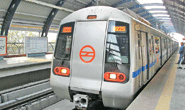
Mobility solutions
The total investment required in urban transport works out to roughly about Rs.1 lakh crore per year for the next 20 years. It is important to find appropriate ways and means to be able to generate this kind of investment.The next phase of India´s growth is predominantly dependent on planned urbanisation and the key to planned urbanisation is robust.
Post
Proud Pioneer
Bharat J Thakkar, an innovative entrepreneur, has been closely involved in the international air cargo industry for over 40 years and has been responsible for many ´firsts´ in India´s air cargo industry, including bonded trucking and door delivery of cargo.
Post

How does the new Land Acquisition Act impact the infrastructure sector?
The subject of land acquisition has been a thorny issue, and Infrastructure Today has been closely following the progress of the legislation that the government has been trying to put in place.
Post

Another milestone in Karnataka's solar plans
Jindal Aluminium Limited (JAL), India's leading manufacturer of aluminium extruded profiles, commissioned the company's first photovoltaic grid connected solar power generation plant at Chitradurga, Karnataka,
Post
Plan Bangalore 2025
The concern about Bangalore's megacity status is its infrastructure. The industry is garnering government support to a "totality" plan worth Rs 2.5 lakh crore over the next 11 years.
Post

Kempe Gowda International Airport: Aerotropolis of the south
Until recently the fastest growing city in the continent, Bangalore now has an airport that is expanding at the fastest rate in the country. With a spanking new Terminal 1A, it now hopes to be the hub of choice for the south.
Post
Automation will reduce commute
Bangalore's dreaded traffic has been debated, but what has escaped much of the media is that several initiatives are in place to limit mobility while augmenting traffic infrastructure.