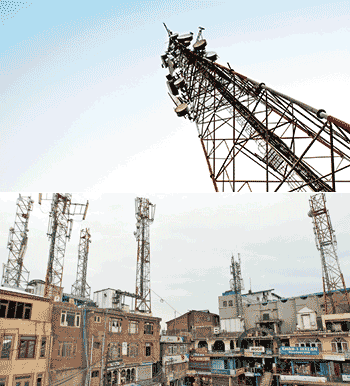
Earlier last month, civic authorities sealed a mobile tower atop a school building in the town of Aurangabad in the state of Maharashtra after residents registered as many as six complaints, citing radiation concerns.


Tag: BIR
Post
Post

Michael Repacholi, Founder Chairman, ICNIRP, former head, WHO EMF Project
Base stations are engineered to provide radio frequency (RF) signals to a given area called a ¨cell¨ (this is why they are sometimes called cell phones). The strength of the signal is just sufficient to allow the mobile phone user to make a good quality call. If the RF level of the base station is lowered, then the calls will either be low quality or voids will occur in the area covered so no call can be made
Post

Professor Girish Kumar, Electrical Engineering department, IIT Bombay
Professor Girish Kumar of the electrical engineering department of IIT Bombay, has researched electromagnetic fields for decades. Here, he explains why telecommunications is fast becoming the second cigarette industry.