

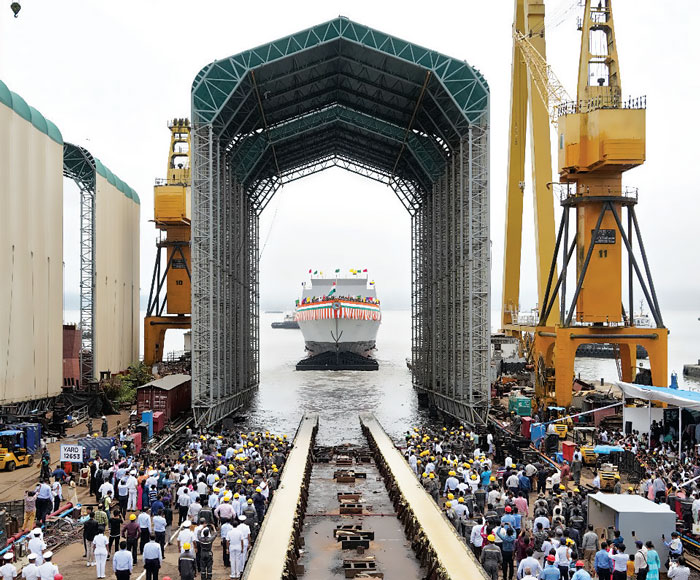
As part of its Amrit Kaal Vision 2047, India has undertaken systemic reforms as well as initiated the construction of mega ports and transhipment hubs to reclaim its position as a global maritime superpower, opine Jagannarayan Padmanabhan and Parul Singhal Garg.
The Amrit Kaal Vision 2047 expands the goals of the Maritime India Vision 2030 and aims to put India firmly on the global maritime map. The focus is on efficiency through the modernisation of ports and developing transhipment hubs, as well as investing in sustainability through carbon neutrality and in technology via digitalisation and innovation.
India is currently the 16th-largest maritime country in the world, with its over 11,000 km coastline dotted with 12 major and 205 notified non-major ports. The importance of the vision’s target can be gauged from the fact that maritime transport accounts for
95 per cent of India’s trade by volume and 65 per cent by value.
Transformative regulations
The 2025 monsoon session of Parliament will be remembered as a landmark moment for India’s maritime sector, marked by the passage of five critical bills between July and August. The Indian Ports Bill, 2025, seeks to establish a Maritime State Development Council as a statutory consultative body to coordinate between the centre and states. Its objective is to promote integrated port development and enable a data-driven decision-making process. The bill focuses on enhancing port competitiveness through transparent tariff policies and a more robust investment framework. It also mandates the adoption of uniform international standards for safety, sustainability and disaster mitigation, alongside green initiatives. Compliance with global environmental conventions, such as MARPOL for prevention of pollution from ships and Ballast Water Management, is now a statutory requirement.
The Merchant Shipping Bill, 2025, replaces the bulky Merchant Shipping Act of 1958. Comprising 16 parts and 325 clauses, the new legislation aligns India’s maritime governance with international conventions, reinforces safety at sea, and strengthens emergency response and environmental protection. It also aims to reduce the compliance burden, increase Indian tonnage, and prioritise seafarer welfare and ship safety.
The Coastal Shipping Bill, 2025, supports the government’s push to increase coastal cargo movement. With six chapters and 42 clauses, the bill simplifies the licensing system for coastal shipping and sets out a framework to regulate foreign vessels engaged in coastal trade. It mandates the formulation of a National Coastal and Inland Shipping Strategic Plan to guide infrastructure development and policy direction. Additionally, it provides for the creation of a National Database for Coastal Shipping, offering real-time access to authentic and regularly updated data. This is expected to improve transparency and keep potential investors informed about development plans and policy priorities.
The Bills of Lading Bill, 2025, functions as a legal passport for shipments, a receipt acknowledging cargo received for transport by the carrier. The new legislation simplifies legal language, aligns Indian law with international shipping practices, and lays the groundwork for future digitisation of trade documents. While electronic bills of lading are not yet enabled, the bill proposes a separate framework to support their eventual rollout.
The Carriage of Goods by Sea Bill, 2025, defines the responsibilities, liabilities, rights and immunities related to goods transported from Indian ports. By adopting the Hague–Visby Rules of the Brussels Convention, the bill brings greater clarity to international dealings for shippers, carriers, importers and exporters. It clearly outlines the rights and liabilities of carriers, encourages digitisation, and empowers the central government to make amendments via notification in the Official Gazette in case of objections.
Holistic development approach
To address longstanding challenges such as inadequate draft depth, low mechanisation and port congestion, the Ministry of Ports, Shipping and Waterways has focused on improving key efficiency parameters over the past decade. These include average turnaround time, pre-berthing detention and output per ship berth day. Complementary efforts are underway to enhance mechanisation, reengineer operational processes, strengthen port community systems and integrate multi-modal logistics.
As part of its infrastructure expansion strategy, India is set to develop a series of mega ports and transhipment hubs. Capacity augmentation of over 500 million tonnes per annum (MTPA) is planned at Deendayal and Paradip ports by 2030, with further expansion at VO Chidambaranar Port Authority, Chennai, Kamarajar Port Ltd, Vizag and Jawaharlal Nehru Port Authority by 2047. The Paradip and Vadhavan-JNPA cluster alone is expected to exceed 750 MTPA. Transhipment hubs are being established at Vizhinjam and Cochin by 2030, with a new port planned at Galathea Bay by 2047. In parallel, major ports will undergo infrastructure upgrades to increase draft depth to 18 metres or more, with a focus on maximising the number of berths offering at least 14 metres of draft.
To promote a modal shift towards coastal shipping, the government is addressing key bottlenecks such as high first and last-mile lead times, elevated freight costs, lack of return cargo flows, low parcel sizes and weak commodity-specific infrastructure. Measures include incentivising coastal berths, reducing tariffs and introducing green channel clearance. Additional initiatives such as priority berthing, cabotage relaxation and discounts on vessel-related charges and coastal shipping bills are expected to boost traffic. Potential coastal routes have been identified for commodities, including coal, iron ore, petroleum, oil and lubricants, cement, steel and agricultural produce. Improved road and rail connectivity between ports and hinterland regions will be critical to resolving systemic inefficiencies.
To stimulate domestic shipbuilding, repair and recycling, the government has introduced a series of targeted interventions. These include mandating domestic cargo movement on India-built ships and encouraging state-owned enterprises to place orders with local shipyards. Plans are underway to develop integrated shipbuilding clusters with ancillary units focused on specialised mid-sized vessels and green-fuelled ships. Skill development is also a priority, with efforts to bridge technological gaps through international collaboration and upskilling of engineers and designers. On the financing front, the Maritime Development Fund—announced in the 2025 Budget—is expected to offer low-cost, long-term loans and bank guarantees linked to ship orders. The fund will also support research and development, technology upgrades and policy reforms, including proposed amendments to the Securitisation and Reconstruction of Financial Assets and Enforcement of Security Interest (SARFAESI) Act, 2002 Act.
Setting up liquefied natural gas bunkering stations, shore power facilities and hydrogen hubs are the target areas to achieve the goal of carbon-neutral ports in India.
The country has also taken steps to reduce its dependence on importing fossil fuels and develop an ecosystem for green hydrogen. As a clean fuel, green hydrogen can be utilised in applications such as hydrogen-based fuel cells to power port-side equipment and vehicles.
Navigating what’s next
Efficient use of port assets remains a pressing need. Many ports are located within large urban agglomerations, leaving little room for efficient cargo evacuation or infrastructure expansion. The government must consider repurposing such assets for alternate uses. At present, capacity utilisation across major and non-major ports stands at a modest 50-55 per cent. Only 30 per cent of berths at major ports are operated by private players, with the remainder managed by port authorities. The poor condition of infrastructure, limited draft availability and suboptimal operational efficiency point to the need for asset monetisation. This will require greater private sector participation.
Merchandise exports and imports grew by approximately 1.5 per cent and 2.5 per cent, respectively, in FY2025. Overall port traffic—including EXIM and coastal cargo—has increased at a moderate pace of 4 per cent annually over the past few years. A significant portion of domestic cargo movement has shifted from road and rail to coastal shipping. The share of coastal cargo has risen from
5-6 per cent of total port traffic to 20-25 per cent over the past 5-10 years. Industry reports suggest that merchandise imports and exports are expected to grow by around 5 per cent and 6 per cent, respectively, over the next two to three years. Ports must be better equipped to handle this anticipated surge in traffic.
Driving efficiency across the sector will require targeted interventions. The modal share of railways in cargo movement
remains low, with most non-major ports having limited or no rail connectivity. Improving port–rail linkages will help reduce logistics costs and make transport more competitive. There is also a need for more integrated logistics providers. While some non-major ports operated by private entities offer end-to-end logistics solutions, and a few PPP operators at government ports do the same, the
sector requires a broader base of service providers capable of managing cargo from origin to final delivery.
Digitalisation is another key lever for efficiency. Ports must keep pace with evolving trends and adopt technology to streamline operations and improve management systems.
India’s global aspirations in the maritime sector are also taking shape. International port terminal operators such as PSA International, DP World and AP Moller-Maersk have established successful operations in the country. Meanwhile, India Ports Global Ltd (IPGL) is developing and managing port assets overseas. Drawing inspiration from public sector units in the energy domain, Indian port authorities, alongside private companies, could explore global projects to strengthen India’s leadership position in international maritime trade.
About the author:
Jagannarayan Padmanabhan, Senior Director and Global Head, Consulting-Transport, Mobility and Logistics, and Parul Singhal Garg, Lead Infrastructure Specialist, Consulting-Transport, Mobility and Logistics, Crisil Intelligence.
India’s Rs.697 Billion Maritime Revamp
India has unveiled a Rs.697.25 billion ($8.4 billion) package to revitalise its shipbuilding and maritime ecosystem. Anchored in a four-pillar strategy, the initiative aims to strengthen domestic capacity, improve long-term financing, promote shipyard development, enhance technical capabilities and skilling, and implement legal, taxation, and policy reforms. The Shipbuilding Financial Assistance Scheme has been extended until March 31, 2036, with a corpus of Rs.247.36 billion, including Rs.40.01 billion for Shipbreaking Credit Notes. A National Shipbuilding Mission will oversee implementation and strategic alignment. To address financing challenges, the Maritime Development Fund has been approved with a Rs.250 billion corpus. This includes a Rs.200 billion Maritime Investment Fund, with 49 per cent government participation, and a Rs.50 billion Interest Incentivisation Fund to reduce borrowing costs and improve bankability. With a Rs.199.89 billion outlay, the Shipbuilding Development Scheme targets the expansion of domestic shipbuilding capacity to 4.5 million gross tonnage annually. It will support mega shipbuilding clusters, infrastructure upgrades, and the India Ship Technology Centre under the Indian Maritime University, while offering insurance and risk coverage. The package is expected to generate nearly 3 million jobs and attract investments of approximately Rs.4.5 trillion into the maritime sector.