

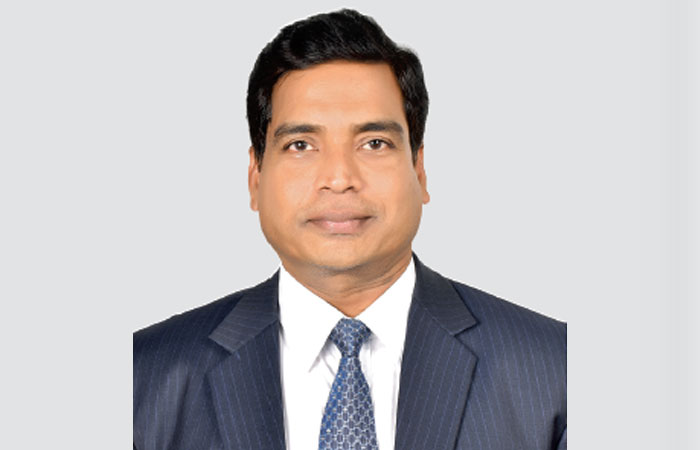
As India’s newest development financing institution (DFI), the National Bank for Financing Infrastructure and Development (NaBFID) is targeting Rs.1.2 trillion in loan sanctions for this fiscal year. Samuel Joseph Jebaraj, Deputy Managing Director, tells INFRASTRUCTURE TODAY’s Manish Pant that while deepening its presence in renewables and roads, the DFI is also underwriting municipal bonds and scaling partial credit enhancement through special purpose vehicles (SPVs). He adds that the RBI’s new lending guidelines offer a timely buffer against risky assets, signalling a shift to more resilient infrastructure finance. Edited excerpts.
The National Bank for Financing Infrastructure and Development was established during the COVID-19 lockdown, when uncertainty shrouded the future. Using that as a starting point, what are the key drivers of your current loan book?
The COVID reference is understandable, but to clarify: while the [National Bank for Financing Infrastructure and Development] Act was passed in 2021, we were operationalised only in December 2022. Over the past ten quarters, since we began lending, business traction has been quite encouraging. Sectorally, the key drivers have been energy and transportation, as defined under the harmonised list of infrastructure sectors by the Department of Economic Affairs. Within energy, the focus has largely been on generation, particularly renewable energy. We have also financed transmission projects, though not distribution. In transportation, roads have dominated our portfolio. We have also supported select projects in ports and pipelines, including those for transporting liquids and gases.
You mentioned transportation and energy, both of which continue to drive growth across the infrastructure sector. Beyond these, which other sectors do you see gaining traction?
Yes, transportation and energy remain dominant, even from a macro perspective. But we are also seeing notable traction in other areas. One such sector is data centres. There is a surge in investment, driven partly by exponential growth in demand and partly by government policies around data localisation. This has created a strong pipeline of opportunities. In social infrastructure, there is considerable consolidation underway in the hospital segment. This opens up avenues for brownfield expansion and inorganic growth. Mergers and acquisitions often present opportunities for refinancing, extending tenors, and supporting new capital requirements. We are also seeing some greenfield capacity additions in this space. Beyond these, water and sanitation are emerging as other active areas. Several PPP (public-private partnership) projects are coming up, and we have already financed a few. Looking ahead, we expect further traction here. We also anticipate growth in shipping, especially following its inclusion under the infrastructure umbrella in the recent Union Budget. While we have already supported a few port projects, other subsegments—such as vessel financing—are likely to pick up.
With the first half of the financial year nearly behind us and two more quarters to go in FY2026, what is your guidance for the remainder of the year?
We expect to sanction approximately Rs.1.2 trillion this year. In terms of disbursements, we are targeting around Rs.700 billion for the full year. As for our outstanding loan book, we anticipate it will stand at roughly Rs.1 trillion by March 2026.
That suggests you have leveraged your loan book quite effectively over the last ten quarters.
Yes, the sanction pipeline is very strong.
As of now, we have cumulatively sanctioned around Rs.2.5 trillion. But in infrastructure finance, disbursements typically take longer. There is often a significant lag between the sanction and the first disbursement, and subsequent disbursements are milestone-linked. For example, a pure solar project
might be implemented within 12 months. But even within renewables, wind projects take longer. Road projects have even longer timelines, and ports take longer still. So, disbursement in infrastructure is inherently slower than in corporate finance. That’s why there is a gap between our sanction figures and actual disbursements.
Given your distinct role as a DFI, how are you engaging stakeholders to build awareness around your financing solutions?
There is reasonable awareness within the industry, but our outreach is happening at a different level. In the infrastructure space, viable private sector projects—those sensibly bid and open to financial covenants—generally get funded. The real gap lies with urban local bodies. Municipal infrastructure spending should be higher, but project conception and financing awareness remain limited. Even basic awareness around financing options remains low. We have been actively engaging with municipal corporations to explain the kinds of financing and structuring solutions we offer. Urbanisation is inevitable if India is to become a developed economy. But today, our cities are bulging, and infrastructure is under severe strain. If we don’t address this, we risk a serious urban infrastructure crisis.
Take waste-to-energy, for instance. Cities are ringed by waste, contaminating soil, groundwater, and fuelling social challenges. Whether it’s Mumbai, Delhi, or elsewhere, the need of the hour is to convert this waste into usable energy. Indore Municipal Corporation has done commendable work, and some Delhi corporations have made progress. But many others are lagging. We need to replicate successful models across the board. To support this, we have launched a templated product specifically for urban local bodies, designed to be easy to understand and implement. From a risk mitigation standpoint, we secure ourselves not only through project cash flows, which remain primary, but also through limited recourse to property tax revenues collected by these bodies.
That’s interesting. But how do you propose to get municipalities involved?
Our approach is to showcase five to seven successful infrastructure examples to 50-75 urban local bodies. The idea is that once these are understood and adopted, the next 500 will follow. This is the specific outreach we have been undertaking. We are also working on broader market development initiatives. For instance, we have introduced partial credit enhancement, a sophisticated instrument aimed at deepening the infrastructure financing ecosystem. Currently, most infrastructure projects in India are funded through the loan market, primarily by banks. There’s very little participation from insurance and pension funds, which shouldn’t be the case. Globally, completed projects with stable cash flows typically transition to the bond market. That’s not happening here. Ironically, the same projects are attracting overseas investments from Canadian pension funds, sovereign wealth funds, and others. These investors have confidence in our infrastructure assets and are earning healthy returns. Meanwhile, domestic funds remain hesitant. I wouldn’t say they are pessimistic; perhaps they don’t fully understand the credit risks involved. This is where a DFI like NaBFID can play a catalytic role. By providing credit enhancement, monitoring projects, and publishing regular reports, we can help build confidence among domestic insurance and pension funds. It’s a different kind of outreach, aimed at unlocking new pools of capital.
However, while the municipal bond is a well-established product in developed economies, it is still evolving in India. How are you planning to scale this segment, particularly for low-rated urban bodies and institutional investors?
For low-rated urban local bodies, partial credit enhancement is an ideal solution. We are also educating them on how pooled structures can improve credit ratings. Tamil Nadu and Karnataka have successfully implemented pooled financing models backed by state-level first-loss default funds. These structures can help expand the municipal bond market. More importantly, many urban local bodies lack the capacity to conceive and execute infrastructure projects. That’s where we step in with transaction advisory services. Unless we help them develop bankable projects—with proper techno-economic viability studies, PPP frameworks, and concession agreements—the scale we are aiming for will remain elusive. Addressing this gap at the conception stage
is critical.
We have already invested in several municipal bonds over the past two years. These weren’t issuances we brought to market but existing ones. Still, the moment we commit to underwriting or participating in a full issuance, it boosts market confidence. In some cases, even when we didn’t win the bid, the issuer secured funding at a significantly lower rate. That’s a win in itself. That said, the scale is still modest. Even major municipal bonds— around Rs.2 billion—fall short of actual infrastructure needs. We need to help them think bigger. For instance, we are currently working with a municipal corporation that already has renewable energy assets and is now exploring riverfront development. These are the kinds of forward-looking examples we need to replicate. Scaling municipal financing means addressing both the funding and capacity-building gaps.
With the partial credit enhancement facility being an important part of your activity, how do you see it shaping India’s corporate bond market for infrastructure, particularly in relation to private sector SPVs (special purpose vehicles)?
Current IRDAI (Insurance Regulatory and Development Authority) guidelines restrict insurers’ participation. Their exposure is linked to the issuer’s capitalisation, in this case, the SPV. Infrastructure projects typically follow a 75:25 debt-equity structure. Of that 25 per cent equity, only a fraction—usually around 25 per cent—is pure promoter equity; the rest is often structured as subordinated unsecured debt. When an insurance company evaluates such an SPV, the available pure equity is just 6.25 per cent of the total project cost. If their exposure is capped at 20 per cent of that, the permissible investment becomes negligible. This severely limits direct access to SPVs.
However, alternative structures—such as holding or operating companies with higher net worth—offer more flexibility. Our view is that waiting for a perfect regulatory ecosystem before launching the product would be counterproductive. Instead, we have chosen to proceed despite certain constraints. The idea is to launch the product, demonstrate its viability, and then engage with regulators to explore whether norms can be revised for broader replication. We are not waiting for a complete overhaul. We are moving ahead. Once the product gains traction, we will revisit the regulatory framework to assess how individual SPVs can be brought into the bond market more effectively.
With the RBI’s revised project finance guidelines now in force, what impact do you foresee on risk assessment, capital provisioning, and execution timelines across India’s infrastructure lending landscape?
The RBI’s final circular on project finance is a welcome move. It removes ambiguity and embeds key risk mitigation measures into the regulatory framework. Disbursements can now begin only after all major approvals for that stage are received upfront. Earlier, banks followed varied approaches; if one relaxed its pre-disbursement conditions, others often followed suit to stay competitive. With uniformity now mandated, implementation delays and COD (commercial operation date) extensions would be reduced significantly, as approvals will be in place before the first rupee is disbursed. From a financing perspective, this is a positive development.
Yes, there will be additional provisioning requirements during the implementation phase. COD extensions will require higher capital buffers. But prudentially, this is necessary.
Bad assets often emerge in good times, a fact we must stay mindful of. The regulator’s move is timely and appropriate. We will now be setting aside more capital for under-construction infrastructure projects, which is healthy for the system. While the initial years may see higher capital requirements—reflected in pricing—over the medium to long term, this will benefit all stakeholders: banks, developers, and authorities.
You are spot on with the assertion that prudence must be exercised during the best of times…
Prudence must be exercised in the best of times because if we miss the moment, the worst of times will leave us scrambling
for bailouts!
NaBFID’s New Playbook for Infrastructure Finance
- Rs.1.2 Trillion Loan Target: DFI aims to sanction `1.2 trillion ($14.4 billion) in infrastructure loans this fiscal, signalling scale and ambition.
- Municipal Bond Underwriting: Actively supporting urban local bodies (ULBs) to issue municipal bonds, expanding access to long-term capital.
- Partial Credit Enhancement: Credit enhancement facility helps de-risk infrastructure SPVs, making them more attractive to institutional investors.
- Expanding Investor Access: Strengthening credit structures to unlock participation from pension funds, insurers, and long-term investors.
- Outreach to ULBs: Engaging municipalities and state agencies to build awareness around financing options and project bankability.
- TEV Studies: Techno-economic viability studies remain central to project appraisal, ensuring feasibility and financial sustainability.
- Pooled Financing Models: Exploring pooled structures to aggregate smaller projects and attract institutional capital.