

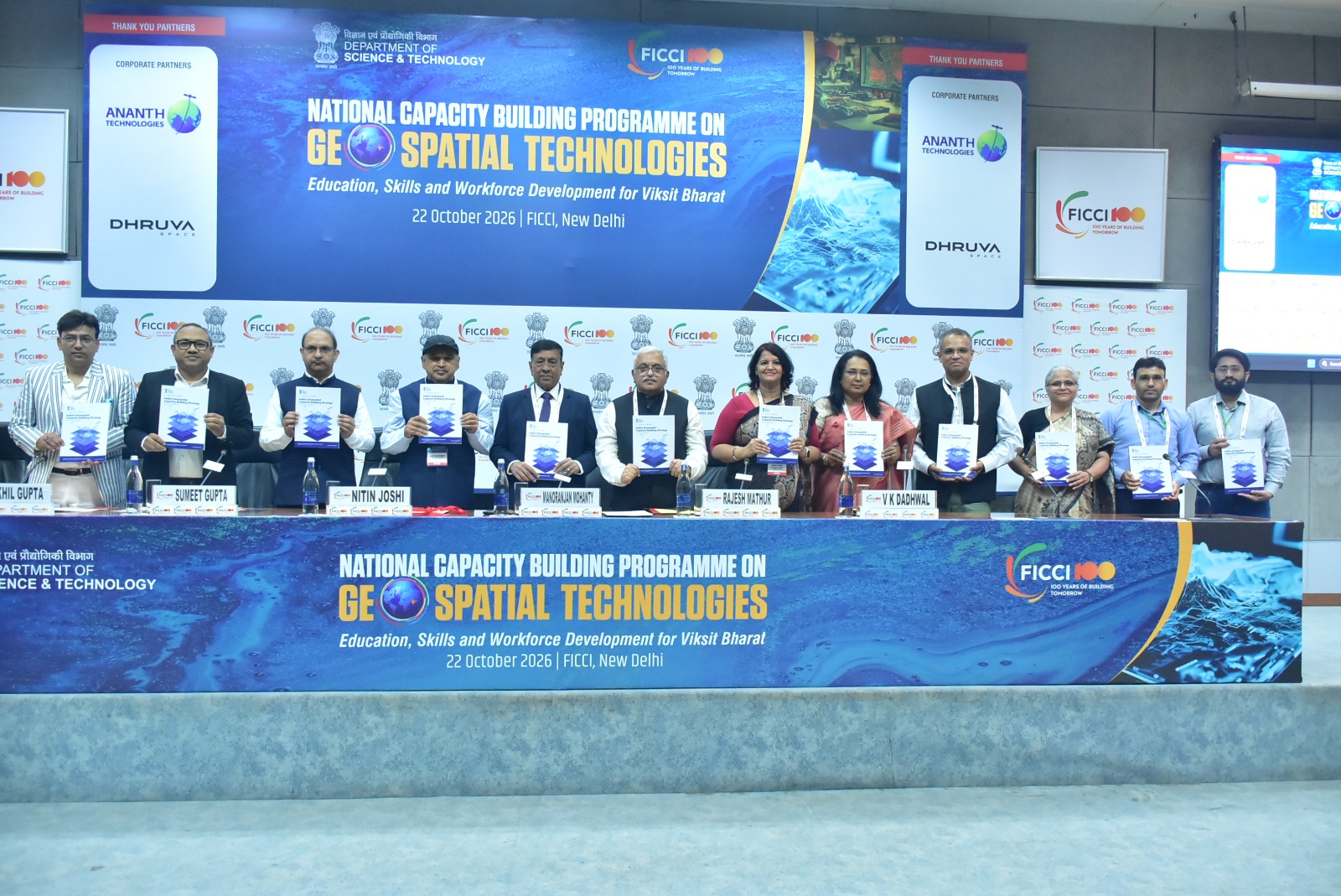
India will need around 1 million additional skilled geospatial professionals beyond its current workforce to meet the goals of the National Geospatial Policy 2022, stakeholders have said.
India will need around 1 million additional skilled geospatial professionals, over and above its current workforce, to achieve the goals of the National Geospatial Policy 2022.
Addressing the industry chamber FICCI’s ‘National Capacity Building Programme on Geospatial Technologies: Education, Skills & Workforce Development for Viksit Bharat’, Nitin Joshi, Additional Surveyor General, Northern Zone at the national mapping agency Survey of India, on Thursday said that skilled mid-level and senior professionals are especially scarce. “The policy has opened the door and technology will provide the tools, but it is skilled manpower that has to walk through these doors to build a Viksit Bharat (Developed India).”
Joshi proposed a formal certification system for surveyors, similar to those for lawyers and doctors. He also invited industry and academia to partner with Survey of India’s National Institute for Geoinformatics Science and Technology, Hyderabad, through scheduled courses, custom-designed programmes and institutional partnerships.
On the occasion, Manoranjan Mohanty, Scientist & Head, National Geospatial Programme, Department of Science and Technology (DST), said that DST has trained more than 6,000 professionals over the past decade through its multi-tier national capacity-building programme.
DST is working with the All India Council for Technical Education (AICTE) and University Grants Commission (UGC) on courses and certification, and geospatial technology is now a Graduate Aptitude Test in Engineering (GATE) subject. “Industry must work more closely with academia by sharing real-world problem statements, offering internships and recruiting from campuses, and working with state governments,” he added.
Mohanty released the White Paper on India’s Geospatial Capacity Building Strategy: Vision 2030 and Beyond.
Bridging the Talent Gap
With demand rising rapidly, the focus is shifting to developing a skilled geospatial workforce at scale. VK Dadhwal, Visiting Professor at National Institute of Advanced Studies (NIAS), said, “India has a five-to-eight-year window, and not until 2047, to build the workforce Viksit Bharat requires.”
He identified four gaps to close, including aligning academic training with current industry tools, turning policy into usable foundational data, moving solutions from pilot to implementation, and building talent at scale across disciplines.
Rajesh Mathur, Senior Advisor at the geospatial technology leader ESRI, said, “Geospatial technology has moved from survey and mapping to a powerful decision-support system and a mainstream IT component. Future professionals will need programming, enterprise integration and domain skills alongside core GIS expertise.” He said this calls for close collaboration among industry, academia and user agencies.
India unveiled the National Geospatial Policy 2022 in December 2022. The policy seeks to strengthen the geospatial ecosystem through wider access to geospatial data, capacity building, innovation and private-sector participation, while positioning India as a global leader in the sector. Today, the country is deploying geospatial technologies across infrastructure planning, urban development, agriculture, disaster management, transportation and environmental monitoring, among other sectors.