Resumption and broad-basing of private investments has become critical to sustain the share of infrastructure investments.


Category: Roads & Highways
Post
Post
Paving the Way
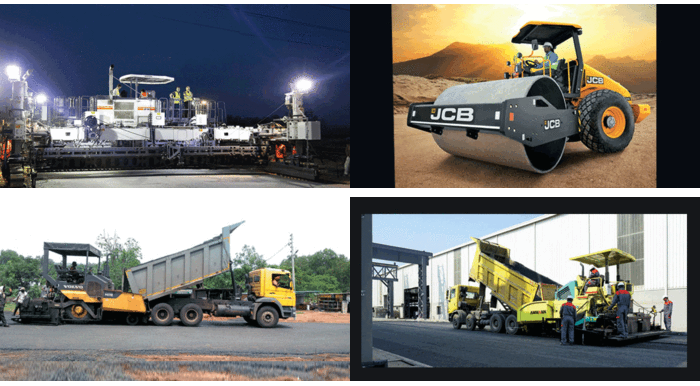
The road construction companies are eying 20 per cent growth through this fiscal. With this, a plethora of opportunities have opened up for road equipment industry.
Post
The Sweet Spot
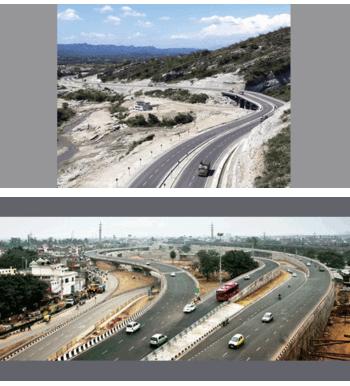
While the road sector is arguably in a sweet spot, land acquisition is unquestionably the biggest hurdle afflicting roads development.
Post

Construction risk is higher than post-construction risk
The National Investment and Infrastructure Fund (NIIF) is planning a third fund targeting investment in greenfield projects, with a view to provide long-tenor financing. Sujoy Bose, Managing Director and Chief Executive Officer, NIIF shares some insights, particularly on the roads sector.
Post
A Tidal Wave in the works!
As the stance of governance is hardening, institutions standing on weak or corroded legs, are stumbling and crumbling. After the case of corrosion of ethics in ICICI, the IL&FS too seems to have bloodied its nose by first becoming a messiah to MaytasInfra (the Satyam scam fall out) in 2009 and then several unrelated forays.
Post
Gurugram gets a green signal for electric vehicles
Electric vehicles and Exicom Tele- Systems AC and DC Fast Chargers will start functioning soon on the streets of Gurugram, under the management of Gurugram Metropolitan Development Authority (GMDA) officials.
Post
Auction of eight highways to fetch Rs 54 billion
Nearly Rs 54 billion will be generated through the auction off the second tranche of eight completed national highway projects. The Toll Operate Transfer (TOT) will be responsible for the maintenance and will have the right to collect the toll on these stretches for 30 years.
Post
Essel plans Rs 17.5 billion project for EV charging infrastructure in UP
In order to implement the initiative of setting up electric vehicle charging and battery swapping infrastructure under Essel Green Mobility, Essel Infraprojects (EIL) is planning to invest Rs 17.5 billion in a phased manner. In 20 cities, EIL will set up 250 charging stations and 1,000 battery swapping stations.
Post
950 km of roads will come up under Bharatmala project
Under the Bharatmala project, roads and highways measuring a total of 950 km will be developed in Chhattisgarh. The Central Government had already declared 290.08 km of road as new national highways during FY 2017-18.
Post
Ahmedabad BRTS to use electric buses
By next year, Ahmedabad Bus Rapid Transit System (BRTS) will become the first service in India to use electric buses. Ashok Leyland, a commercial vehicleÂ’s manufacturer, in an agreement with Ahmedabad Janmarg (AJL), will run 50 electric buses on the BRTS corridor and will look after the maintenance, appointment of drivers and installing chargers.