

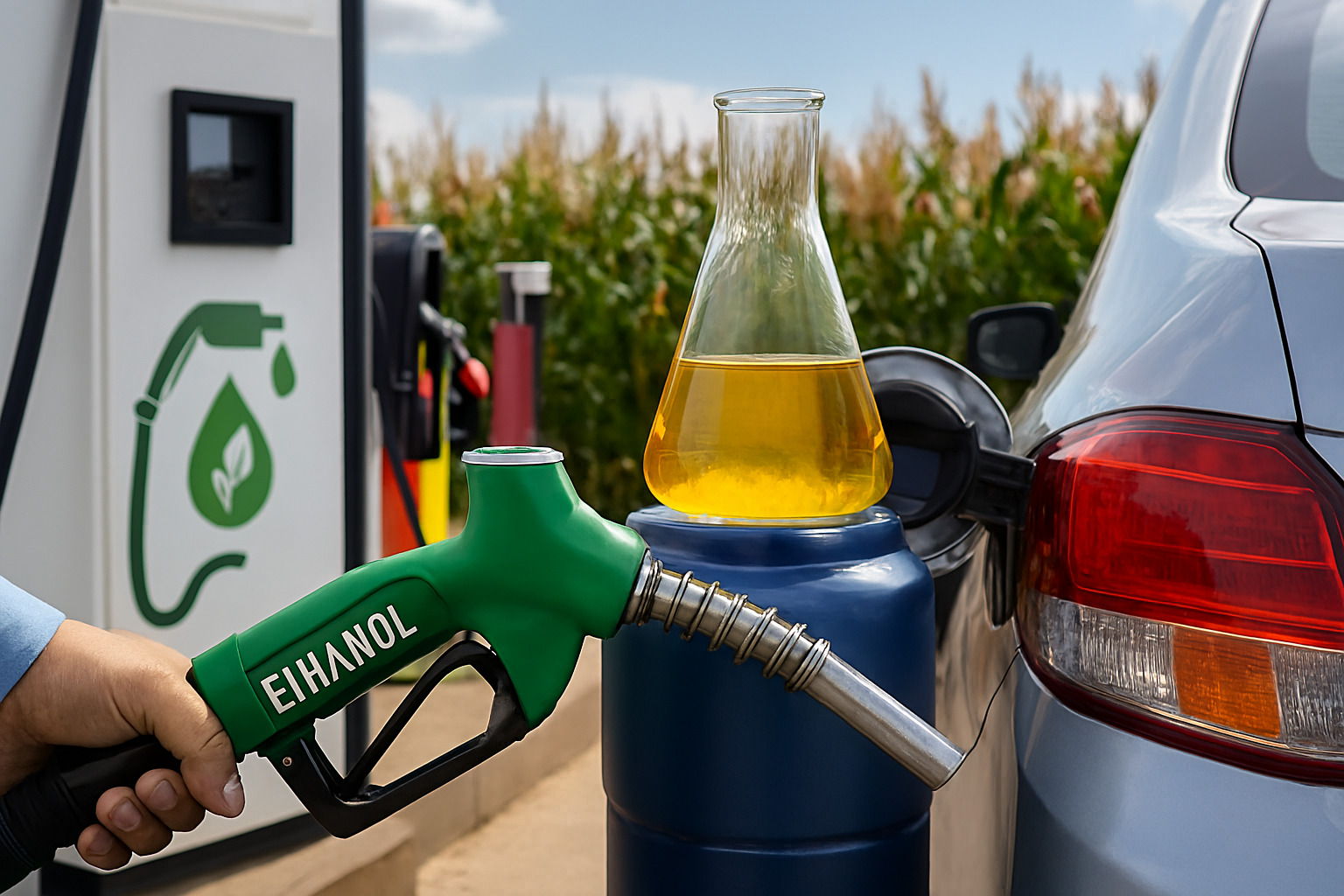
Despite ethanol now costing more than refined petrol, oil marketing companies continue blending it into fuel, citing long-term gains in energy security, rural incomes, and environmental sustainability, according to the ministry.
Amid growing public debate over the impact of 20 per cent ethanol-blended petrol (E20) on vehicle mileage and engine life, the Ministry of Petroleum and Natural Gas has issued a detailed clarification defending the programme’s environmental, economic, and technological merits.
The response, released on August 4, addresses concerns raised by consumers and industry stakeholders, while reaffirming the government’s commitment to cleaner fuels and calibrated energy transition.
The ministry highlighted that ethanol and natural gas are India’s ‘bridge fuels’, enabling a non-disruptive shift towards net-zero emissions by 2070. Citing a study by the government think tank NITI Aayog, it noted that sugarcane-based ethanol reduces greenhouse gas emissions by 65 per cent and maize-based ethanol by 50 per cent compared to petrol.
Over the past decade, ethanol blending has saved ₹1.44 trillion ($16.5 billion) in foreign exchange, substituted 24.5 million tonnes of crude oil, and reduced carbon dioxide emissions by 7.36 million tonnes, which is equivalent to planting 300 million trees. In FY2025-26 alone, farmers are expected to earn ₹400 billion from ethanol sales, while forex savings are projected at ₹430 billion.
Over the past several weeks, the country’s ethanol blending rollout has faced engine performance concerns due to older vehicle calibration, limited flex-fuel adoption, and patchy consumer awareness. Critics have argued that countries like Brazil have succeeded by mandating flex-fuel vehicles, offering tax incentives, ensuring clear labelling, and building public trust through decades of policy continuity and infrastructure readiness.
Performance, Compatibility and Cost Dynamics
The ministry dismissed claims of drastic mileage reduction, stating that vehicle efficiency depends on multiple factors, including driving habits, maintenance, and air conditioning load. Research by Indian Oil Corporation Ltd (IOCL), Automotive Research Association of India (ARAI) and the Society of Indian Automobile Manufacturers (SIAM) has shown that E20-compatible vehicles—some dating back to 2009—perform well, with marginal efficiency drops in older E10 models.
Ethanol’s higher octane rating of nearly 108.5 against petrol’s 84.4 improves acceleration and ride quality, especially in city driving. It also enhances volumetric efficiency by cooling intake temperatures. Regular petrol in India now has a Research Octane Number (RON) of 95, up from 88, due to ethanol blending, resulting in better anti-knock performance.
Addressing cost concerns, the ministry clarified that ethanol was cheaper than petrol in 2020-21, but procurement prices have since risen. As of July 2025, the average ethanol cost stands at ₹71.32 per litre, higher than refined petrol. Despite this, oil marketing companies continue blending due to the programme’s long-term benefits.
A Farmer’s Dividend
Union Minister Hardeep Singh Puri, speaking at the Pioneer Biofuels Summit 360 in New Delhi on Friday, declared, “Ethanol is not just fuel; it’s a farmer’s dividend. Every litre blended is a step towards rural prosperity and energy independence.”
Calling the recent concerns regarding ethanol-blended fuel as misinformation spread by vested interest lobby groups, Puri claimed there has not been a single case of engine failure or breakdown reported since E20 became a base fuel over the last ten months.
“Let me be clear, E20 fuels do not void your vehicle insurance. Fear-mongering on this issue is irresponsible and factually incorrect.”
The ministry further clarified that safety standards for E20 are well-established through the Bureau of Indian Standards (BIS) and Automotive Industry Standards. While some older vehicles may require minor gasket replacements, these are inexpensive and manageable during routine servicing.
The government reiterated that any move beyond E20 will be carefully calibrated. The current roadmap extends till 31 October 2026, with decisions beyond that date pending stakeholder consultations and review of the Inter Ministerial Committee’s recommendations.