

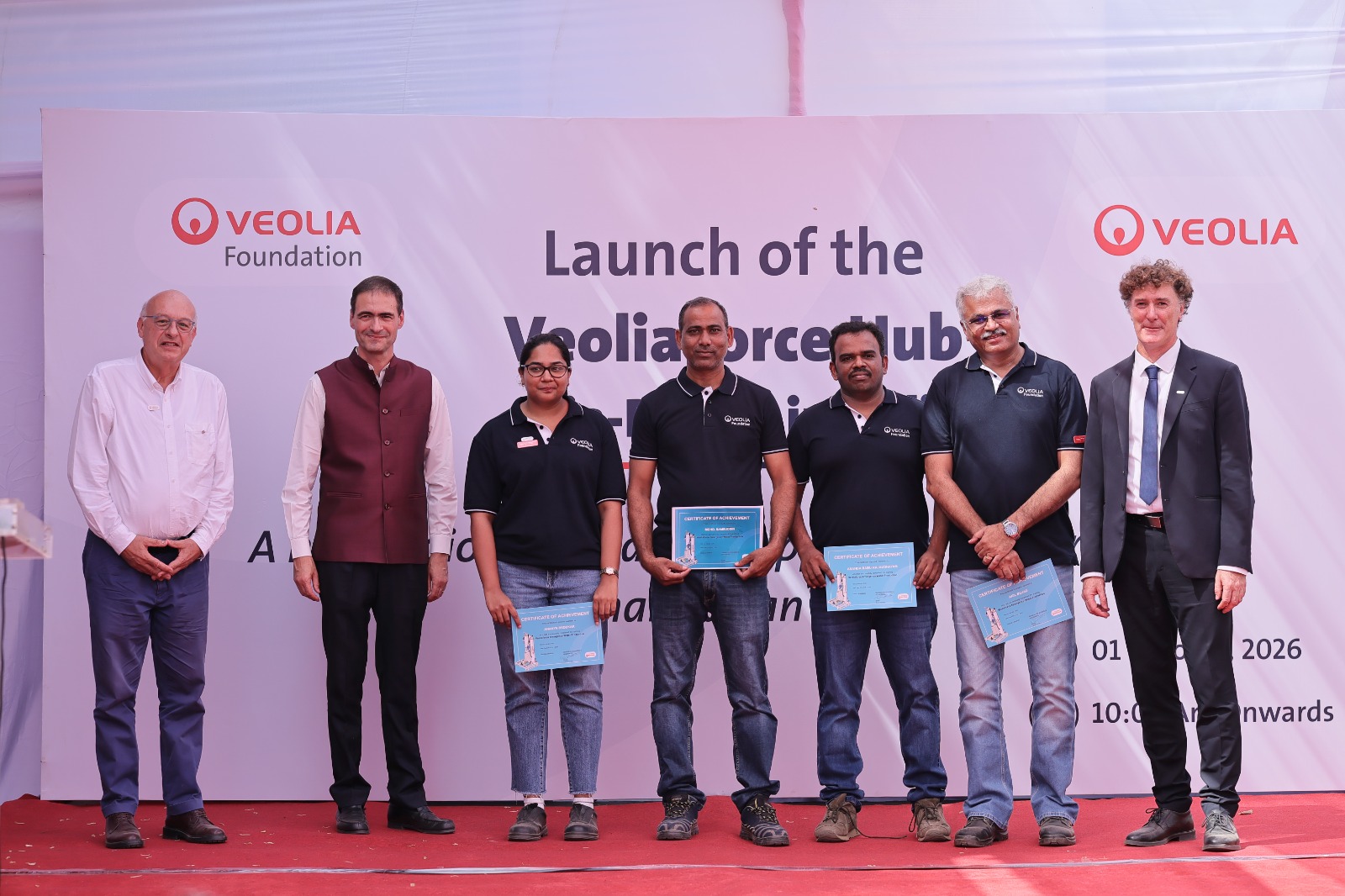
The Delhi hub is designed to deliver immediate aid across APAC disasters by combining local talent, technical expertise and specialised technology.
The Veolia Foundation, the CSR arm of global environmental solutions leader Veolia, has officially launched a new Veoliaforce Hub for the Asia-Pacific (APAC) region in Delhi, India. The hub is designed as a regional rapid-response base, allowing Veolia to pre-position critical equipment and mobilise trained employees closer to areas affected by natural disasters and humanitarian emergencies.
The Delhi Hub will act as an operational and training node for the region, equipped with mobile water treatment technology that can be rapidly transported and deployed in emergency conditions. It has a high-speed response capability, designed to produce safe drinking water within hours of arrival on site. Certified expert teams will be able to deploy mobile water treatment units to supply drinking water to populations ranging from 2,000 to 7,500 people per unit. The Delhi hub combines a regional mobilisation model with locally trained employees, pre-positioned equipment and Veolia’s operational expertise in water, sanitation and essential services.
By positioning equipment and trained responders in India ahead of emergencies, Veolia can act faster when disaster strikes, providing critical support during the first stages of a crisis when access to safe water and essential services is often most urgent.
Alongside the ongoing operational commitment of Veolia’s local business entities, the establishment of the Delhi hub reinforces the Paris-headquartered group’s long-term presence in India, while supporting key local initiatives such as Medical Mobile Units in Gujarat and social insertion programmes like Life Project 4 Youth (LP4Y).
Local Volunteer Training
The launch of the hub included an intensive week of field training and certification of 25 volunteers from Veolia selected from Bengaluru, Noida, Gujarat, Karnataka and Nagpur. Prepared to intervene in natural disasters or humanitarian crises, the team trained on crisis simulations and the deployment of specialised technology, including Aquaforce mobile water treatment units capable of producing safe drinking water in critical environments.
Guillaume Dourdin, CEO, India at Veolia, said, “With this new Veoliaforce Hub in Delhi, we are putting people, equipment and expertise closer to where they may be needed, so that we can respond faster when a disaster strikes. India’s strategic location, growing disaster-response capabilities and strong Veolia operational footprint make it an ideal base for coordinating emergency interventions across South and Southeast Asia.”
The idea is to deliver immediate, concrete aid when disasters strike through a combination of local talent, technical know-how and specialised technology.
Regional Response Network
The hub relies on a competency-based volunteering scheme, drawing on the technical expertise of Veolia’s workforce in water treatment, sanitation, logistics and environmental engineering. Building on the strong employee engagement already demonstrated, the Delhi hub creates a dedicated pool of trained specialists who can be mobilised alongside Veolia Foundation emergency partners when a crisis occurs.
David Poinard, Executive Director, Veolia Foundation, said, “Proximity and rapid deployment are essential to delivering effective support during emergencies. The Delhi hub gives our employees a concrete framework to put their professional skills at the service of communities affected by crises, while enabling us to mobilise the right expertise and equipment more rapidly across the region. Through pre-positioned equipment and skills-based volunteering, our trained teams provide technical support directly to populations in distress, working alongside our emergency response partners.”
Launch of the Veoliaforce Delhi hub for APAC brought together key international partners, including the Red Cross and local authorities, to align emergency response protocols and operational strategies. This joint effort reflects a shared conviction: territorial resilience is built through coordination, shared knowledge and complementary capabilities.