

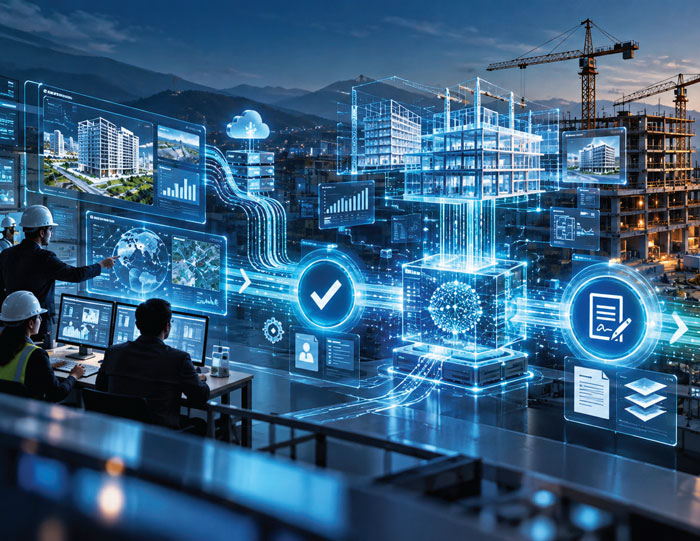
India’s challenge has shifted from building more infrastructure to making project execution predictable, Varghese Daniel asserts.
India’s infrastructure build‑out is taking place at a scale that makes project execution increasingly complex. Public capital expenditure has risen from about `2 trillion in FY2014‑15 to `12.2 trillion in FY2026‑27, underlining the sustained focus on infrastructure‑led growth.
The scale of projects being executed is equally significant. As of June 2026, the Central Government’s PAIMANA platform was monitoring 1,847 ongoing central‑sector infrastructure projects across 17 ministries and departments, with a combined revised cost of `40.54 trillion. Transport and logistics alone accounted for 55 per cent of this project value.
At this scale, the challenge is no longer simply building more infrastructure. It is improving the predictability of project execution.
Managing project futures
The conventional approach to project controls is well established. Projects are planned using applications such as Primavera or MS Project. Actual progress is subsequently collected from different stakeholders, consolidated and presented through reports and dashboards.
During weekly or monthly reviews, teams examine what has been completed, what has slipped and what remains to be done. They then reforecast the schedule and cost to determine whether the project can still be completed within the planned time and budget.
The limitation is that this approach is fundamentally reactive.
A dashboard tells us what has happened.
It does not necessarily tell us what is going to happen or what action should be taken before a situation becomes critical.
A project report is like a newspaper; it tells only what has already happened. But once something has happened, it cannot be changed.
If a delay is identified only during a weekly or monthly review, valuable recovery time may already have been lost. Corrective action then becomes increasingly difficult, and discussions can shift towards identifying who was responsible for the delay.
The objective of digital project controls should therefore not be simply to produce dashboards faster. It should be to provide enough intelligence and lead time to prevent problems rather than merely report them.
Shifting response window
Digitalisation can significantly improve the frequency and quality of project information. When project stakeholders capture actual progress digitally, organisations can move from weekly or monthly reporting towards daily or near‑real‑time visibility. Data from different sources can be brought together automatically to create a common view of project performance.
However, real‑time data by itself does not make project management predictive. Even
if a project manager receives an updated dashboard every day, the process remains reactive if the manager still has to identify the problem, understand its potential consequences and determine the response manually.
This is where AI can add another layer of intelligence.
An AI‑powered project management information system (PMIS) can continuously monitor project data, identify deviations and recommend corrective or preventive actions.
If an activity scheduled for today has not progressed, the system can identify the deviation immediately and suggest an appropriate response.
More importantly, it can look beyond today’s problem.
Consider a delayed material delivery.
The immediate issue may appear relatively small. But if that material is required for a construction activity scheduled several weeks later, today’s delay could eventually affect the construction sequence.
Project intelligence should therefore connect today’s event with tomorrow’s potential consequence. The earlier that connection is identified, the greater the number of options available to the project team. That could involve expediting procurement, changing logistics or resequencing work.
Predicting project delays
Infrastructure projects operate within many known constraints: monsoons, holidays, manufacturing lead times, logistics limitations, site conditions and interface dependencies. These factors should be incorporated into project risk analysis rather than treated as surprises.
If a current delay means that a work package will become ready during a monsoon period, for example, the eventual impact could be substantially greater than the original delay. An AI‑enabled project control environment can continuously analyse current project status against upcoming conditions and identify such risks in advance. This creates three levels of intervention: corrective action for immediate issues, preventive action for upcoming activities and predictive action for longer‑term risks.
The value is not simply in predicting that a project might be delayed. The real value lies in identifying the risk early enough for the project team to do something about it.
Unified project truth
One of the biggest challenges facing infrastructure organisations is not the absence of digital systems. It is the presence of too many disconnected systems.
An organisation may use Primavera or MS Project for planning, an ERP system for procurement and financials, a document management platform for engineering information, MS Power BI for dashboards and mobile applications for site progress.
Each system may work effectively within its own function. The problem arises when these systems operate in silos. Project intelligence requires these information streams to be connected. A single source of project truth should bring together schedule, cost, progress, engineering, procurement, construction, quality, safety, risks and issues across the project lifecycle.
This becomes particularly important when projects involve multiple contractors and packages. A delay in engineering can affect procurement. Procurement can affect construction. Construction can affect commissioning. A problem in one package can therefore create consequences across several others. If these relationships are not digitally connected, project teams are forced to discover them manually.
Robust AI data
There is understandable enthusiasm around AI in infrastructure. But AI cannot produce meaningful predictive intelligence from fragmented data. The foundation has to be an integrated project information environment. Schedule, cost, progress, engineering, procurement, construction, quality, safety, risk and issue information need to be connected. Existing specialist systems can continue to be used, but relevant information needs to flow into an integrated project environment.
Equally important is how people use the system.
Digital transformation should not mean duplicating manual work into another application. The project workflow itself needs to become digital. When project activity itself generates the data, the information becomes more current and reliable.
Once the data is connected and captured in real time, AI can continuously analyse it and provide recommendations about what action needs to be taken, who needs to take it and
by when.
Reducing information burden
Project intelligence is not limited to schedule and cost forecasting. Large infrastructure projects generate enormous volumes of engineering specifications, standards, technical submissions, bids, drawings and contracts. Reviewing this information manually consumes significant engineering and commercial resources.
AI can learn project specifications and standards and compare technical submissions against defined requirements. This can help identify deviations and reduce the manual effort involved in technical reviews, while retaining human expertise for judgement and validation.
The same principle can be applied to bid analysis, drawing revisions and contract governance.
Workflow governance
Digital project controls can strengthen governance without creating another layer of reporting. When workflows and approval processes are embedded within the system, the platform can help ensure that defined processes are followed and required checks are completed. AI can further support governance by analysing project information and highlighting areas requiring attention.
This also changes the role of the project manager. Instead of spending significant time simply understanding project status, project leaders can focus more on validating recommendations, resolving exceptions and making decisions.
Importantly, AI does not replace project managers. AI should remain an intelligent assistant, not the decision‑maker. It can identify patterns, suggest actions and continuously track project conditions, but experienced project professionals remain responsible for judgement and decisions.
Change management barrier
India’s infrastructure sector does not necessarily lack digital tools. In many organisations, the problem is that digitalisation has happened in pockets. One department may have a planning system, another a document management platform, another a dashboarding solution and another a mobile application.
The biggest transformation is therefore not necessarily implementing another technology. It is developing the organisational willingness to connect these systems and change the way project teams work. Resistance to change and the desire of departments to retain independent systems can prevent organisations from achieving the benefits of integration.
The starting point is a clear organisational decision to establish an integrated project environment and make it the platform through which project stakeholders execute their day‑to‑day activities.
Digitalisation to intelligence
For Indian infrastructure companies, the next phase of digital transformation should be about integration rather than accumulation.
An AI‑powered integrated PMIS goes beyond monitoring: it predicts risks, analyses project intelligence, and recommends timely corrective and preventive actions. The future of project controls is therefore not about producing more reports or dashboards. It is about creating an environment where project information continuously generates intelligence, where emerging risks are identified early, their downstream impact is understood, and the right people receive actionable recommendations while there is still time to respond.
India’s infrastructure ambition demands an equally ambitious approach to project execution.
Better project intelligence will not eliminate every project risk. But by connecting data, processes, people and AI, it can give project teams something conventional project controls often struggle to provide: more time to act before risk turns into delay.
About the author
Varghese Daniel, Co‑Founder & CEO of Wrench Solutions, created SmartProject, an integrated information platform used by EPC firms globally, and champions sustainable, technology‑driven living.