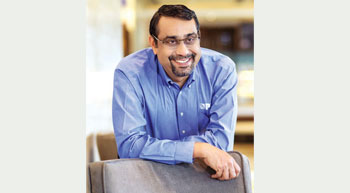
<p>In an interview to INFRASTRUCTURE TODAY, <span style="font-weight: bold;">Raj Kalady</span>, <span style="font-weight: bold;">Country Director,</span> <span style="font-weight: bold;">Project Management Institute</span> <span style="font-weight: bold;">(PMI)</span>, describes himself as a man in a hurry. However, this urgency is not unfounded since the country, as the worlds fastest growing major economy, is projected to require seven million new project managers in the next 10 years.</p> <span style="font-weight: bold;">According to the Project Management Job Growth and Talent Gap 2017/2027 report, the project management profession is likely to outperform total global job growth over the next decade. What will be the factors behind this boom?</span><br /> All the various projects that the Government of India has initiatedûsuch as Sagarmala, Smart Cities, or Ganga Rejuvenationûrequire skilled people to ensure they get completed on time for, only then will the country truly benefit from them. The earlier they get completed, the faster will be their benefits to the citizens. However, if they get delayed, their cost also escalates. From a global perspective, today there are perhaps only a handful of countries that have posted a positive GDP growth, and India is at the top. When you have growth like that, there are definitely going to be investments in new projects. So, you need people like project managers to execute those projects. <p></p><span style="font-weight: bold;">You just asserted that project managers can actually help in the faster execution of public projects. Please elaborate on that.</span><br /> Project management involves anticipated planning. Simply put, it is planning the work and working as per the plan. When you take any infrastructure project, you know there are issues, such as land acquisition, relocation, rehabilitation, and regulatory approvals, which the project can face. If you comprehend these issues proactively, you can plan more effectively. This way, you can be assured that the project is appropriately implemented. <p></p> <p>A trained project manager understands the positive and negative risks inherent in any project. Negative risks can have an adverse impact on the project. For example, if you are working on an infrastructure project, like a building or highway, and the monsoon sets in early, your work might get affected. However, if the monsoon is delayed, do you have a plan-B in place that enables you to continue the work to complete certain things before the onset of the rains? Proactive measures like these help in faster and improved execution of projects.</p><span style="font-weight: bold;">You have projected India as having the second largest number of project management-oriented jobs (21.8 million) by 2027, lagging only behind China (46 million). However, with some of the big-ticket infrastructure projects in offing, do we presently have the capacity to train the required number of people?</span><br /> Right now, we do not have the capacity. However, the good thing is that the project management programme does not require students to devote months or years to complete. It just requires a short period of time and, consequently, scaling up on new skills is also easy. Currently, we have 70 registered education providers (REPs) in the country who can train people. But what is important is that to meet the anticipated demand, academic institutions must include this as an integral part of the curriculum, especially for management and engineering graduates. <p></p>Once that is done, they can be easily absorbed into the workforce. Otherwise, there is always this gap where members of both the current and future workforce will be deficient in the required skills. Therefore, how do you bridge that?<br /> You can train the existing workforce separately, even as training can be imparted to the future workforce in their academic institutions. The programme itself need not be of more than seven-day duration. Here, we are talking about something like up to 45 hours of training at the most. <p></p> <span style="font-weight: bold;">What kind of salary and other advantages do certified project management professionals enjoy over their non-certified peers?</span><br /> Project management is a fantastic career option for the simple reason that a project manager simultaneously handles three key responsibilities. One, he has to keep the cost of the project within the budget. Two, he has to ensure that it is completed on time, and three, he has to fulfil the scope. What happens typically is that when the economy is doing well, the pressure is to deliver on time. But when the economy is not doing too well, then the pressure is to deliver on cost. Therefore, a project managers role is economy agnostic. PMI also conducts a biennial survey called Earning Power:<span style="font-size: 13.3333px;">Project Management Salary Survey</span> <p></p>The tenth edition of the survey had 33,000 respondents from 37 countries. Project management professionals in India holding the Project Management Professional (PMP) certification earn 36 per cent more than their non-certified peers, and that is clearly a major incentive for anyone to get certified. Meanwhile, the global average is about 23 per cent. Therefore, the job is secure and well-paying. <p></p>Around $1 million is wasted every 20 seconds collectively by organisations the world over due to ineffective implementation of business strategy arising out of poor project management practices. This works out to roughly $2 trillion wasted in a year. Although at 8.1 per cent or $81 million per $1 billion, India reports among the lowest average monetary waste on projects, how can the country further pare this loss?<br /> That is what PMI has been working on with the government and several other organisations. I see this as a 3-P process. The first P-E is the people, where you train to make them understand the importance of the subject. The second P-E is the process, where you ensure that the organisation they are working with has the necessary mechanisms in place. For instance, at the time of the award of a government contract, it must be ensured that the winner has enough qualified project managers and well-documented processes in place. The third P-E is the promotion. No organisation today can execute a project by itself and has to create an ecosystem of sub-contractors. The organisation, therefore, must promote the 3-Ps among its sub-contractors to get the best results. This does not require too much of expense and the returns are much higher. However, it does not offer instant gratification, but is a long drawn out solution, where the results of what we do today are visible only after a period of time. Let me put it this way: the presence of project management is known in its absence! <p></p>Several years ago, when infrastructure projects like the bullet train were still a pipe dream in India, you had urged the teaching of project management at the school level. Are you satisfied with the way things have shaped up in the past four years?<br /> I am not unhappy. But I am also a man in a hurry and, I believe, we should have more people taking up project management. We need a policy at the level of the Ministry of Human Resource Development for its effective implementation in institutions. In 2011, we started the PMI India Research and Academic Conference that is meant for only academic institutions and scholars. So far, we have done four conferences. The number of papers submitted and attendees at each conference has grown progressively with each edition. This is something I am very happy about. <p></p> <p>If you look at PMI India website, today, there are plenty of local case studies available for training. Earlier, most case studies used to be from the West. We have the CSR wing of the PMI called the PMI Education Foundation, which works with schools. In fact, from this year onwards, we have a full-time employee to look after the foundationÆs activities. It works not only with schools, but also with NGOs. The latter sometimes do not have project management skills, but they have projects. We also provide a learning resource called as Project Management Methodology for Post-Disaster Reconstruction to NGOs and government institutions.</p> <p>- Manish Pant</p>
FlashNews:
Sovereign Cloud Emerges as India’s AI‑Ready Digital Foundation
Shivalaya Construction Secures ERES‑47 Transmission SPV for Eastern Grid Expansion from RECPDCL
India’s Open Mobility Pioneer Takes Its Ride‑Hailing Model to Europe
NTPC, Africa50 Join Forces to Develop Power Projects Across Africa
NHAI Introduces Independent Design Checks for Major Bridges and Critical Highway Structures
SITA to Acquire Collins Aerospace Airport Solutions, Expanding Global Airport Technology Capabilities
RITES Dispatches First 18‑Coach Rake to Bangladesh Railway under Export Contract
AM/NS India Signs Pact to Upgrade Four ITIs in Andhra Pradesh under PM‑SETU
KONE Opens India’s First Digital Experience Centre in Pune to Drive Smart Building Innovation
NTPC Seeks Industrial Partners for 26% Equity in Co‑Generation Projects
India Businesses Advance AI, Digital Tools and Sustainability: Autodesk Report
Modi Opens India Mobile Congress, Says Nation Has Shifted from Consumer to Creator
Air India, Akasa Join IndiGo in Raising Fares as ATF Costs Surge 25%
Tata Power Partners with Norway’s Ocean Sun to Pilot Membrane‑Based Floating Solar in India
New Relic Rolls Out Infrastructure 360 for Faster, Smarter AI Operations
Inox Green Completes ₹5.5 Billion Acquisition of Wind World’s 4.5 GW O&M Business
Air India, Singapore Airlines Deepen Partnership to Expand Travel Options, Loyalty Benefits
Alok Tiwari Takes Additional Charge as DFCCIL MD, Pushes Tech‑Driven Freight Corridor Agenda
India Launches Integrated Transport & Logistics Authority to Cut Costs and Boost Connectivity


Home » Need policy intervention to boost project management
Need policy intervention to boost project management
ECONOMY & POLICY
May 1, 2018May 1, 2018
Leave a Reply
You must be logged in to post a comment.