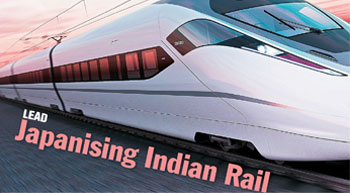
Taking precedence from Japan which heralded the ´bullet train´ legacy in 1964, the world began to partake of this ´race against time´. High-speed rail (HSR), which uses an integrated system of specialised rolling stock and dedicated tracks, can significantly enhance the connectivity and trade between major cities in a country.


Tag: KPMG
Post
Post
Rationale behind HSR
An investment in HSR is typically a government decision which is primarily dependent on a number of factors, such as current and projected traffic, expected saving in time, and a reduction in accidents due to a modal shift, reduction in environmental externalities, ease in congestion in existing modes, and the average willingness of the users to pay.
Post
TRAILBLAZERS
A buzzing campus, enthusiastic students, a well-organised event, distinguished and exemplary speakers all made for a day´s worth of good entertainment but also important information and keen insights on infrastructure in India
Post
Funding Dichotomy
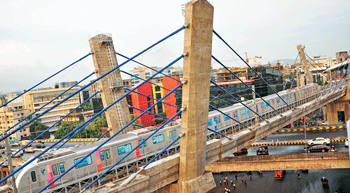
The population surge, rapid urbanisation, and the consequent congestion have time and again fuelled the ´need for speed´. Mass rapid transit system like the metro rail has dawned as a panacea in this regard.
Post

SEZs: Relevance & future
Unlike China, the original concept of SEZs in India got diluted and it witnessed growth of numerous small scale SEZs, pre-dominantly in the IT/ ITeS space. Further, absence of a true ´single window´ to operationalise SEZ
Post
Ultra-modern ´godowns´
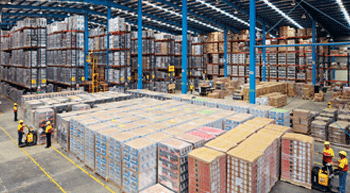
Warehousing market is pegged at Rs 56,000 crore and is expected to grow annually at an average rate of 8 to 10 per cent over the next 5 years to reach a level of 1500 to 1600 million sq ft by 2020.
Post
Can Prabhu bring Indian Railways on track?
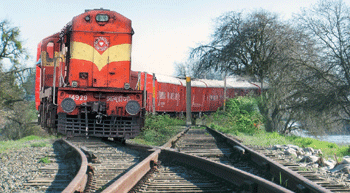
Despite having the second largest rail network in the world, Indian Railways (IR) has not been able to bring it on growth trajectory. The rail sector is infested with challenges like snail´s pace expansion and modernisation, poor customer service
Post

Open Sesame!
Public Sector Units (PSUs) will be pushing the growth engine of the country, be it through almost 18 lakh acres of land reserves with these companies or the cash reserves of almost Rs 2,00,230 crore kept as bank deposits by these enterprises.
Post
Delhi Metro makes it to global list
Delhi Metro is one of the six Indian projects to feature in the prestigious Infrastructure 100: World Markets Report compiled KPMG.
Post
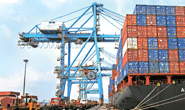
Neighbours´ envy, India´s pride?
Vallarpadam in Cochin run by Dubai´s DP World Ltd is slated to have a companion in Vizhinjam near Thiruvananthapuram as the new transshipment facility.