

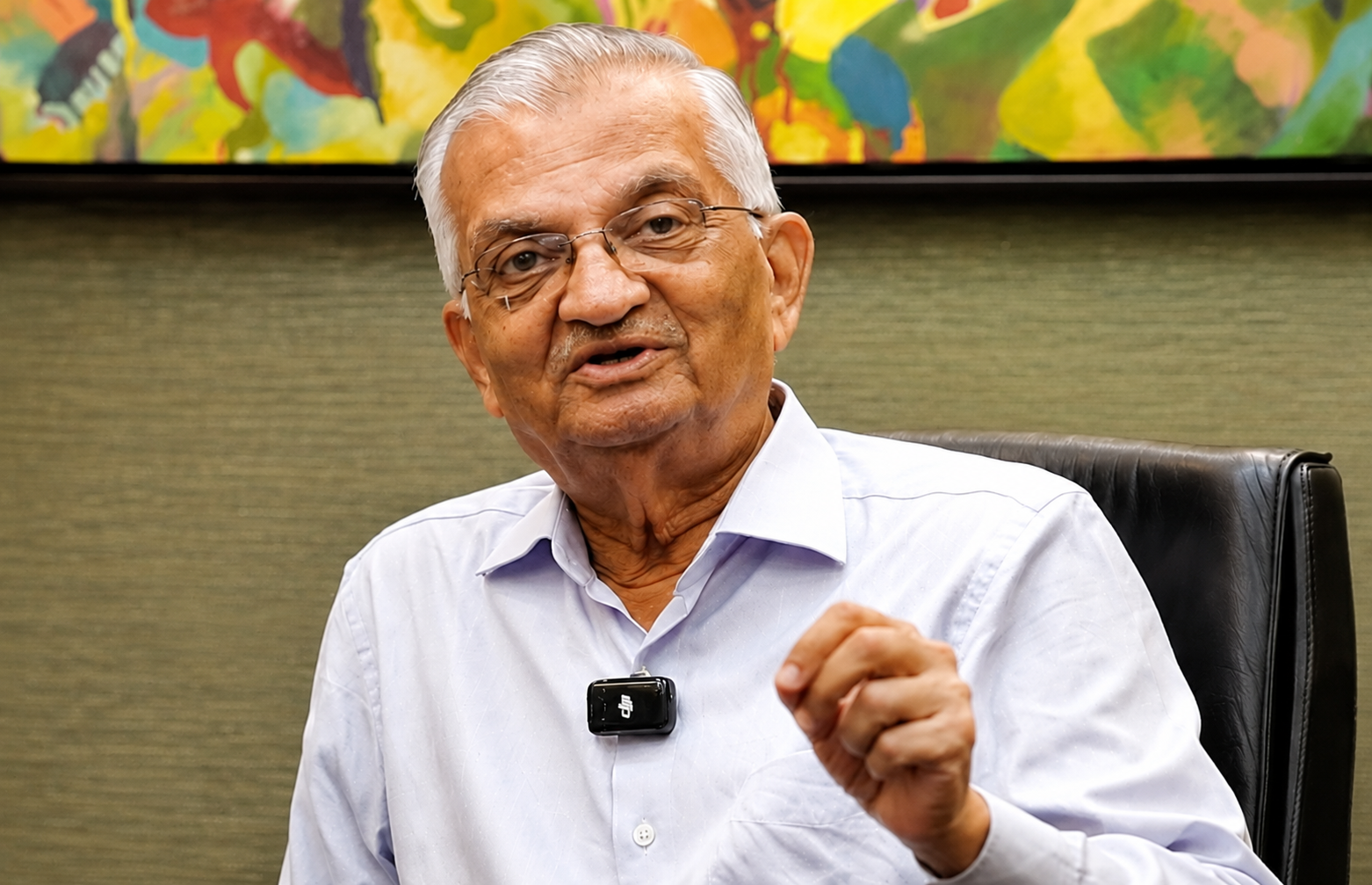
Dr Anil Kakodkar, India’s renowned nuclear engineer and former Chairman of the Atomic Energy Commission, discusses the country’s energy transition, the critical role of nuclear power in achieving Net Zero Emission targets, uranium supply challenges, thorium opportunities, the SHANTI Bill, and the future of Bharat Small Reactors and SMRs, in conversation with Swapnesh Malhotra, a retired Outstanding Scientist from the Department of Atomic Energy.
India has Net Zero Emission target of 2070 and also Viksit Bharat by 2047. What is going to be the role of energy
in achieving these targets ? In your opinion, how much energy will India need by 2070?
For me, Viksit Bharat means that quality of life of every Indian on an average should be comparable to that of the people of ‘Developed Word’. Human Development Index (HDI) has a correlation with the per capita energy consumption. At low HDI, there is steep rise in HDI with increasing per capita electricity consumption. The developed countries are on a horizontal line at HDI of about 0.95. In the middle knee portion of the curve, the slope gradually decreases until it meets the horizontal line India’s energy demand will undergo a massive transformation over the coming decades as it aspires to move from its present HDI 0.685 to 0.95. Today, electricity accounts for only about 15 to 20 per cent of our total energy consumption. During clean energy transition this share of electricity may increase to 60-70 per cent with the balance 30-40 per cent coming from biomass and hydrogen.
For a truly developed India with
Net Zero emissions, our annual electricity requirement could reach around 28,000 terawatt-hours (TWh).
Today, how much is it ?
We are between 9,000 to 10,000 TWh today, so let us say about one third of where we want to reach.
Now a days, there is lot of hype about renewable energy. So much so that the common man feels that the entire demand for electricity can be met by renewable resources. As per you, how much out of the 28,000 TWh can come from renewables ?
If you sum up all the energy that we can get from renewables including small and large hydro, in my assessment it can not be more than 8,000 TWhs. All attempts have to be made to fully realise this potential. Having said that, I agree with you that there is a hype about renewables. I feel now a hype about nuclear needs to be created.
Can you elaborate on the role of and target for nuclear energy in this huge requirement?
Balance has to come from nuclear.
Renewable energy and nuclear energy must complement each other. Without nuclear power, the remaining requirement would have to be met through fossil fuels, which would inevitably result in large carbon emissions and require massive carbon capture, utilisation and sequestration (CCUS) programmes.
CCUS will be extremely expensive. Therefore, it makes far more sense to maximise nuclear energy deployment.
In terms of electricity generation, how much installed capacity would be needed to generate this balance 20,000 TWh?
If we assume a base-load generation source operating at an 80 to 85 per cent plant load factor, generating 20,000 TWh annually would require approximately 2,500 GW of installed capacity.
To put things into perspective, if the same energy were to come from renewables, because of their lower capacity utilisation factors, we would need roughly 10,000 GW of installed renewable capacity. Nuclear energy offers among the highest capacity factors and therefore delivers the largest amount of electricity per gigawatt installed.
The Department of Atomic Energy (DAE) has projected 100 GW of nuclear capacity by 2047 and 200 GW by 2070. Given your estimate of 2,500 GW, do you think these targets are too low?
From the perspective of India’s future energy needs, yes, these numbers are low. However, one must also consider where we stand today. India’s installed nuclear capacity is currently around 8.8 GW. Therefore, moving to 100 GW by 2047 and 200 GW by 2070 is ambitious from an implementation standpoint.
But from the standpoint of national requirements, the targets are clearly inadequate.
I have long maintained that India’s development is directly linked to the development of nuclear energy. All other energy sources are necessary, but nuclear power will ultimately have to become the largest single contributor to India’s clean-energy mix.
Even if India achieves the target of 200 GW by 2070, it would still be less than 10 per cent of the estimated requirement. Doesn’t this raise concerns about achieving Net Zero?
Certainly. If we achieve only 200 GW, a large portion of the remaining demand would have to be met through fossil fuels.
To remain compliant with Net Zero commitments, we would then require CCUS technologies on a very large scale. Alternatively, global timelines themselves may slip, which has happened before in many commitments made by other countries and some international bodies.
India has generally honoured its commitments, but the gap between 200 GW and 2,500 GW is undoubtedly significant. Ultimately, the answer depends on how we define Viksit Bharat and the level of development we seek to achieve.
Even if you take the DAE target of 100 GWe by 2047, out of which 58 GWe is to be put up by DAE and the remaining 42 GWe through public and private participation, how much uranium will we require? How will it compare with the present world uranium supply?
This is perhaps an even bigger challenge.
Today, almost all nuclear reactors globally operate on uranium. At the same time, many countries are planning to triple their nuclear capacity in pursuit of Net Zero goals.
The World Nuclear Association has projected around 1,400 GW of global nuclear capacity by 2050.
However, if we examine commercially available uranium resources and assume current once-through fuel cycles, those resources are sufficient to support only around 500 GW of capacity for 60 years.
There is therefore a clear mismatch between projected demand and available uranium resources.
Sooner or later, the world will face uranium supply constraints and depletion shocks.
This is going to be a very big challenge. What, according to you, should be our approach?
The only sustainable solution is fuel recycling. India has championed closed fuel cycle from the beginning. By recycling uranium, its energy potential increases by almost two orders of magnitude.
The challenge globally has been concerns about plutonium proliferation.
The way to solve this problem is to utilise thorium, converting it into uranium-233 through irradiation. Thorium fuel cycles are significantly more proliferation-resistant.
This is particularly important for India because we possess some of the world’s largest thorium resources.
Thorium offers a pathway to abundant, long-term energy security.
Many experts argue that the traditional three-stage nuclear programme will take too long. Is there a way to accelerate progress?
The logic of the three-stage programme remains sound, but given the delays that have occurred, we need an intermediate pathway. Historically, the first stage was limited because India relied solely on domestic uranium resources. Today, however,
access to international uranium has
changed the situation.
Instead of waiting for the second stage to mature completely, we can begin irradiating thorium in large PHWR fleets and directly generate uranium-233. This would allow us to launch the third stage much earlier.
In effect, we should connect the third stage directly to the first stage while continuing to develop the second stage. That would significantly accelerate the transition towards thorium utilisation.
Nowadays there is a lot of talk about HALEU and the ANEEL Fuel developed by a US company. Can you throw some light on this?
PHWRs are actually very flexible reactors.
There is nothing preventing the use of slightly enriched uranium or thorium-based fuels. In fact, a thorium-HALEU fuel combination offers multiple advantages.
By using thorium as the primary fuel matrix and HALEU as the driver fuel, we can significantly increase uranium-233 production while reducing plutonium generation.
Such systems can achieve burn-ups of 50,000-60,000 MWd per tonne, comparable to modern light-water reactors.
They offer economic benefits, reduce spent fuel volumes and provide additional safety advantages.
I believe there is a strong commercial as well as strategic case for pursuing these fuel cycles.
How do you see the SHANTI Bill? Does it facilitate public and private participation in the nuclear sector?
The SHANTI Act represents a major transition in India’s nuclear policy framework.
The most important aspect is the opening up of the sector to private participation. The scale of investment required for 100 GW—and ultimately much more—is simply too large to be financed entirely through public resources.
Equally important is the need for multiple implementing agencies.
India cannot depend solely on NPCIL and BHAVINI. We will need several organisations with capabilities comparable to them, including public-sector companies, private-sector companies and even institutions capable of accessing technologies from abroad.
The Act allows this to happen, provided activities remain aligned with India’s national nuclear policy and licensing framework.
If implemented effectively, it could become a true game-changer.
What are your comments on Bharat Small Reactors (BSRs) and Small Modular Reactors (SMRs) in India?
The 220 MW PHWR is already the most widely deployed small reactor design in the world and has demonstrated excellent economic and operational performance. India’s industries urgently need clean captive power to reduce the carbon footprint of their products.
Instead of waiting for emerging SMR technologies to mature globally, Bharat Small Reactors provide an immediate and practical solution. Minor design improvements can further enhance safety and reduce exclusion-zone requirements, making industrial deployment easier. In that sense, Bharat Small Reactors are a logical and timely step forward.
We must be careful when evaluating SMRs. If a country deploys thousands of small reactors instead of a smaller number of large reactors, the aggregate risk profile changes. Therefore, SMRs will have to be substantially safer than conventional reactors. For India, safety performance must improve by an order of magnitude before large-scale SMR deployment can be justified.
Personally, I believe the most promising long-term SMR technology for India is the Molten Salt Reactor (MSR). Molten Salt Reactors align perfectly with India’s thorium strategy, offer superior safety characteristics, eliminate conventional core-melt scenarios and can be deployed in capacities ranging from micro-reactors to larger modular units.
Accelerating molten salt reactor development over the next 10-15 years should be a national priority. Such reactors would address long-term fuel security, strengthen India’s thorium programme, improve safety and provide a robust pathway towards sustainable energy independence.