

Generated during beneficiation, the tailings contain minerals such as silica, iron oxides, alumina, calcium, and magnesium, offering nutrients that can strengthen soil health and support crop growth.
ArcelorMittal Nippon Steel India (AM/NS India) and the Indian Council of Agricultural Research-Indian Agricultural Research Institute (ICAR‑IARI) have signed a memorandum of understanding (MoU) to advance research on the sustainable utilisation of iron ore tailings in agriculture. The initiative marks a significant step towards circular economy practices and resource conservation in India.
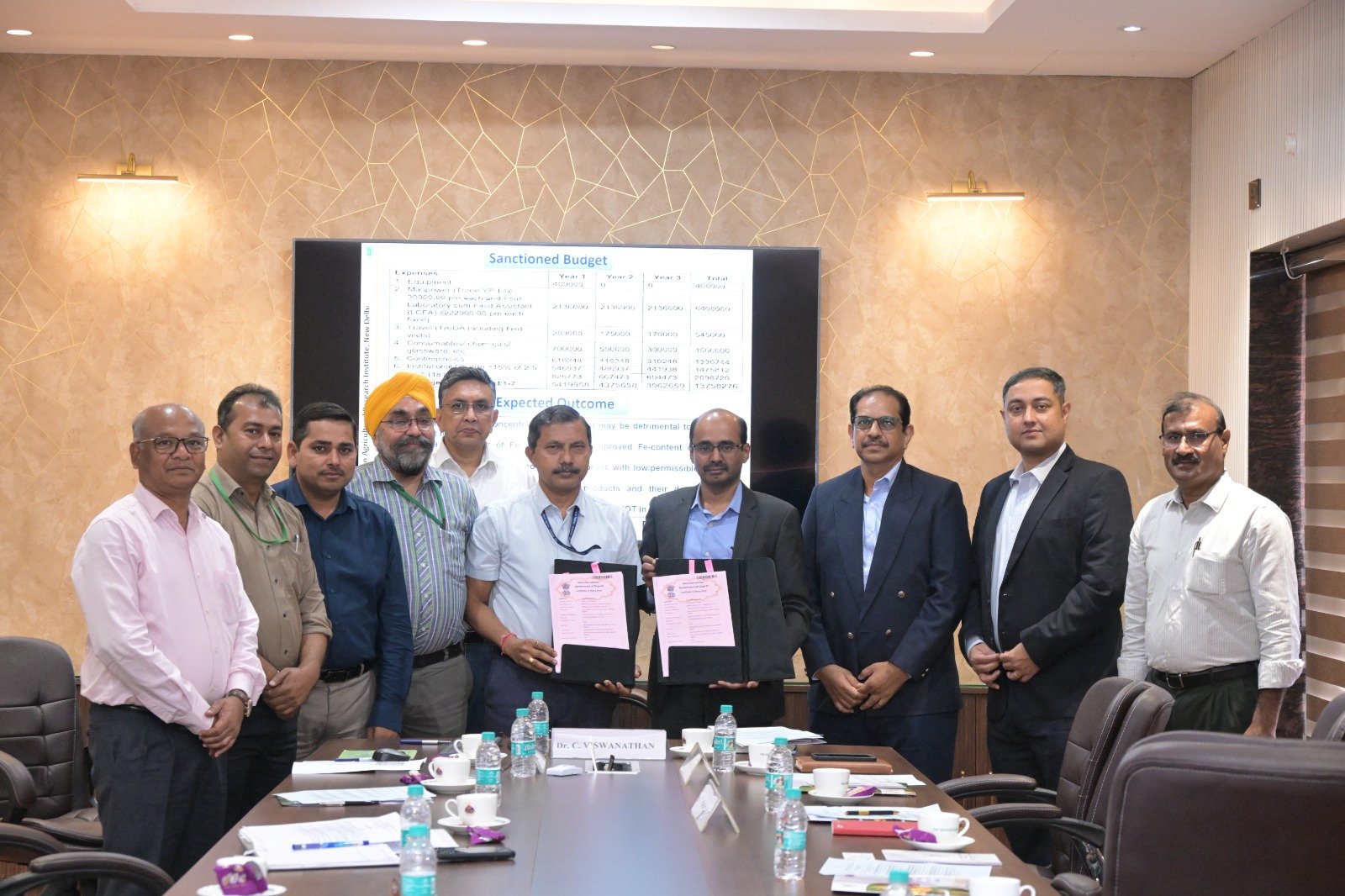
The MoU was signed by Vishwanathan N, Head of Research & Development, AM/NS India, and C Viswanathan, Joint Director of Research, ICAR‑IARI, in the presence of Bhupinder Singh, Principal Scientist and Principal Investigator, ICAR‑IARI, and other senior officials.
The collaboration builds on preliminary studies initiated in 2024, which explored the suitability of iron ore tailings in crop production. Generated during beneficiation, the tailings have been found to contain naturally occurring minerals such as silica, iron oxides, alumina, calcium, magnesium, and other beneficial nutrients that can support soil health and crop growth.
Hiroo Ishibashi, Director & Vice President of Technology, AM/NS India, said, “This collaboration with ICAR‑IARI represents a pioneering effort to unlock the potential of iron ore tailings through science‑led research. If successful, this initiative can reduce environmental footprints associated with by‑product storage while supporting sustainable agriculture and resource conservation.”
Initial laboratory and field studies conducted at ICAR‑IARI, New Delhi, and near AM/NS India’s beneficiation facility in Kirandul, Chhattisgarh, demonstrated promising results. Research indicated potential for utilising iron ore tailings as sources of essential nutrients for crops including paddy, wheat, and vegetables.
Bhupinder Singh, the project’s principal investigator, added, “Our preliminary studies have shown encouraging indications regarding the potential use of iron ore tailings in agricultural systems. Through this long‑term collaborative programme, we aim to generate comprehensive scientific data on agronomic performance, environmental safety, and nutrient dynamics, which can help develop evidence‑based pathways for responsible utilisation of iron ore tailings, particularly for addressing Fe deficiency in degraded soils and for improving Fe concentration in farm produce to support biofortification.”
The MoU focuses on long‑term scientific studies to be conducted at IARI, New Delhi, and at AM/NS India’s Kirandul facility over multiple seasons. Research will evaluate crop response, nutrient availability, phyto‑toxicity, leaching characteristics, and environmental impact, aiming to establish robust evidence for safe and beneficial utilisation of iron ore tailings in agriculture. This approach could reduce the need for long‑term storage of mining by‑products while supporting sustainable farming practices.