

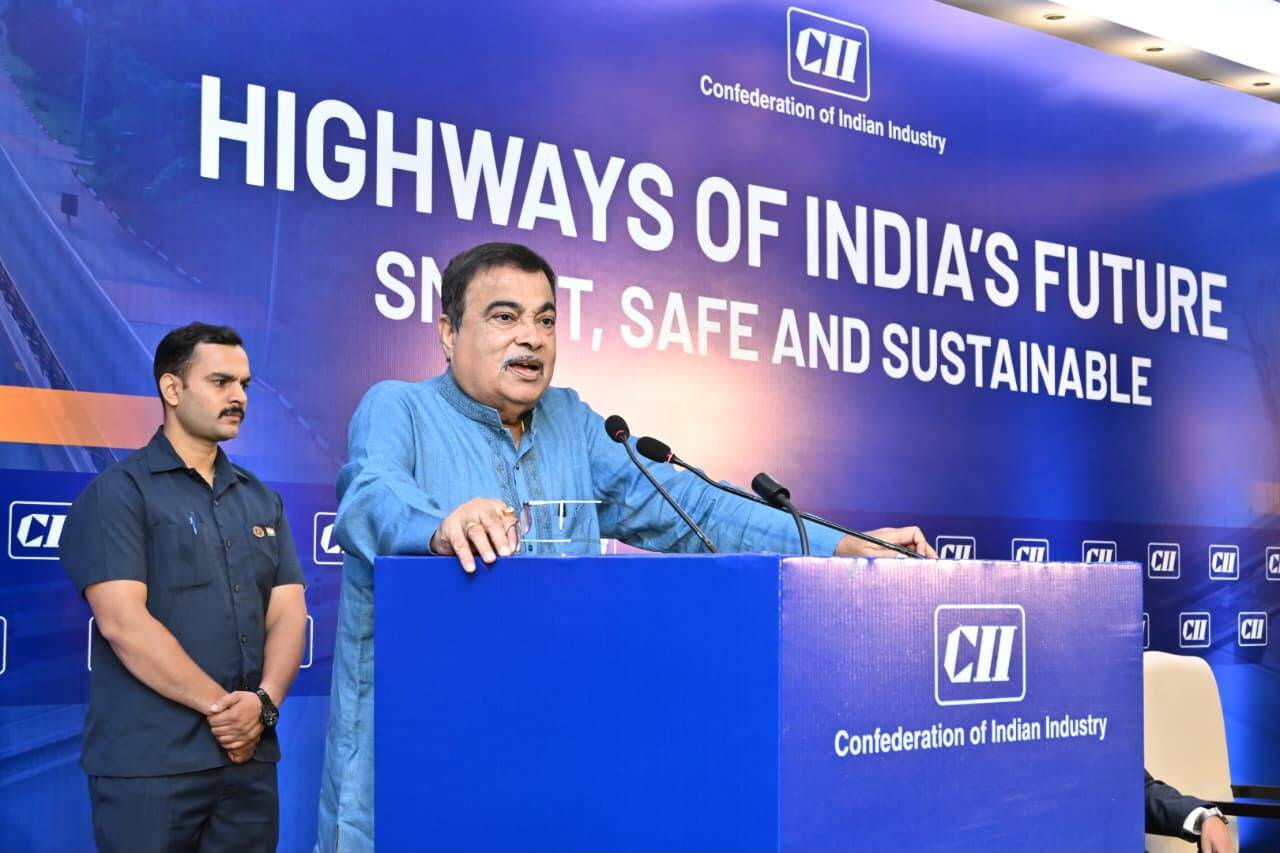
Contractors, consultants and officials found responsible for quality lapses on highways will be blacklisted and penalised, Union Minister for Road Transport and Highways Nitin Gadkari has said.
Union Minister for Road Transport and Highways Nitin Gadkari has said the government will intensify technology-driven monitoring of highway quality through Network Surveillance Vehicles (NSVs), warning that contractors, consultants and officials found compromising on standards will face blacklisting and stringent penalties.
Addressing the ‘Highways of India’s Future: Smart, Safe and Sustainable’ conference organised by the industry chamber Confederation of Indian Industry (CII) in New Delhi on Tuesday, Gadkari said the Ministry has begun closely monitoring road quality through technology and public feedback. “In the last few months, I have been personally monitoring this, and I have reviewed hundreds of projects. Social media posts have also helped flag quality issues at stretches,” he said.
Urging citizens to continue reporting road defects through social media, the minister added, “We have already seen a drop of 30 per cent in such problems since we started monitoring these closely, and I am reasonably sure we will see the rest resolving over the next two years.”
He warned that contractors, consultants and officials found responsible for quality lapses would be blacklisted and penalised.
NSVs are multi-sensor, vehicle-mounted platforms used to automate road-condition and pavement assessments at traffic speeds of 40-80 kmph. Mandated by the Ministry of Road Transport and Highways and deployed by the national road developer, National Highways Authority of India (NHAI), the systems help monitor highway quality, plan scientific repairs and feed data into AI-enabled asset management platforms.
The minister said several manufacturers of bearings and expansion joints had already been blacklisted after failing to meet quality standards prescribed by the ministry.
Logistics Costs Fall
Highlighting the role of infrastructure in India’s economic growth, Gadkari said improvements in road connectivity have helped reduce the country’s logistics costs to single digits.
Recalling that India’s logistics costs were around 16 per cent of GDP two years ago compared with about 8 per cent in China and roughly 12 per cent in Europe and the US, he said the figure has now declined to around 9 per cent. “I am really happy that, as compared with the logistics cost of 8 per cent of GDP in China, 12 per cent logistics cost of European countries and the USA, now from 16 per cent, Indian logistics cost is coming to single digits, that is 9 per cent. I am confident that because of the good roads, our logistics cost is now in the single digits,” Gadkari said.
Calling infrastructure development the backbone of economic growth, he added that every ₹100 invested in infrastructure generates an economic impact of approximately ₹325.
The minister also said India is rapidly deploying AI-based advanced traffic management systems. In the first phase, the technology will be implemented across approximately 1,000 km of highways, enabling real-time monitoring of traffic movement and road conditions.