The metro rail network in India has sharply expanded over the last decade from about 116 km of operational and under implementation network in 2006 to about 425 km of operational and 700 km of under implementation rail network in the country. The operational metro network is expected to increase at a faster pace with multiple new metro rail projects approved or under implementation and an even larger network in the planning stage.
<p></p>
<p> India’s metro rail network is currently amongst the top ten largest metro networks in the world. However, this is still modest in comparison with some large countries like China which has a metro rail network of 4,000 km (30 per cent of the global metro network). The large urban population with many cities with over a million population leaves a tremendous potential for expansion of the metro network in India. </p>
<p>Currently, out of 18 cities with over 2 million population, nine cities have operational metro network, while another five cities have either, under implementation metro projects or proposals for the development of metro. Further, many of the cities with the operational metro network have sizeable expansion plans. In total, about 440 km of new metro network development has been approved and another 800 km of the metro network is under the proposal stage. </p>
<p>Given the sizeable approved metro projects and a large number of projects which are under evaluation or approval stage, the order inflows to the construction sector from the metro rail development segment are expected to remain robust. Many contracts are yet to be awarded in the on-going approved metro rail projects. Apart from the operational and under implementation metro projects, another 15 cities have proposals for the development of metro which has a potential of over 1,400 km of the metro rail network. Currently, the metro rail projects worth Rs 2 trillion of project cost is under the approval stage. Assuming 400 km of the metro network is taken up for the development over the next five years, this would involve a total capital investment of Rs 1 triillion, thereby providing large construction opportunity. </p>
<p> <span style="font-weight: bold;">Present Status </span><br />
The metro rail network is operational (including partly operational) in 10 cities in India while projects on new or the expansion of metro rail network are under implementation in 11 cities (including cities with operational metro). In total, close to 950 km of the network is either operational or under various stages of implementation. These projects have an approved cost of Rs 2.5 trillion of which funding from the Government of India (GoI) is close to Rs 598 billion. The overall cost of the projects being upwards of Rs 2.5 trillion, the construction contractors have benefited from the proliferation of the metro rail projects in India. </p>
<p>Many under implementation metro rail projects are in advanced stage of execution and are likely to be completed over the next 2-3 years.</p>
<p>Apart from the operational and under implementation metro projects, another 15 cities have proposals for the development of metro which has a potential of over 1,400 km of the metro rail network. Currently, metro rail projects worth Rs 2 trillion of project cost is under the approval stage.</p>
<p> <span style="font-weight: bold;">Key Challenges <br />
Execution Challenge: </span>Execution of metro rail projects is often challenging as a majority of the projects are developed in urban areas, which already have high traffic and building density, resulting in limited land availability or the right of way. While the land acquisition is the state’s responsibility, at times delays in securing residual land impacts the project’s progress and can lead to a change of scope or cost escalation leading to disputes at a later stage.</p>
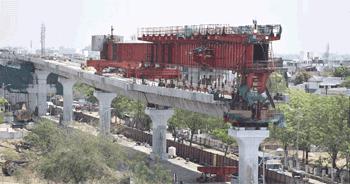
<p>Often, due to lack of land, metro projects have to be developed underground or at elevated levels. While both underground and elevate structures involve high complexity, underground structure is more complex due to the presence of underground utilities, uncertain below the ground conditions, etc.</p>
<p> <span style="font-weight: bold;">Funding Challenge: </span>As metro projects are capital intensive, the funding is often a primary constraint in the development of metro projects. With limited private participation, the costs have to be borne by the public sector- Central and State Governments. Further, in order to meet the growing expectations of urban cities to have their own metro rail infrastructure, many projects have been announced but the availability of financing often becomes a constraint in materialisation of these plans. Further, with low fare revenues, many metro projects are financially unviable unless supported by the government. In addition to the government’s funding, these projects often require low-cost debt to make them financially viable. Multilateral agencies like Japan International Cooperation Agency (JICA), Agence Frantaise de DTveloppement (AFD), European Investment Bank (EIB), Germany’s KFW (KfW), have so far supported metro rail financing. </p>
<p> The availability of such funding is also limited to key projects only.<br />
<span style="font-weight: bold;">Weak Public Private Partnership (PPP) in Metro Rail Projects:</span> Globally, less than 20 per cent of all metro projects have been taken up in the PPP mode despite the maturity of many markets with respect to ridership and fair pricing. Similarly, most of the projects in India have been taken up with the public finance on the EPC mode. So far, only five PPP projects in the metro rail sector in India have been taken up. The track record of PPP in the metro sector in India is not strong. Of the five projects awarded on PPP basis, one project – Mumbai Metro Ph-II was terminated before the start of the project while another one – Delhi Airport Line was terminated after becoming operational. Currently, there are two operational metro projects (Mumbai Metro One and Gurugram’s Rapid Metro which is divided in two phases). The last PPP project is partly operational and is being developed by L&T group.</p>
<p> For the complete article log on to www.infrastructuretoday.co.in</p>
<p> Authored by<span style="font-weight: bold;"> Abhishek Gupta, Assistant Vice President-Corporate Ratings, ICRA.</span></p>


Opportunity Foreseen, Albeit Challenges
Leave a Reply
You must be logged in to post a comment.