This landmark maritime reform is set to drive leasing, financing, and ship‑owning through GIFT City, while opening India’s maritime assets to deeper global capital participation. In a landmark reform, the Centre has exempted units established in the International Financial Services Centre (IFSC), GIFT City, Gandhinagar, from the licensing requirement under Section 11 of the Coastal...


Tag: Exim trade
Post

Post
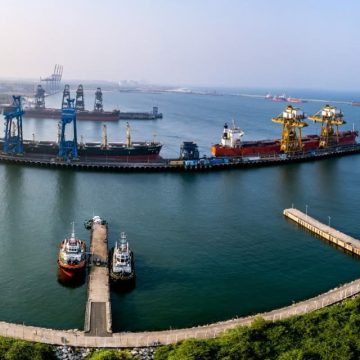
Kamarajar Port Joins Visakhapatnam as India’s Second 18‑Metre Deep‑Draft Port
This will deliver major economic gains to regional trade while enhancing the port’s competitiveness against domestic and global peers. Kamarajar Port Ltd (KPL) has emerged as a deep‑water port capable of handling Capesize vessels following completion of the sixth phase of its Capital Dredging project. With an operational draft of 18 metres, the port 22...
Post

IL&FS Maritime Infrastructure
Indian Ports comprising 13 Major and 187 Non Major ports form the backbone of the EXIM trade in India and handle 95 per cent by volume and 70 per cent by value of the trade.
Post
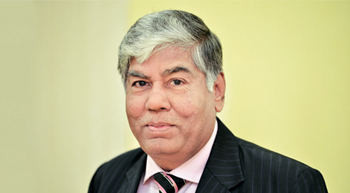
Dighi port is the final node of DMIC
As a result of the capacity constraints being faced by the major ports, cargo is diverted to the private ports due to locational advantages, high operating efficiency, superior cargo handling equipment and investment in large capacity creation.
Post
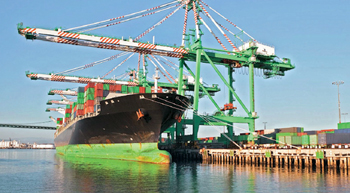
Fathoming the deeps
The meandering course of the Indian ports sector, the backbone of the country´s trade and commerce, has long been raising alarms. There are no two views about the importance of ports and their contribution in sustaining the growth and development of the economy.
Post

More than 36 PPP projects have been successfully launched
As such there is no diversion of cargo from the major ports to the non-major ports. As far as the traffic at major ports is concerned, there is consistent traffic flow and is largely on the increasing trend. However, non-major ports are also attracting cargo due to being captive ports and having no regulatory mechanism like TAMP, etc.
Post
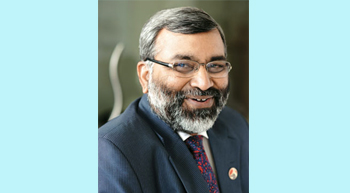
Need to focus on projects which are remunerative
Sunil Srivastava, Managing Director, Balaji Railroad Systems Ltd, comments on the dismal state of the Indian Railways, delayed projects, and the government´s role in improving the sector.
Post
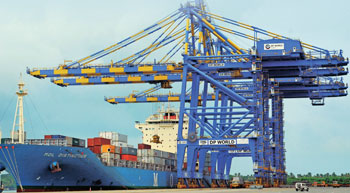
SETTING SAIL
Over the past few years, maritime industry has been the centre of focus for the country´s EXIM trade. Indian ports and shipping play a vital role in sustaining the country´s growth in trade and commerce.
Post
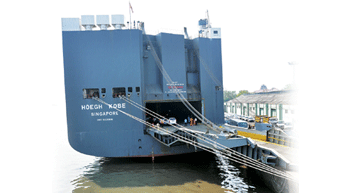
Port of Call
The Indian port sector has gathered pace with the government´s focus on revival of the manufacturing sector through the ´Make in India´ campaign. The manufacturing sector is likely to drive the growth of the port sector as the carrier of cargo - ports
Post

Ports need capacity augmentation
Jawaharlal Nehru Port Trust (JNPT) has achieved a growth of 7.33 per cent during the financial year 2014-15 by handling 4.467 million TEUs of container traffic. Neeraj Bansal, Chairman-In-Charge, JNPT
- 1
- 2