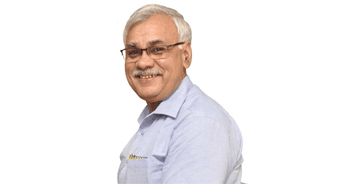
Urban transport and development is a state subject. With the Centre and the State coming together to fight the decade-old urban issue for a few and a century-old issue for many cities, <span style="font-weight: bold;">Durga Shankar Mishra, Secretary, Ministry of Housing and Urban Affairs (MoHUA)</span> feels that the Centre providing a helping hand to the State is like a corporate federalism. In an exclusive interaction, Mishra states that programmes like Smart Cities Mission, Housing for All, new Metro Policy, to cite a few will definitely streamline some of the tedious urban issues and the state government can achieve a better liveability or ease of living for its citizens.
<p></p>
<p> <span style="font-weight: bold;">Currently, there are 53 cities with 1 million population and 201 cities with 2 million plus population. How has the ministry planned to expand the entire metro network in India?</span><br />
With the Prime Minister inaugurating Bahadurgarh to Mundka (11 km) route of the Delhi Metro, the total operational kilometre in the country has touched 490 km. Of which, 289 km itself was operationalised by the Delhi Metro Rail Corporation (DMRC).</p>
<p> That said, by March 2019, the DMRC will be the fifth largest metro across the world and will lead in the league of cities like Shanghai, Beijing, London and New York. We have achieved this feat in 17 years. By March 2019, the DMRC will touch 350 km and by then, the country will witness a metro rail network of 650 km. At present, work on nearly 620 km of metro rail projects are under implementation. Also, for the first time, around 380 km of Regional Rapid Transport (RRT) projects in the country have been planned. The government is actively considering RRT on the similar lines of Mass Rapid Transport System (MRT). We have planned the first project from Delhi to Meerut, connecting all the cities close to Delhi.</p>
<p> <span style="font-weight: bold;">But will it be elevated or underground? </span><br />
It will be both. Better way to answer your question is, it will be a combination of the best and the cheapest. We are planning the RRT to move at a speed of nearly 200 km per hour. The first route planned by the Central Government- Delhi to Meerut- will cover 90 km in 60 minutes. Since, the metro rail is catching up in India, the government has come out with a new metro rail policy, which will create new opportunities and an ecosystem for upcoming projects. </p>
<p>The government is also promoting the Make in India programme in a big way. Here, through this programme, we are standardising all the rolling stocks, signalling system, eligibility criteria, electrical systems, etc., to mention a few. The standardisation as per the Indian requirement will led to cost efficiency and indigenisation. Through the Make in India programme, we would like to make this country a hub where companies can export metro-rail materials to markets like South East Asia, East Asia, Africa, Australia, etc. </p>
<p><span style="font-weight: bold;">Currently, number of projects are being implemented on an EPC mode. Has the ministry burnt their fingers and learned lessons from the PPP experience?</span> <br />
It is incorrect to say that we have burnt fingers regarding the public-private partnership (PPP) mode. Now under the new metro policy, the government has given options of pure PPP mode or a mix of PPP and EPC or pure EPC. There are three ways by which a state can implement the metro project. First option is where the Central Government can aid the metro project with 10 per cent grant of the total project cost. Second option is the State and the Central Government jointly implement the project where the Centre can give 50 per cent aid and the rest will be raised by the state government. Apart from the aforementioned options, there are many options that can be unbundled such as contracts can be given to different players for services such as fare collection, technology collaboration, electrical system, rolling stocks or communication systems, etc. We are unbundling such contracts in the Delhi Metro project. </p>
<p> <span style="font-weight: bold;">Well, the country’s leadership, whether before or now, always thinks about the big-ticket projects. However, the decision makers always give less priority to the last-mile connectivity. Do you differ my view or it’s just a common perception? </span> <br />
I cannot comment on the earlier regime. However, in the current metro policy, while submitting the project plan, the state government has to prepare a detailed study about the last-mile connectivity from each metro station. Again, Delhi Metro is an example to cite. A subsidiary was formed by the DMRC just to make sure that there is a last-mile connectivity. This subsidiary company is going to be responsible for taking people up to 5 km with various modes of transport such as bicycle sharing, e-rickshaw and electric buses, and state transport buses. </p>
<p> The subsidiary company will operate on the viability gap funding model. Here, the subsidiary company will create the necessary infrastructure at each metro station for seamless integration of various means of transport. India is confused about the overall progress on the Prime Minister’s ambitious 100 smart cities. Your comment. </p>
<p> Considering 100 smart cities, we are expecting a total investment of Rs 2 trillion over a period of five years. Out of which, Rs 1 trillion will be aided by the Central Government and balance will come through the state government and conversions, through synergy of various programmes and PPP. As we speak, around 332 projects worth Rs 60 billion are complete. Around 697 projects, amounting Rs 277 billion are under implementation at different stages and 432 projects worth Rs 191.62 billion are under the tendering stage. </p>
<p> Now let me give you some specific examples; you must have heard about the Prime Minister inaugurating the Integrated Command and Control Centre (ICCC) near Naya Raipur. It was tenth in the country. Apart from these 10 cities, the ICCCs in another 15 cities are under implementation at present and 32 ICCCs are under the tendering process. In case of smart road, four roads are already completed, 32 are under implementation at different stages and nine are under the tendering stage. For rooftop solar projects, seven solar projects are already completed, 42 are under implementation at present and seven are under the tendering stage. </p>
<p> Six smart water project have been completed so far; 34 are under implementation and 10 are under the tendering stage. Two cities have completed smart waste water project, 28 are under implementation and 17 under the tendering stage. </p>
<p> In case of PPP, 14 projects are already completed, 30 are under implementation and 29 are under the tendering stage. We have got PPP projects worth nearly more than Rs 80 billion. </p>
<p> Through the Make in India programme, we would like to make this country a hub where companies can export metro-rail materials. </p>
<p> <span style="font-weight: bold;">- RAHUL KAMAT</span> </p>


We are implementing smart cities projects worth Rs.510 billion
Leave a Reply
You must be logged in to post a comment.