

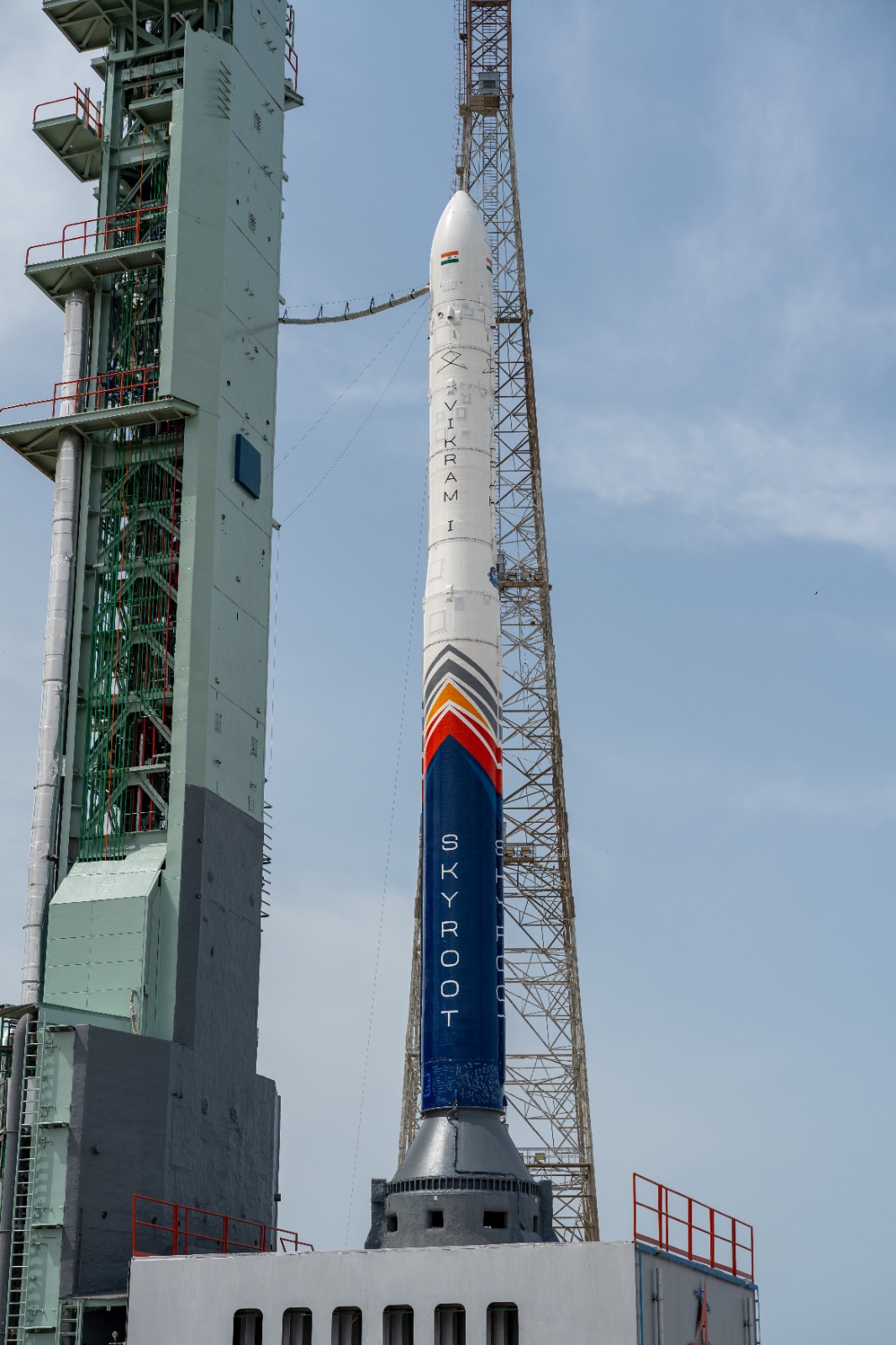
The rocket will carry technology demonstration payloads, alongside an artwork and a micro‑art installation.
Hyderabad‑based launch vehicle maker Skyroot Aerospace will attempt the maiden test flight of its orbital‑class Vikram‑1 rocket from the Satish Dhawan Space Centre‑Sriharikota (SDSC‑SHAR) on July 18 at 1130 IST.
Authorities have issued airspace and maritime notices, formally designating restricted zones along Vikram‑1’s ascent and impact corridor.
Mission Aagaman— Sanskrit for “arrival”—marks Skyroot’s second mission after the successful suborbital flight of Vikram‑S, the first private rocket to reach space from Indian soil, on November 18, 2022.
“We are eager to see how Vikram‑1 performs in a real flight environment for the first time. This test flight will provide valuable data foundational to our aspiration of establishing a launch cadence,” said Pawan Kumar Chandana, Co‑founder & CEO, Skyroot Aerospace.
Vikram‑1 will carry technology demonstration payloads from Grahaa Space, Cosmoserve, DCubed and Skyroot’s own SCOPE, along with Cosmos Diamonds’ artwork ‘Cosmic Bloom’ and a micro‑art piece.
Chandana noted that demand for small satellite launches continues to grow while supply remains constrained. “The clearance of Vikram‑1 for flight following rigorous testing is a defining milestone in India’s space journey. This first test flight marks the beginning of Skyroot’s aspiration to open space for all.”
All stages of Vikram‑1 have been integrated and stacked on the launch pad. Final integrated checks have been completed from Skyroot’s launch control centre, along with interface checks with telemetry ground stations and tracking radars.
Co‑founder & COO Naga Bharath Daka added, “This launch represents the hopes and hard work of around 1,000 people, the contribution of over 400 suppliers, and nearly 3,000 days of resolve to build a global offering from India. With in‑flight data from this mission, we will learn, improve and build further. This test flight is the first step towards creating a reliable, on‑demand launch company for the world from India.”
Standing seven storeys tall, Vikram‑1 is a multi‑stage orbital launch vehicle built with an all‑carbon composite structure and powered by in‑house propulsion systems, including 3D‑printed engines and high‑thrust solid‑fuel boosters. Designed to carry satellites up to 350 kg to Low Earth Orbit (LEO), its first test flight targets a 450 km orbit at 60‑degree inclination.