

The prize pool for NIDAR 2.0 has been expanded to over ₹6.5 million, with winners gaining internships, incubation and cloud credits to help turn prototypes into commercial products.
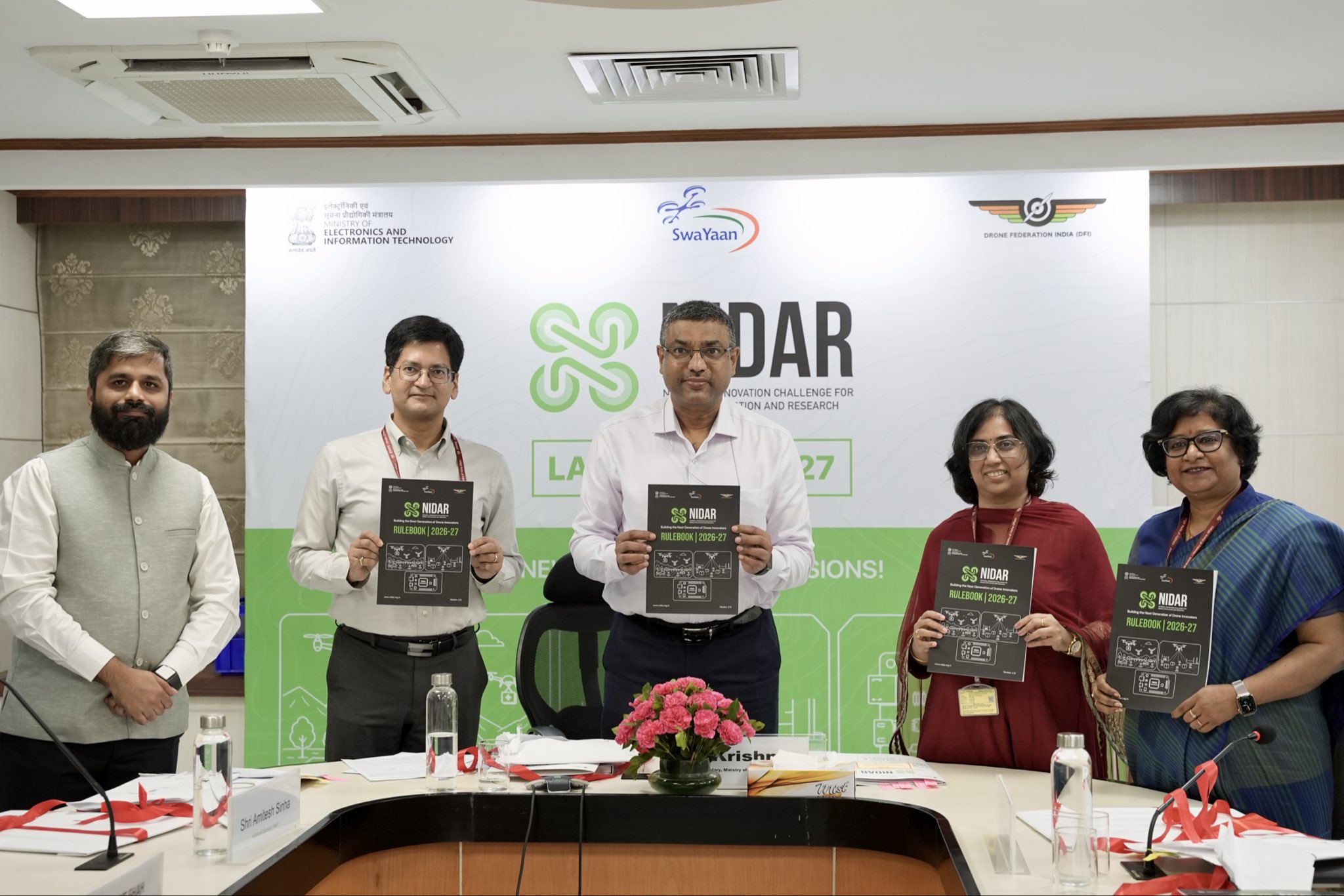
The Ministry of Electronics and Information Technology (MeitY), in collaboration with the Drone Federation of India (DFI), has launched the second edition of the National Innovation Challenge for Drone Application and Research (NIDAR 2.0), 2026-27, under its SwaYaan initiative.
NIDAR 2.0 challenges students to build smarter drones powered by the VEGA processor, a family of indigenous microprocessors. Designed by the Centre for Development of Advanced Computing (C‑DAC) under MeitY’s Microprocessor Development Programme, it is based on the open‑standard RISC‑V architecture. By placing this processor at the centre of the component innovation track, NIDAR 2.0 encourages students to build the control systems of Indian drones on Indian‑made chips.
Addressing a gathering of students, faculty, government officials and industry leaders on Monday, S Krishnan, Secretary, MeitY, said, “NIDAR 2.0 takes our students from just flying drones to building the drone’s brain. When the drone’s brain runs on India’s own VEGA processor, we are not just training engineers. We are laying the foundation of a self‑reliant drone industry.”
The first edition of NIDAR 2025-26 drew around 3,500 students from 109 cities in 26 states and union territories, who built autonomous drone solutions for disaster management and precision agriculture. In the grand finale, 24 teams out of 93 shortlisted went home with prizes worth ₹4 million.
To match the wider scope, the prize pool for NIDAR 2.0 has been expanded to over ₹6.5 million. Winners will also receive corporate internships, incubation support and cloud computing credits to help turn their prototypes into commercial products.
Tomorrow’s Solutions Today
Since civilian and defence drones share much of the same core technology, ideas emerging from NIDAR can therefore strengthen both civilian and defence applications. This is aligned with the goals of Atmanirbhar Bharat and Viksit Bharat @2047.
Also speaking at the event, Smit Shah, President, DFI, stated, “NIDAR 2026-27 is about building the technologies that power the next generation of drones with a new focus on drone components. India’s drone ambitions will ultimately be shaped not just by policies or manufacturing, but by the engineers and innovators we nurture today.”
NIDAR 2.0 raises the level of the challenge. It moves the focus from conventional airframes to autonomous systems, indigenous avionics and core drone components. The challenge runs across two tracks.
Track 1 or Drone Innovation tasks student teams to build fully autonomous swarm drones that can locate survivors and deliver medical parcels in a disaster zone without any external communication network. It also challenges teams to develop a GPS‑denied drone that can navigate confined indoor spaces for industrial inspection.
Track 2 or Component Innovation challenges teams to design an indigenous flight controller and autopilot built around the VEGA processor, using indigenous electronic components. After technical evaluation, the top 100 teams will each receive two VEGA processor kits for development, testing and integration.