

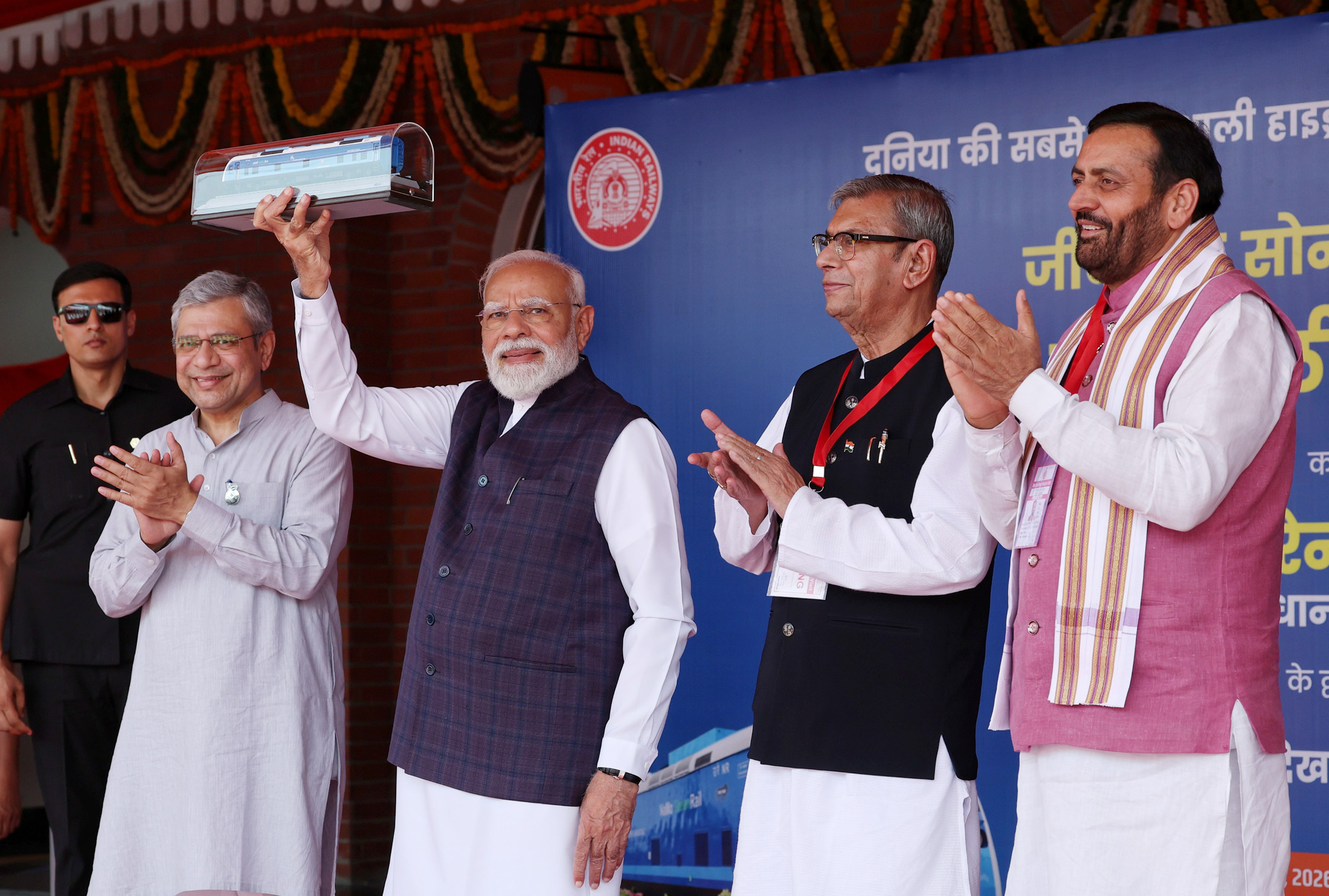
Flagging off the world’s longest and most powerful hydrogen train, Modi said the fuel will define rail mobility in the 21st century.
Prime Minister Narendra Modi said rapid electrification of the Indian Railways has helped the country avoid a potential transport crisis triggered by fuel supply disruptions from the ongoing West Asia conflict.
“If such a situation had arisen before 2014, the entire railway system would have come to a halt because most trains ran on diesel. Imagine if diesel imports had stopped, the nation would have faced a massive crisis,” Modi told a public rally after inaugurating India’s first hydrogen train service between Jind and Sonipat.
He noted that in the 90 years from 1925 to 2014, only 30 per cent of the network was electrified. “At that pace, it would have taken another 200-300 years to electrify the Railways. But in the past 12 years, nearly 99 per cent of India’s rail network has been electrified. Because of this, despite wars and oil crises, India’s railways have not stopped; the engine of India’s development has not stalled.”
He said this transformation was made possible through pragmatic planning.
Hydrogen Rail Future
Modi said hydrogen will define rail mobility in the 21st century, just as coal powered the 19th century and diesel and electricity the 20th. “Indian Railways has taken a big step into this technology. For now, the journey is 90 km long, but in the future, there are immense possibilities for expansion. We will continue researching ways to reduce costs and increase efficiency, moving forward step by step.”
The train launched by Indian Railways, at 3,200 horsepower, is the most powerful hydrogen train in its category and also the longest, globally. “India, in its very first attempt, has run a ten‑coach hydrogen train, planting its flag in the world. It is smoke‑free and a shining example of Make in India, designed by Indian engineers and built by an Indian company,” Modi said.
He added that new factories will be created in Jind to support the hydrogen train network, generating jobs for Haryana’s youth.

Rail Projects Surge
Railway Minister Ashwini Vaishnaw credited Modi’s leadership and India’s engineering talent for the milestone. He said rail project allocations in Haryana had risen to ₹35 billion from ₹3.15 billion over the past decade.
“Today, projects worth over ₹180 billion are being implemented in Haryana. This includes redevelopment of 34 stations, launch of 16 Vande Bharat and eight Amrit Bharat services, 100 per cent electrification of the state’s rail network and benefits from the Dedicated Freight Corridor running from Ludhiana to Rajasthan, Gujarat and Maharashtra.”
Haryana Chief Minister Nayab Singh Saini called the event a celebration of Viksit Bharatm (developed India) and Aatmanirbhar Bharat (self-reliant India). “It is a historic day for Haryana. Prime Minister, your commitment to green energy has resulted in this gift of India’s first hydrogen train to Jind.”
Saini said Modi had given Haryana projects worth more than ₹710 billion earlier, and on this visit announced nine development projects worth over ₹150 billion. He added that the state had received grants exceeding ₹7 trillion under the “double‑engine” government.
He thanked the audience for making the rally eco‑friendly by travelling to the venue in non‑hydrocarbon vehicles, aligning with the green‑energy theme of the day.
– Manish Pant