

Following the mission’s success, India and firms like Skyroot are positioning to disrupt the satellite launch segment, which has seen the rise of global leaders such as Elon Musk’s SpaceX.
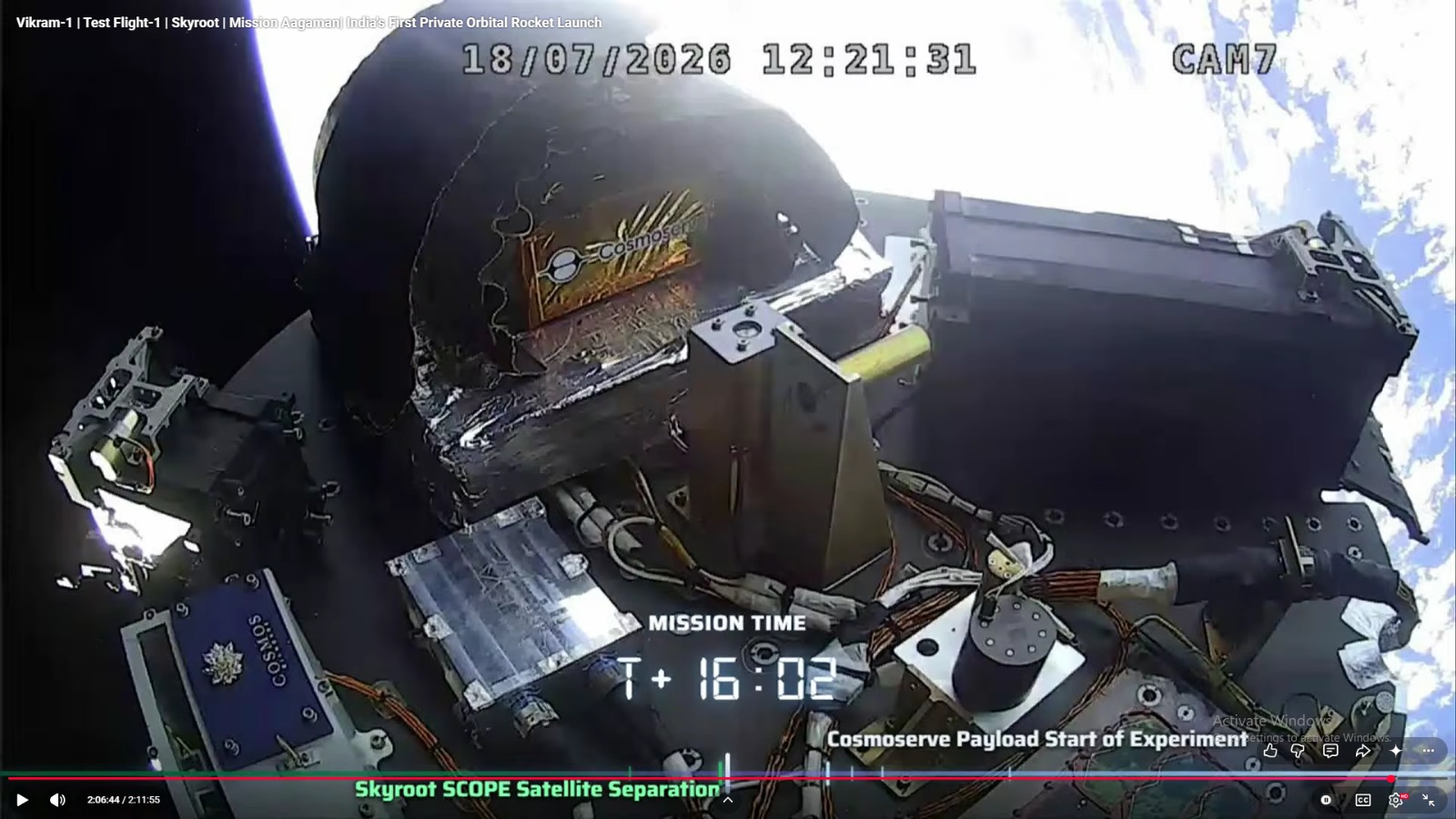
As Skyroot Aerospace’s navy blue and white Vikram‑1 rocket lifted off at 12:05 IST from the First Launch Pad at the Satish Dhawan Space Centre, Sriharikota, it marked a milestone in India’s journey to open space to the private sector.
The initial anxiety on the face of Pawan Kumar Chandana, Co‑founder & CEO of the Hyderabad‑headquartered launch vehicle maker, and his team gave way to applause and cheering once the rocket cleared the launch tower about ten seconds after liftoff.
Following the separation of the three Kalam engines, the 3D‑printed Orbital Adjustment Module took over to place the rocket into its intended Low Earth Orbit (LEO). With India’s first privately built rocket completing its final burn and deploying its payloads into a 450 km orbit, India became the third country in the world, after the US and China, with private orbital launch capability.
One payload was a handwritten card inscribed with “Vande Mataram” (Glory to the Motherland) from Prime Minister Narendra Modi, marking the 150th anniversary of the national song composed by writer Bankim Chandra Chatterjee.
After congratulating the Skyroot team by phone, Prime Minister Modi wrote on X (formerly Twitter): “This is a defining moment in India’s space journey. The growing participation of our private sector is opening new frontiers and accelerating innovation. This achievement will encourage countless youngsters to dream bigger and innovate fearlessly.”
Nine months earlier, in November 2025, Modi inaugurated Skyroot’s 200,000‑square‑foot Infinity Campus, designed to produce a rocket a month.
V Narayanan, Chairperson of the Indian Space Research Organisation (ISRO), said, “This achievement is the outcome of years of innovation, perseverance and engineering excellence, and reflects the growing maturity of India’s private space sector.”
Pawan Kumar Goenka, Chairperson of the Indian National Space Promotion and Authorisation Centre (IN‑SPACe), added, “Only a handful of nations can reach space on their own, and today a private Indian company joined that exclusive club. What lifted off today is the culmination of years of work, a team of over a thousand people, and the efforts of close to four hundred suppliers.”
Vikram‑1, the country’s first private commercial rocket, was designed and developed in‑house in under four years. It can deploy multiple payloads of up to 350 kg in LEO in a single mission. Other technological firsts include a body made entirely from carbon fibre, 3D‑printed hypergolic engines, and a Kalam‑1200 booster stage built with advanced composites.
This was Skyroot’s second mission after the successful suborbital flight of Vikram‑S in November 2022.
$21 Billion Market
Vikram‑1’s successful launch takes the founders closer to targeting the $21 billion global launch services market. Skyroot’s ‘Cab to Space’ model aims to provide dedicated, precise, and affordable launch opportunities, reducing bottlenecks for satellite operators.
“We are immensely proud to stand here today. Vikram‑1 reached its designated orbit and deployed our own SCOPE satellite, Grahaa Space’s Solaras satellite, and other in‑orbit experiments, making Skyroot the first private company to take a rocket to orbit on its very first flight,” Chandana said in a company statement.
Co‑founder & COO Naga Bharath Daka added, “During the flight, Vikram‑1 completed every principal mission milestone, validating the performance of its propulsion, avionics, and guidance, navigation and control systems under true operational conditions.”
The launch’s success will help validate the design and provide insights for developing a reliable, high‑cadence commercial launch programme. Amid speculation over launch’s cost—with estimates wildly swinging between $1 million and $2 million—Infrastructure Today has learned the company is confident of delivering one of the most cost‑effective launch services globally once commercial operations begin.
Breaking Legacy Barriers
Skyroot’s achievement has been widely welcomed by stakeholders in India’s $8.4 billion spacetech industry. The mission, named ‘Aagaman’—meaning ‘arrival’ in Sanskrit and other Indic languages—highlighted the symbolic significance of India’s first private orbital launch.
Lt Gen (Retd) A.K. Bhatt, Director General of the Indian Space Association (ISpA), said Skyroot has “broken legacy barriers,” proving the domestic industry can handle end‑to‑end space missions. “The Indian private space sector is no longer a high‑risk bet; it is a highly bankable, globally competitive asset class capable of breaking the global small satellite launch bottleneck.”
Subbu Rao Pavuluri, Chairman & Founder of aerospace engineering firm Ananth Technologies, remarked, “Success of Skyroot launch is a great milestone for private initiatives in India and leads India into launch‑capable nations. Augurs very well for Bharat.”
Krishanu Acharya, CEO & Co‑founder of Suhora Technologies, noted that dependable domestic launch capability changes the economics of Earth observation. “Lower‑cost and more responsive launch services will enable more Indian satellite operators to deploy and replenish constellations, significantly improving data timeliness and availability.”
Global players also lauded the success. Gautam Sharma, Managing Director of satellite communications firm Viasat India, said, “This milestone beautifully demonstrates how India’s space economy is thriving through a collaborative ecosystem where government, startups, academia, investors and global industry players are helping build the NewSpace future together.”
India’s space economy is projected to grow to $44 billion by 2033. Indigenous private launch capability will be a critical enabler of this growth, signalling investor confidence and the maturity of the country’s commercial space ambitions. India and players like Skyroot—which became the country’s first spacetech unicorn with a $1.1 billion valuation in May 2026—are now positioning to disrupt the same segment that has seen the rise of global leaders such as Elon Musk’s SpaceX.
– Manish Pant