

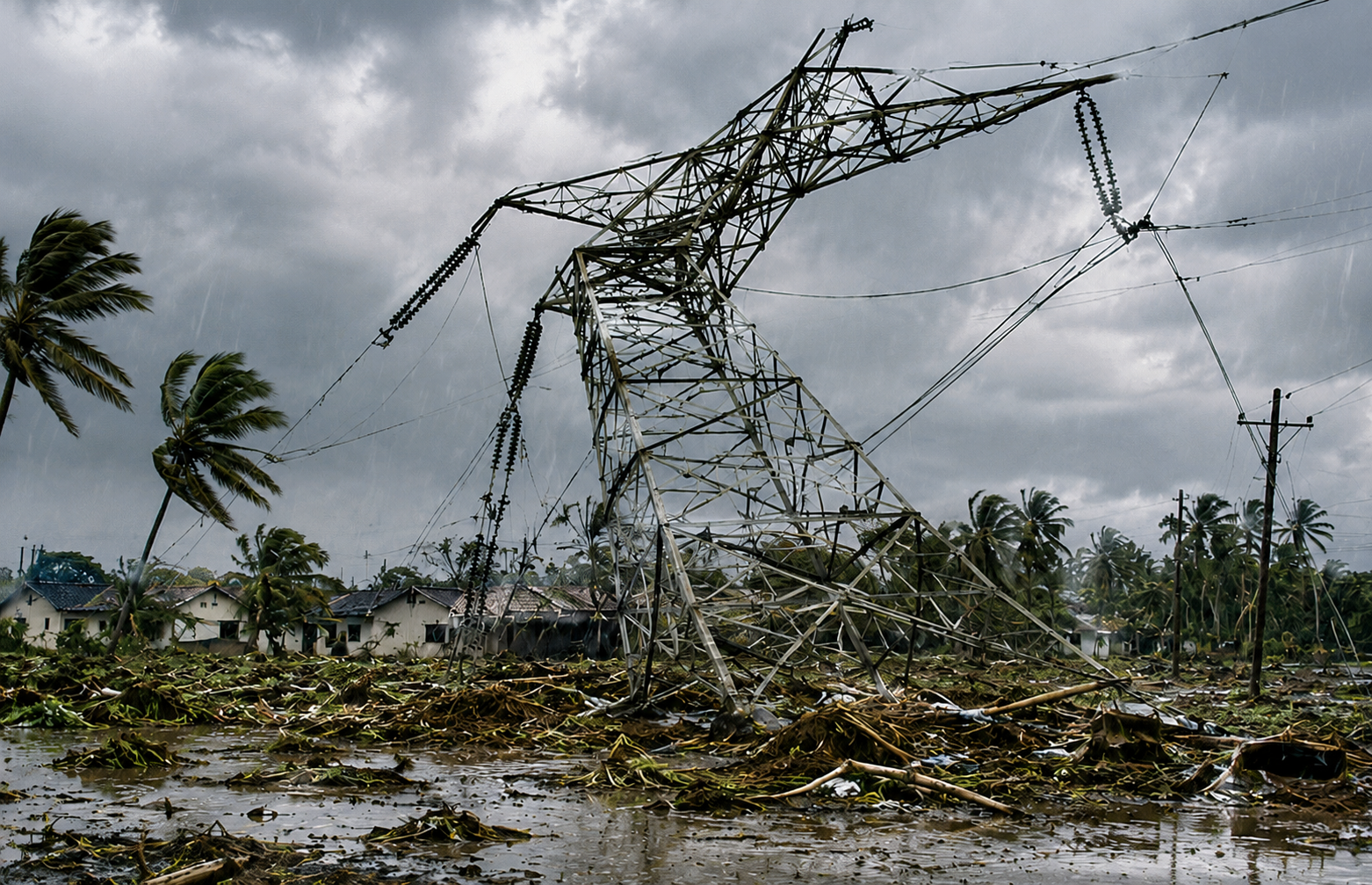
Intensifying climate shocks and rising asset exposure demand climate‑informed resilience across India’s power sector value chain, argue Zeya Farhan and Krishna S Kumar.
India’s power sector is undergoing
historic expansion, driven by urbanisation, electrification, and economic growth. Historically, India’s power generation
fleet has been dominated by conventional generation capacity. However, in the last decade, renewable energy, particularly solar, has been at the forefront of India’s power capacity expansion.
The National Electricity Plan (NEP) expects India’s power generation capacity to reach more than 900 GW by 2031-32, up from the current generation capacity of 520 GW, with an estimated future demand of approximately 2,473 TWh. The build-up of transmission and distribution (T&D) infrastructure will be essential as demand and loads scale. The national transmission network already spans well over half a million circuit-km and continues to expand to accommodate large renewable energy clusters and connect distributed systems. Per the NEP, addition of over
191,000 circuit-km of transmission lines and 1,274 GVA of transformation capacity are planned between 2022-23 and 2031-32,
along with 33 GW of HVDC links. As per the Central Electricity Authority (CEA), currently there are about 2.5 lakh 11kV feeders, 15 million distribution transformers, and 340 million end-users.
Like any other large country, India’s power sector rests on capital‑intensive infrastructure designed to operate for decades. However, the sector in India is not vertically integrated, with different parts of the value chain handled by separate entities. These generation assets, transmission corridors, substations, and distribution networks are deployed across diverse geographies, ranging from arid heat zones to flood-prone regions. According to the Climate Risk Index published by Germanwatch in 2025, India ranked sixth among nations hit hardest by extreme weather over the
past 30 years. Between 1993 and 2022, the country endured more than 400 extreme events, including floods, heatwaves, and cyclones. This highlights how intensifying climate stressors are resulting in widespread multi-hazard exposure.
As one of the world’s largest synchronised grids, an impact on any part of the country could potentially snowball, triggering cascading issues. These systems are therefore increasingly vulnerable to climate events, making infrastructure resilience an urgent priority for long-term power-sector planning.
Rising Climate Risks
Climate change-linked extreme events are increasingly recognised globally as a key risk to physical infrastructure, with 97 per cent of infrastructure investors identifying climate-induced impacts as significant and 76 per cent expecting material impacts on investments. The increasing interactions between climate change-linked extreme events and power infrastructure has turned climate change into a systemic complexity for power systems as well.
Per International Energy Agency data, in many regions in India, climate-related events have started causing disruptions and causing financial losses for utilities due to reduced power generation and unexpected repair costs. As power demand continues to grow, the resilience of power systems to climate impacts is likely to become a key concern for energy security.
Weather Shocks
Climate impacts stress power infrastructure beyond its design limits, triggering operational disruptions. When these thresholds are exceeded, equipment performance degrades, or protection systems trigger shutdowns, resulting in downtime. As India’s generation
mix becomes increasingly diversified, climate impact manifests differently across conventional generation, renewable energy, and transmission assets.
Thermal assets are sensitive to heat and water stress. Ambient temperature increase may reduce the efficiency of condensers and cooling towers, affecting optimal heat exchange and lowering overall generation potential. Rise in temperature of the cooling water can result in a reduction in output capacity, ranging from about 5 per cent at a 1.5°C increase to 15-20 per cent at 3°C.
Across the boiler-turbine-generator system, operating efficiency may decline by around 0.3-0.7 per cent for every 10°C increase in ambient temperature. As these plants are dependent on large volumes of water for cooling, drought and water stress conditions can severely affect operations and cause downtime. Furthermore, flooding also disrupts operations by damaging safety systems, intake pumps, and affecting the water supply.
Solar PV systems operate in the open and are directly exposed to weather conditions.
PV modules typically operate between panel surface temperatures of about -40°C and 85°C, with efficiency losses beginning when cell temperatures exceed about 25°C. Output declines by roughly 0.4-0.5 per cent for every 1°C increase above this threshold, and systems may temporarily shut down if panel surface temperatures exceed the upper threshold.
As the module surface temperatures rise, power losses can increase from roughly
5 per cent at 40°C to more than 16 per cent at 65°C. In addition to thermal effects, other extreme weather events, such as storms
and flooding, can damage mounting structures and associated electrical components, including inverters and transformers within
PV installations.
Wind turbines operate within certain defined wind load thresholds, typically generating power between speeds of 3 to 25 m/s, with assets automatically shutting down at higher wind velocity to prevent damage to rotors and the tower structure. Turbines function optimally within ambient temperatures of about 10°C to 40°C and can tolerate temperatures ranging from
20°C to 50°C, with derating beginning near 40°C influenced by changes in wind’s kinetic energy due to variations in air density.
T&D infrastructure is also affected by extreme weather events. Rising temperatures stress transformers and reduce conductor capacity, increasing the likelihood of thermal faults. In Europe, wind‑driven weather events are projected to raise SAIDI—the System Average Interruption Duration Index, which measures the average outage duration per customer—by about 9 per cent by 2030. This equates to roughly 1.5 extra minutes of outage per customer annually. Multiplied across millions of accounts, even small increases in outage duration represent a significant reliability challenge over the long term.
The need to ensure that India’s rapidly expanding power system remains reliable under changing climate conditions highlights the importance of addressing the complexities and challenges discussed through a systematic approach to assessing climate impact across electricity infrastructure, thereby informing and guiding the integration of resilience measures into long-term infrastructure planning.
Assessing Climate Impact
India’s Electricity Act 2003 broadly reformed the power sector under the umbrella of the core principles of reliability, accessibility, and affordability, ensuring a low-cost, continuous, quality supply of electricity to all consumers. As climate change-linked events escalate, they could progressively undermine these core principles of the power sector. For instance, prolonged heatwaves have the potential to reduce generation and drive demand spikes that strain grid reliability. Erratic monsoons and cyclones damage T&D assets, affecting accessibility, and the cumulative cost of outages and post-disaster restoration constrains affordability.
Existing climate impact assessment methodologies offer a well-established foundation for integrating climate considerations into infrastructure planning.
The World Bank’s Climate and Disaster Risk Screening Tools, ADB’s climate-proofing approach, and JICA’s Climate-FIT are purpose-built instruments that support early-stage identification of potential climate impacts through structured screening across hazards, exposure, and vulnerability, and serve their intended function effectively at the project preparation and appraisal stage. As climate impact analysis continues to mature, particularly for application in operational and investment contexts within complex infrastructure systems, there is an opportunity to extend these approaches through more granular, equipment-level assessment.
An operational climate impact assessment framework that incorporates the technical parameters of specific asset types and their components, including engineering thresholds for derating, forced shutdown, equipment failure, restoration time, and financial loss, could complement existing screening tools by enabling more precise translation of climate stressors into engineering and financial impacts. For a power sector as heterogeneous as India’s, where thermal plants, solar parks, substations, and transmission corridors face distinct risk profiles, such an approach would support more informed resilience planning, capital allocation, and help keep India’s grid safe and reliable.
The primary function of such a framework would be to inform investment prioritisation by identifying critical hotspots and estimating the costs of resilience measures. For generation assets, this could include interventions such as upgrading cooling systems to manage higher ambient temperatures, retrofitting thermal plants with dry cooling to reduce water dependency, and strengthening solar and wind installations in cyclone-prone regions through improved design standards, etc.
Strengthening India’s power sector response to climate impacts from extreme weather events requires building on existing foundations across three interconnected areas. On data and measurement, enhancing reliability reporting to disaggregate outage data by weather event type—capturing power lost, frequency, and specific triggers—would give planners the climate‑attributed evidence base needed for more informed infrastructure decisions. On financing resilience, as tariff frameworks and power purchase agreements continue to evolve, there is an opportunity to establish clear regulatory pathways for resilience‑related expenditure. The Coalition
for Disaster Resilient Infrastructure (CDRI)-Prayas report notes that cost‑sharing mechanisms between state support and user contributions, as well as tariff provisions for extreme weather costs, remain areas for
further development.
On decision‑support, institutionalising a process to quantify asset‑level impacts of climate events and prioritise resilience expenditure across scenarios would translate broad acknowledgement of climate risk into systematic planning. Advances across the three areas of data, financing, and decision‑support would meaningfully strengthen the sector’s capacity to plan for and finance climate resilience proactively.
India’s power sector has made significant progress in expanding infrastructure and increasingly recognising the need for climate resilience. As climate change-linked extreme weather events intensify and asset exposure grows, there is an opportunity to build on these efforts by further strengthening systematic, climate-informed planning across the entire power sector value chain. This could help support the long-term reliability, accessibility, and affordability of power supply, supporting India’s economic growth.
Therefore, a climate impact assessment tool could provide a framework capable of aggregating asset-level physical outputs into financial impact estimates. Such a framework would enable utilities, regulators, and financiers to embed climate factors into long-term electricity planning and support more informed decisions on investment, tariff design, and asset management. By integrating climate impact factors with investment decisions in the planning stage, the framework could directly reinforce the pillars of the Electricity Act by building resilience to improve system reliability and accessibility and protect the long-run supply of affordable power.
About the author
Zeya Farhan, Analyst, Climate Policy Initiative (CPI), and Krishna S Kumar, Analyst, Climate Policy Initiative (CPI), with Arnab Sarkar, Senior Analyst, CPI, also contributing to the story.