

Stand beneath the soaring spans of a modern industrial hub or a high-velocity transit terminal, and the space feels inevitable. Yet anyone who has lived through a project knows construction is rarely about concrete or steel alone. It is about managing relentless collisions of capital, weather, material markets, and dozens of trade contractors competing for the same square metre.
When budgets fracture and timelines collapse, the instinct is to blame execution. In truth, most failures are coordination failures disguised as construction failures. India’s contracting market is filled with firms that can pour concrete and lay steel. What it has often lacked is certainty before the first excavator arrives. That gap defined the origin of VIDVEDAA.
From Necessity to Capability
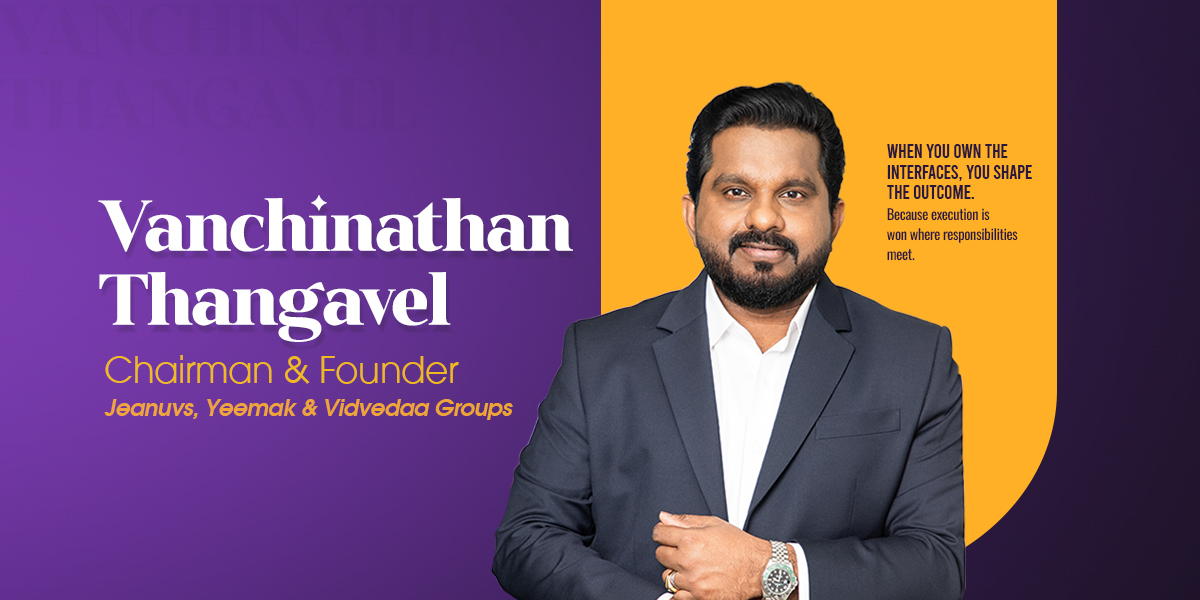
When Vanchinathan T. sought to expand the R&D centre for his electronics design enterprise, JEANUVS, he refused to outsource his schedule to a fractured market. He built the capability himself. VIDVEDAA was never conceived as a standalone construction firm. It emerged from the group’s need to create manufacturing and commercial environments that the market could not reliably deliver.
Over seven years, VIDVEDAA has executed more than 4 million sq. ft. across industrial, commercial, and institutional infrastructure. Growth was never the objective. Reducing uncertainty was. Every expansion was a response to a dependency previously left outside the firm’s control. Each programme expanded the organisation’s willingness to assume responsibility for increasingly complex stages of delivery.
Owning the Interfaces
The company’s early interior fit-out operations revealed a structural truth: to an observant builder, interiors are the autopsy of every upstream error. That conviction—that the boundary of an infrastructure company is defined by the problems it is willing to own—shaped VIDVEDAA’s operating philosophy.
Industrial projects demand locked-down commercial structures and sequencing before mobilisation. For Vanchinathan, procurement is not a purchasing exercise; it is where engineering judgement first becomes commercial discipline. When YEEMAK, the group’s manufacturing arm, required a massive expansion, VIDVEDAA stepped directly into heavy civil execution. At the ₹320 crore non-leather footwear facility in SIPCOT Industrial Park, the company chose to manufacture its own Pre-Engineered Building (PEB) components at Gummidipoondi. It was never about owning another factory. It was about controlling the schedule-critical interface that determined whether the programme accelerated or stalled.
Industrial and Live Environments
VIDVEDAA’s discipline translated into repeat programmes across sectors, with clients returning not for capacity alone, but for certainty.
The true test came at Chennai Airport, where VIDVEDAA delivered 26,000 sq. ft. of retail concessions inside a live aviation hub. Unlike greenfield sites, airports never stop. Every engineering decision had to coexist with passenger footfall, aviation security, and regulatory oversight. Every hour of delay affects passengers who will never know construction is happening around them. The work also demanded coordination across airport authorities, operators, leading project management consultants, and architectural practices. Here, interface management was not secondary; it was the core of execution discipline.
From Projects to Ecosystems
Mastering both industrial fabrication and live operational environments shifted VIDVEDAA’s horizon from execution to ecosystem design. Its planned expansion into industrial infrastructure in Andhra Pradesh reflects this ambition: not merely to construct factories, but to help shape where future manufacturing chooses to locate.
By the time the first shovel touches the ground, the outcome has already been decided. The hardest part of building happens before construction.