


As industrial activity rises, India’s logistics ecosystem is expanding to handle inbound and outbound goods, asserts Abhishek Bhutani, Managing Director of Logistics & Industrial, Cushman & Wakefield, and a member of the UK-based Royal Institution of Chartered Surveyors (RICS). In a recent interaction at the real estate advisory’s India headquarters in Gurugram, Bhutani told Infrastructure Today’s Manish Pant that evolution in warehousing, growth in e‑commerce, quick commerce and third‑party logistics, and infrastructure creation are all boosting the sector. At the same time, challenges such as post‑harvest handling, high forwarding costs, land acquisition, and the lack of institutional training support must be addressed on priority to secure long‑term, uninterrupted growth. Edited excerpts.
How is the pursuit of efficiency, demand and infrastructure defining the transformation of India’s logistics sector?
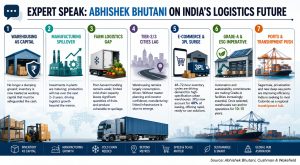
No longer are warehouses seen as dumping grounds. Back in the day, you needed space to store cargo before it was sold. Today, warehousing has evolved into a critical part of the supply chain. It’s no longer just box‑in, box‑out. Warehouses now handle complex back‑end processes. Earlier, supply chain departments struggled with inefficiencies, pilferage, and damage. Cargo was often poorly stacked, leading to losses from rats, termites and other issues. The mindset has shifted. Inventory is now viewed as cash; working capital that must be safeguarded like money in a bank. If products are damaged or delayed, customer complaints tarnish the company’s reputation. This recognition has driven demand for better infrastructure. Companies also face a surge in SKUs (stock keeping units), requiring more sophisticated storage solutions. Warehousing has become a key element in the supply chain, intrinsic to business continuity and growth.
Since liberalisation in the 1990s, the services sector has made a significant contribution to GDP. Do policies aimed at boosting manufacturing already show a spillover effect on logistics growth?
Yes, definitely. We are no longer a service‑dependent economy, though services still account for a large share of GDP. Manufacturing is growing and is expected to reach the government’s target of 25 per cent of GDP in the coming years. Services scale quickly; you set up BPOs or KPOs, hire staff, provide laptops and start operations. Manufacturing is slower; a plant takes two to three years to become operational. Investments made in recent years are now beginning to yield results. In the next two to three years, production will rise significantly. As factories produce more, the ecosystem expands. Logistics, being a derivative, will grow alongside, handling inbound materials and outbound goods. Manufacturing has so far been concentrated in certain cities, but new destinations are emerging, which will further drive logistics expansion.
What role will farm logistics—from cold chains to rural connectivity—play in this evolution?
Farm logistics and cold chain are treated as separate subjects in India. While farming is heavily supported, post‑harvest handling receives little attention. The government invests in productivity, farmer education and loans, but the missing piece is what happens after harvesting. This leads to huge wastage. Overseas, farm logistics is an integrated ecosystem; produce is processed immediately and sent to market as raw material. In India, produce is transported unprocessed, then handled at factories. Backward integration is lacking. Cold storage is currently restricted to finished goods like perishables, meat and refrigerated products. Yet India produces vast quantities of fruits that rot due to inadequate storage. Farm logistics needs a broader vision, with cold storage embedded into the supply chain rather than treated as an aftermarket solution. Investment and focus in this area are essential.
You have said warehousing has moved beyond real estate to infrastructure intrinsic to growth. Does economic expansion mean Tier‑2 and Tier‑3 cities are seeing increased investment?
At present, Tier‑2 and Tier‑3 cities mainly host consumption‑driven warehousing. Manufacturing-linked warehousing is limited. As manufacturing grows in these regions, warehousing will follow. For example, Alwar and Neemrana in Rajasthan are being promoted as manufacturing destinations. Gorakhpur in Uttar Pradesh is developing an industrial park, Meerut has facilities, and the Yamuna Expressway belt near Greater Noida is seeing activity. Where manufacturing expands, warehousing will attach itself. Otherwise, these cities will continue with consumption‑based warehousing, serving local populations and last‑mile deliveries.
So, why has infrastructure development in Tier‑2 and Tier‑3 cities not kept pace?
Institutional focus remains on metros, driven by profitability. Developers hesitate to invest in smaller cities due to concerns over returns and exits. Tier‑2 and Tier‑3 cities need advanced master planning with a ten‑year horizon for manufacturing and logistics. Currently, warehouses appear at city fringes, assumed to be markets, but true planning is absent. Buzz around smaller cities has slowed in the past two years as developers fail to see net returns. Without defined sectors, geographies or master plans, investment committees abroad cannot be convinced. Basics must be addressed before logical investment decisions can be made.
Amid these changes, how are e‑commerce, quick commerce and third‑party logistics developing?
E‑commerce and quick commerce have transformed logistics. Products move rapidly, with inventory cycles of just 48-72 hours. If stock lingers longer, sellers are asked to remove it. Warehouses are designed for fast‑moving items, with space utilisation maximised. Unlike manufacturing warehouses, which store pallets and boxes, e‑commerce warehouses handle loose products in varying quantities. Specifications are more demanding, requiring higher‑grade infrastructure. This has also driven the previously uncommon use of urban warehousing to support last‑mile delivery. Precision is vital, as a single order may be delivered separately from others placed the same day. Here, 3PL (third-party logistics) providers play a crucial role. They offer ready solutions, setting up warehouses overnight if needed. With expertise in trucking, labour, racking and operations, they enable e‑commerce firms to focus on their marketplace model. Today, 3PLs account for about 40 per cent of logistics leasing nationwide, supporting exponential growth.
If you take a long‑term view, where do you see 3PL by 2030?
Their market share will grow further. Warehousing operations are becoming complex and tech‑driven, with expanding product portfolios and consumer bases. Companies need outsourcing partners to manage inventories and ensure timely deliveries. 3PLs thrive on handling inventories; it is their expertise. Many also have export‑import arms, enabling them to manage EXIM cargo. While India’s e‑commerce remains domestic, global players like Amazon rely on 3PLs such as UPS and FedEx for worldwide reach. India may reach that level in the next decade. For now, 3PLs are indispensable to domestic logistics and will continue to expand their role.
How will Grade‑A warehousing, automation and sustainability shape the industry in the medium to long-term?
In the medium term, automation is essential. Warehouses now span 400,000-500,000 sq. ft. Manual operations cannot handle thousands of daily orders. Automation ensures efficiency and speed. Longer-term ESG (environmental, social and governance) commitments are becoming integral. Supply chain managers increasingly consider environmental and social factors when selecting warehouses. Grade‑A infrastructure is therefore non‑negotiable. Automation and ESG both demand high‑quality facilities. Moving warehouses is disruptive and costly; inventories worth billions cannot be shifted easily. Companies prefer to invest in Grade‑A today and remain for 10-15 years.
Developers say land acquisition remains a challenge. Do you see any change on the ground?
No, land acquisition is still the biggest hurdle. Government infrastructure spending has raised expectations in rural areas, but comparables are hard to establish. Farmers remain wary due to past exploitation. They also lack opportunity cost, as selling land often means buying land again, or relocating families. Land is not a commodity; it is livelihood. Fragmented ownership adds complexity. Indian laws empower multiple family members to contest sales, leading to prolonged disputes. These factors make acquisition difficult despite rising demand.
Geopolitical events after COVID‑19, including China’s lockdowns and conflicts in Ukraine and West Asia, disrupted supply chains. Is it time to pursue new networks like IMEC (India‑Middle East‑Europe Economic Corridor)?
That’s already under consideration, and we should have it. India still has a huge dependence on imports, particularly from the Middle East, so IMEC is definitely an action item. More importantly, as a large economy with a vast population, we must be self‑dependent. Had we not taken initiatives towards self‑reliance, the crisis period would have been far more severe. Imagine the inflation we could have faced if we had been entirely dependent on imports. We survived because the government had buffers to spend on behalf of the people, and because we relied heavily on domestic products. Without that cushion, inflation could have risen to levels seen in other countries. That said, we still have a lot of ground to cover. Establishing IMEC will be critical. It will not only reduce our dependence on single geographies but also create alternative routes and networks that strengthen India’s position in global trade. For a country of our size, it’s not just desirable, it’s necessary.
What about India’s goal of bringing down logistics costs to around 8 per cent of GDP?
It’s ambitious and not easy. Comparisons with the West are unfair because of structural differences. For example, Amazon warehouses in the US or Europe process 5,000-10,000 orders daily. In India, 5,000 is peak productivity; regular output is 2,000-3,000. Trucks abroad travel 400 km a day; in India, 300 km is the limit. Education is another gap. Logistics is rarely chosen as a career. Few courses exist at bachelor’s or master’s level. Without fresh talent, intellectual innovation is lacking. Capital has entered the sector, but talent remains scarce. Until logistics is seen as aspirational, achieving the 8 per cent target will be tough.
Do you mean availability of skilled manpower is a challenge?
Not in general education, but specifically for logistics. Courses exist for marketing, banking, real estate and manufacturing. ITIs (Industrial Training Institutes) supply shop‑floor workers daily. Logistics lacks such institutional pipelines.
Despite challenges, what role will aviation and maritime play in India’s logistics growth story?
Railways remain the backbone. The government is also advancing maritime through the Sagarmala project, developing waterways between cities. Some clients already use these routes, finding them faster and more cost‑effective. Aviation is mature in terms of connectivity, but volumes are low; only 1-2 per cent of cargo moves by air. The value is high, covering pharmaceuticals and surgical products needed urgently. Costs must come down for aviation to become a regular part of the supply chain.
Maritime faces limitations since not all states are connected by waterways, and water scarcity is an issue. But EXIM cargo is well supported. Port productivity has improved dramatically, with waiting times at JNPA (Jawaharlal Nehru Port Authority) reduced from days to hours. Private ports in Gujarat, like Adani’s, offer run‑through efficiency. Privatisation has helped achieve these gains.
As far as deep‑sea ports go, Vizhinjam is already shaping up well, while work is also underway on Vadhavan.
Yes, work on Vadhavan has started. Adani is developing a new port at Dighi in Maharashtra as an alternative to JNPA, and another in Surat, which will expand beyond oil and gas to consumer cargo and chemicals. Visakhapatnam port is being renovated, with a multimodal logistics park sanctioned there. On the eastern coast, Odisha has a new port under development. Both western and eastern coastlines are seeing activity, which will strengthen India’s maritime network.
India is also aiming to become a regional hub for transhipment. How do you see this playing out?
That’s a bullish prospect. At present, Colombo serves as the regional hub, but India is well placed geographically, connecting Southeast Asia and the Middle East. If we establish ourselves as a transhipment gateway, it will bring significant advantages to the logistics sector. Combined with port modernisation and development of dedicated rail freight corridors, India can position itself as a central player in global cargo flows.
– Manish Pant