The Indian mobile telephony industry currently has a cumulative debt of over Rs 300,000 crore with many operators even making negative returns on their investments.


Author: admin (Infratructure Today)
Post

Post
Is India´s steel industry ready to take the torch from China?
As Prime Minister Narendra Modi pushes for improvements in India´s infrastructure and housing, the nation´s steel consumption is set to accelerate. China´s demand for steel, meanwhile, is retreating from the double-digit growth rates of the past 10 years as Beijing tries to shift the economy to focus on domestic consumption rather than exports.
Post
Unravelling growth
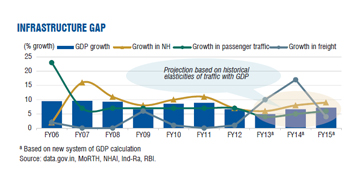
At 4.87 million km, India has the second largest road network in the world. Transporting over 60 per cent of the country´s goods and serving 85 per cent of total passenger traffic, it is little wonder the Modi Government has accorded the highest priority to developing roads and highways.
Post

Land acquisition and MOEF clearances have held up projects
Roads and highways sector has observed a significant growth over the past few years compared to the other heavy civil engineering sectors such as power and water. The growth has come, especially in the EPC mode of the business, whereas PPP and annuity based projects have also witnessed a few bids.
Post

Gaining momentum
The Ministry of Road Transport and Highways (MORTH) has made significant efforts to put the sector on a growth trajectory. While there has been noticeable improvement, a more collaborative endeavour is sought to bring about the desired effect.
Post

Govt to award 10,000 km of NH for development
The major policy initiatives of MoRTH in recent past are as follows:
Exit Policy: The cabinet recently allowed private developers to exit all operational BOT projects two years from start of operations.
Post

Rational expansion of electricity consumption
India´s low per capita electricity consumption, which currently stands at less than 1,000 kWh per annum, has been a subject of debate and consternation. The situation is likely to undergo a change, but it is imperative to set rational goals in this regard.
Post
From thought to action
If the change in governance at the Centre last year brought reason to cheer, the first year of the NDA government´s rule also showed that intent alone was never going to be enough.
Post

A close assessment
There´s a big scope of service delivery improvement and the government needs to think mobile first. The ´Digital India´ initiative aims at preparing India for a knowledge-oriented future. The programme´s objectives clearly highlight that it is a comprehensive
Post
Digital India: The next steps
The noble vision of having paperless governance needs to overtake a mindset and working style of decades. It needs the transition of people more than infrastructure at any juncture.