

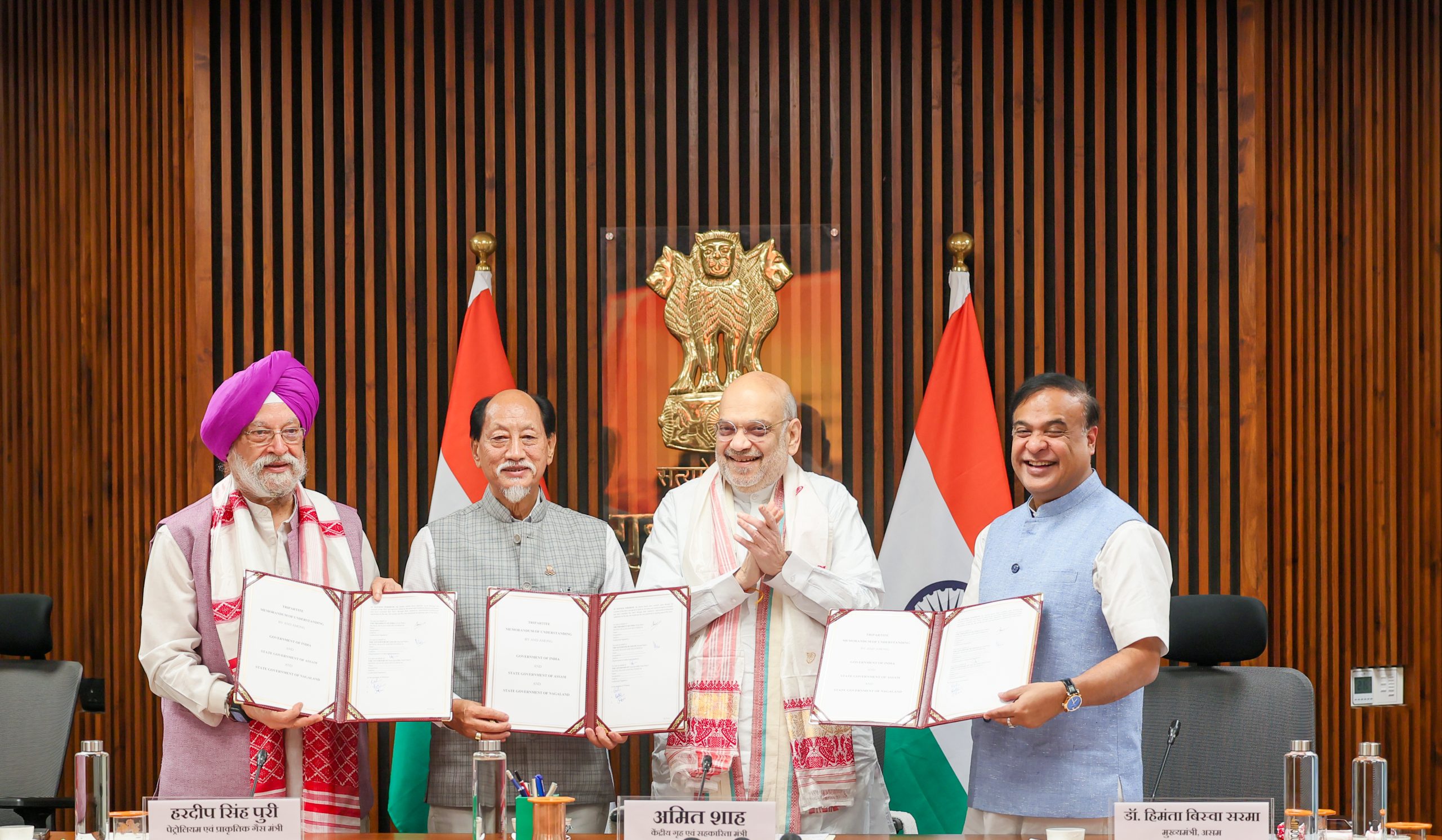
Union Home Minister Amit Shah said the tripartite agreement would unlock new possibilities for oil and natural gas exploration, as well as mineral mining, across the Northeast.
As part of India’s long‑term energy security strategy, the Government of India and the State Governments of Assam and Nagaland signed a tripartite MoU on Thursday to facilitate mineral oil operations in the Assam-Nagaland boundary areas.
The landmark agreement was signed in New Delhi in the presence of Union Home Minister Amit Shah, Union Minister of Petroleum and Natural Gas Hardeep Singh Puri, Assam Chief Minister Himanta Biswa Sarma, and Nagaland Chief Minister Neiphiu Rio.
Speaking on the occasion, Shah said the agreement would open up possibilities for oil and natural gas exploration as well as mineral mining, removing a longstanding obstacle to Prime Minister Narendra Modi’s vision of a prosperous Northeast.
“The entire North‑East is moving forward today with a spirit of ‘Nation First’ through this agreement. Both states decided that they would not allow any obstacle to India’s oil exploration but will advance on the path of mutual cooperation, as these resources constitute national wealth,” he stated.
Shah added that Nagaland has agreed to extend oil exploration across the entire state beyond the six designated fields, while Assam has also committed to cooperation, making this a win‑win situation for all stakeholders. He emphasised that the tripartite agreement would pave the way for mineral exploration and mining across the entire Northeast region.
Northeast possesses not only vast reserves of oil and gas but also an immense wealth of minerals. With the signing of this MoU, there is potential for the current extraction capacity of 1,000-1,500 barrels per day to increase by more than tenfold, Shah said.
An April 2018 report by the Nagaland State Mineral Development Corporation Ltd (NSMDC) estimated 500 million metric tonnes of petroleum and natural gas reserves along the Nagaland-Assam border. However, political sensitivities and inter‑state claims had delayed tapping one of the country’s largest reserves.
Energy Independence Drive
Shah expressed confidence that the extraction of oil and gas resources in Nagaland would significantly reduce India’s dependence on foreign sources. He noted that, in the absence of such an agreement, longstanding challenges had hindered the economic development of both states.
“There could be no greater example of cooperative federalism than this tripartite agreement,” he said.
Since 2019, twelve peace accords have been signed in the Northeast, resulting in an 80 per cent reduction in violence and enabling rapid infrastructure expansion. Shah underlined that the pace of development would not have been possible without these agreements.
The MoU establishes a coordinated framework for mineral oil operations, ensuring operational continuity, safety and security of personnel and assets, and effective coordination among all stakeholders. It is expected to support exploration and production activities, encourage investment in the upstream petroleum sector, and contribute to India’s energy security objectives.
Hailing the decision, Union Minister for Petroleum and Natural Gas Puri noted on the microblogging site X, “The resumption of mineral oil operations will generate direct and indirect employment, stimulate local entrepreneurship, strengthen physical infrastructure, create opportunities for contractors, service providers and small businesses, and contribute significantly to the economic development of surrounding communities and the entire NE Region.”
The Ministry of Home Affairs facilitated the discussions leading to the signing of the MoU in close coordination with the Ministry of Petroleum and Natural Gas and the Governments of Assam and Nagaland. The agreement is expected to provide greater certainty and stability for ongoing and future hydrocarbon operations in the area.