The ports and terminals developed under public private partnership (PPP) model in Gujarat have been performing quite well over the years, in terms of the efficiency parameters, says Amrendra Kumar Rakesh, Vice Chairman & CEO, Gujarat Maritime Board.


Author: admin (Infratructure Today)
Post

Post

Portal of Economic Growth
The Maritime Agenda envisages plans for creation of port capacity of around 3200 MMT for handling the expected traffic of about 2500 MMT by 2020. However, in order to scale up this capacity
Post
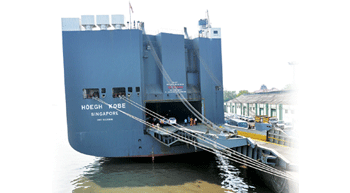
Port of Call
The Indian port sector has gathered pace with the government´s focus on revival of the manufacturing sector through the ´Make in India´ campaign. The manufacturing sector is likely to drive the growth of the port sector as the carrier of cargo - ports
Post

Ports need capacity augmentation
Jawaharlal Nehru Port Trust (JNPT) has achieved a growth of 7.33 per cent during the financial year 2014-15 by handling 4.467 million TEUs of container traffic. Neeraj Bansal, Chairman-In-Charge, JNPT
Post
Ports on the Go
Achieving the targets of the Maritime Agenda of the Shipping Ministry seems ambitious. The installed capacity in FY14 was 1,400 million tonne (MnT), i.e., 800 MnT for the major and 600 MnT for the non-major ports.
Post
Need to focus on efficiency enhancement
Capacity constraints, low level of mechanisation, low pace of project execution, lack of last mile connectivity, shallow drafts, etc., are the factors that affect cargo handling of the major ports, states Ravi Parmar
Post

Solar on Slow Track
With 3,000 hours of sunshine every year, which is equivalent to 5,000 trillion kilowatts of energy, India´s solar energy potential is vast. According to the Ministry of New & Renewable Energy Annual report 2014-15, of the total renewable energy
Post

PPP framework and policies need to be revamped
Highlighting the role of the mass rapid transit system in the Indian urban transportation, Abhay Kumar Mishra, CEO, Mumbai Metro One Pvt Ltd, lauds the successful completion of the first year of the Mumbai Metro
Post
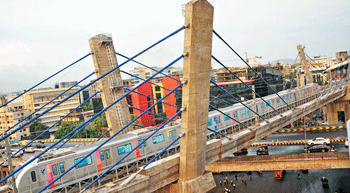
Funding Dichotomy
The population surge, rapid urbanisation, and the consequent congestion have time and again fuelled the ´need for speed´. Mass rapid transit system like the metro rail has dawned as a panacea in this regard.
Post
Empowering the Cities
Bringing safety, enhanced performance and lowered life-cycle cost to metros is the modern signalling technology called communication-based train control (CBTC). The methodology and technology have been perfected by companies like Thales.