

Developed under the Sagar Aankalan framework, the index serves as a national benchmark to evaluate and enhance the operational performance of Indian ports.
As part of its maritime modernisation drive, India has unveiled the Logistics Port Performance Index (LPPI) for FY2024‑25, alongside four major digital initiatives aimed at enhancing governance, transparency, and ease of doing business across the shipping ecosystem.
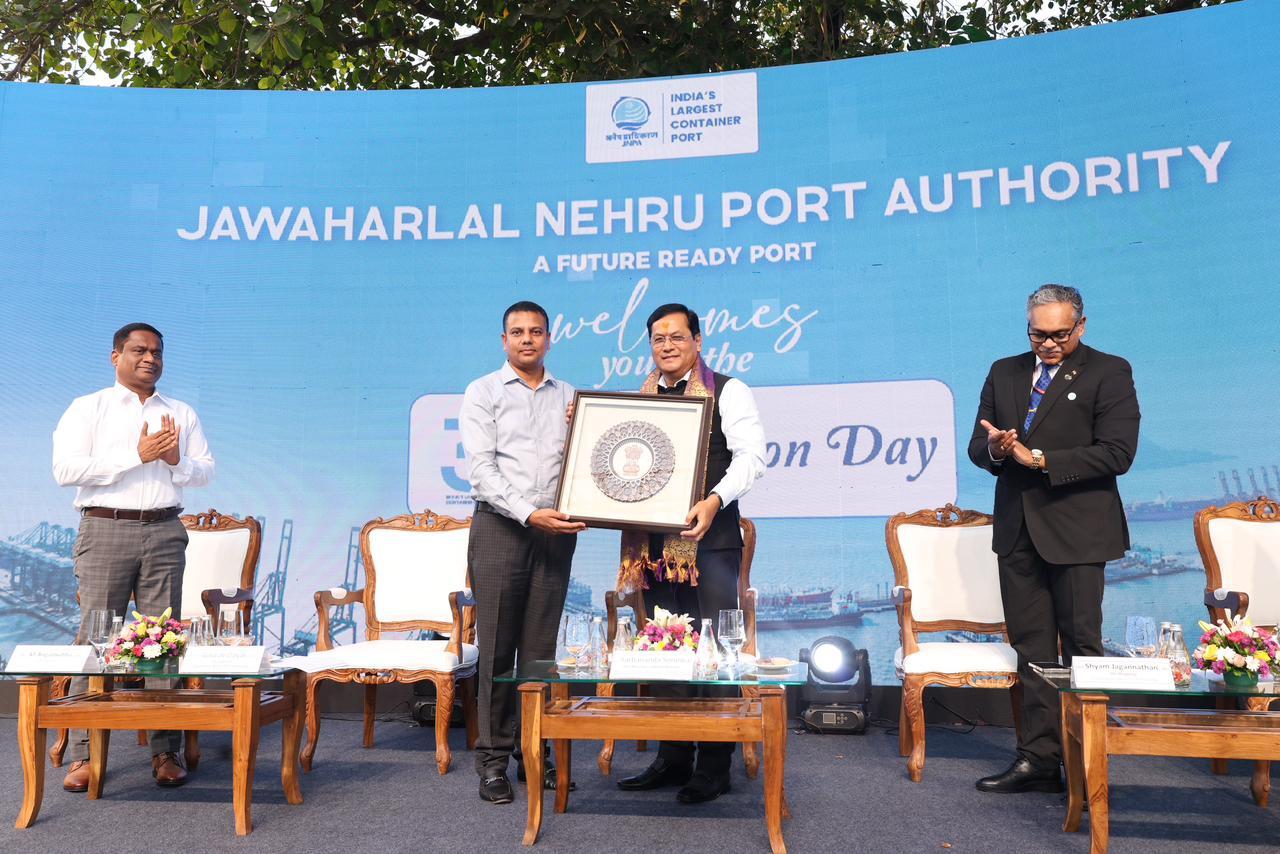
Unveiling the mechanism at the 37th foundation day celebrations of the Jawaharlal Nehru Port Authority (JNPA) in Mumbai, Union Minister for Ports, Shipping and Waterways, Sarbananda Sonowal said, “It [LPPI] is a major step towards improving the efficiency, transparency and global competitiveness of Indian ports. By promoting continuous improvement and global benchmarking, it will strengthen India’s position as a leading maritime power.”
Developed under the Sagar Aankalan (Sea Assessment) framework, the LPPI is a national benchmarking mechanism designed to assess and improve the operational performance of Indian ports. The index aligns with the PM Gati Shakti National Master Plan, Maritime India Vision 2030, and Maritime Amrit Kaal Vision 2047, reinforcing India’s position in global logistics and maritime trade.
It evaluates ports across three cargo segments—dry bulk, liquid bulk, and container cargo—using operational indicators such as cargo handled, vessel turnaround time, berth idle time, pre‑berthing waiting time, container dwell time, and ship berth day output. Equal weightage is assigned to absolute performance and year‑on‑year improvement, encouraging continuous enhancement of port operations.
Alongside the LPPI, Sonowal launched four digital initiatives developed by the Directorate General of Shipping (DGS) to improve service delivery, transparency, and accountability for seafarers and maritime stakeholders. These include a 24×7 Grievance Redressal Module under the e‑Navik platform, a ship registration module on the e‑Samudra platform, a medical practitioner module, and a unified ship recycling credit note module.
Maritime Welfare Reforms
Describing the grievance redressal platform as a major welfare measure for Indian seafarers, Sonowal said the system would allow grievances to be filed through multiple channels, including the e‑Navik portal, toll‑free helplines, WhatsApp, and dedicated email services from anywhere in the world.
“Seafarers work far away from home, often under difficult and uncertain conditions. An effective grievance redressal mechanism is not merely an administrative necessity but a critical welfare and protection framework,” Sonowal said.
He described the digital ship registration module as an important flagging reform that would simplify vessel registration procedures and bring India’s maritime administration in line with major global shipping nations. The medical practitioner module, Sonowal said, would streamline the registration and monitoring of doctors authorised to certify seafarers, while reducing the risk of fraudulent certifications.
Another key reform announced during the event was the Unified Ship Recycling Portal for the Ship Recycling Credit scheme, part of the Government’s ₹700‑billion maritime development package announced in 2025. Under the scheme, ship owners recycling vessels at Hong Kong Convention‑compliant Indian yards can receive a credit note equivalent to 40 per cent of the vessel’s scrap value, redeemable against new shipbuilding projects in India.
Sonowal also lauded JNPA’s performance, noting that the port crossed 8 million twenty‑foot equivalent units (TEUs) and handled more than 102 million metric tonnes of cargo during FY2025‑26.